

Free vs Paid Discord Community: Which to Build
Starting a Discord community comes with an important decision:
Should people be able to join for free, or should access require a paid membership?
There is no universal answer.
A free community can help you reach more people, build trust, and create an accessible place around your brand or content. A paid community can support a more focused experience where members are paying for deeper access, support, resources, or relationships.
Both models can work.
The better question is what you need the community to do.
Before choosing a price, platform setup, or membership structure, it helps to understand how free and paid communities differ and what each model is actually good at.
Free vs Paid Community at a Glance
At the simplest level, the difference seems obvious.
A free community costs nothing to join. A paid community requires some form of payment for access. But the price is only one part of the difference. Charging changes who joins, why they join, what they expect, and what the community owner needs to provide in return. Keeping access free creates different opportunities, but it also comes with its own challenges.
So the decision between a free vs paid community should not begin with:
How much could I charge?
It should begin with:
What role is this community supposed to play?
Free Communities Reduce the Barrier to Joining
The biggest advantage of a free community is accessibility. Someone can discover your content, see an invitation to join your Discord server, and enter without needing to make a purchasing decision first. That makes free communities useful when the goal is to bring more of your audience together.
A creator might have thousands of followers spread across YouTube, X, Instagram, a newsletter, or other platforms. Those people know the creator, but they may have no connection to each other.
A free Discord community gives them a shared place to gather. The decision to join is relatively easy because there is very little risk involved. Someone can enter, look around, participate in a conversation, and decide whether the community is relevant to them.
For the owner, this creates an opportunity to turn passive followers into active members. But easier entry also means people can join with less commitment. Someone might click an invite because they are curious, browse the server for two minutes, and never return. Another person might join because a free resource was offered and have no interest in the community itself.
A free community can therefore grow quickly without necessarily becoming active at the same rate.
More members does not automatically mean more community.
The quality of the experience still depends on whether people have a reason to participate after joining.
Paid Communities Create a Different Commitment
A paid community introduces friction before someone enters. They need to understand the offer, decide whether it is relevant, and believe the experience is worth paying for.
Naturally, fewer people will cross that barrier. But the people who do often arrive with a clearer reason for being there. Someone paying for a community around freelancing may be actively trying to grow their freelance business. Someone joining a paid fitness community probably has a goal they want help reaching. Someone subscribing to a creator's private community may want deeper access than they receive through public content.
Payment does not guarantee engagement.
A member can still purchase access, participate for a week, and disappear. But charging filters out much of the casual curiosity that exists in free communities. That can create a more focused environment because members have made an intentional decision to join.
Their expectations are also higher.
A free member may be pleasantly surprised when they receive useful support.
A paying member expects the membership to be useful.
When a Free Community Wins
A free community is sometimes treated as the version you build before you are ready to charge.
That undersells what it can do.
For the right creator or business, keeping a community free can be a deliberate strategy. Removing the price barrier allows more people to enter, experience the community, build relationships, and stay connected to the brand without needing to become customers first.
The question is whether that accessibility helps accomplish what you want the community to do.
In some situations, it absolutely does.
When Growth Matters More Than Revenue
If the immediate goal is to grow the community, free access gives you a major advantage.
Every price creates a decision. Even someone who can comfortably afford a membership has to consider whether they need it, whether they trust the creator, and whether they will use it enough to justify paying. Free access removes most of that friction. Someone discovers your content, likes what they see, and joins.
That makes a free community particularly useful for creators who are still expanding their audience or businesses trying to build a larger ecosystem around what they offer. Instead of asking new people to purchase something immediately, you can give them somewhere to become more involved.
That creates a progression:
Discover → Join → Participate → Build trust
Revenue can come later through other parts of the business. At this stage, having more relevant people enter the community may be more valuable than trying to monetize every person who wants access.
When the Community Supports Another Product
The community does not always need to generate revenue directly. Sometimes its job is to make another product or service more valuable.
Consider a software company.
Customers might use a free Discord community to ask questions, exchange workflows, share ideas, and learn from other users. The business already earns revenue from the software, so charging customers again simply to participate in the community may work against the purpose of having it.
The same can apply to creators.
Someone selling courses might operate a free broader community around the subject. A consultant might use a community to gather people interested in the problems their services solve. A creator with sponsorship or product revenue might value having a highly engaged audience in one place even if those members never pay for Discord access.
In these cases, the community contributes indirectly. It can:
- Strengthen relationships.
- Improve the customer experience.
- Keep people connected between purchases.
- Reveal what the audience needs.
- Create conversations around the brand that would otherwise happen separately across social platforms.
The community does not need its own subscription to be commercially useful.
When You Are Still Learning What Members Need
Charging for a community means making a promise. Members are paying because they expect a particular experience or outcome. If you do not yet know what people need from the community, it can be difficult to make that promise confidently.
A free community gives you room to learn. You can:
- Observe which discussions attract participation.
- See what questions appear repeatedly.
- Discover why people joined and what they hoped to find.
Maybe you assumed people wanted educational resources, but the most active conversations revolve around networking. Maybe members consume very little of the content you provide but constantly ask each other for feedback. Maybe beginners and experienced members need completely different things.
Those patterns can shape the future community far better than guessing before anyone arrives.
This can be especially useful for creators building their first membership. Instead of deciding what people should pay for and then hoping they want it, the free community can reveal where demand already exists.
Later, a paid experience can be built around a need members have actually demonstrated.
When Trust Needs Time to Develop
Not every audience is ready to purchase a membership immediately. Someone might discover a creator today and find their content useful without being ready to spend money with them.
A free community gives that relationship somewhere to continue. The person can:
- Join without making a large commitment.
- See how the creator interacts with members.
- Participate in conversations.
- Judge the quality of the people inside the community.
- Receive help before being asked to buy something.
Over time, the relationship changes. The creator is no longer just someone they occasionally see in a feed. The member has experienced the environment around the creator directly.
That can be particularly valuable when the eventual paid offer depends heavily on trust. A landing page can describe a membership. Testimonials can show what other people achieved. But experiencing the community firsthand gives someone their own evidence.
This does not mean the free community should exist purely as a long sales funnel. Members can remain free indefinitely and still contribute to the ecosystem.
The important part is that people have time to build trust before a purchase becomes necessary.
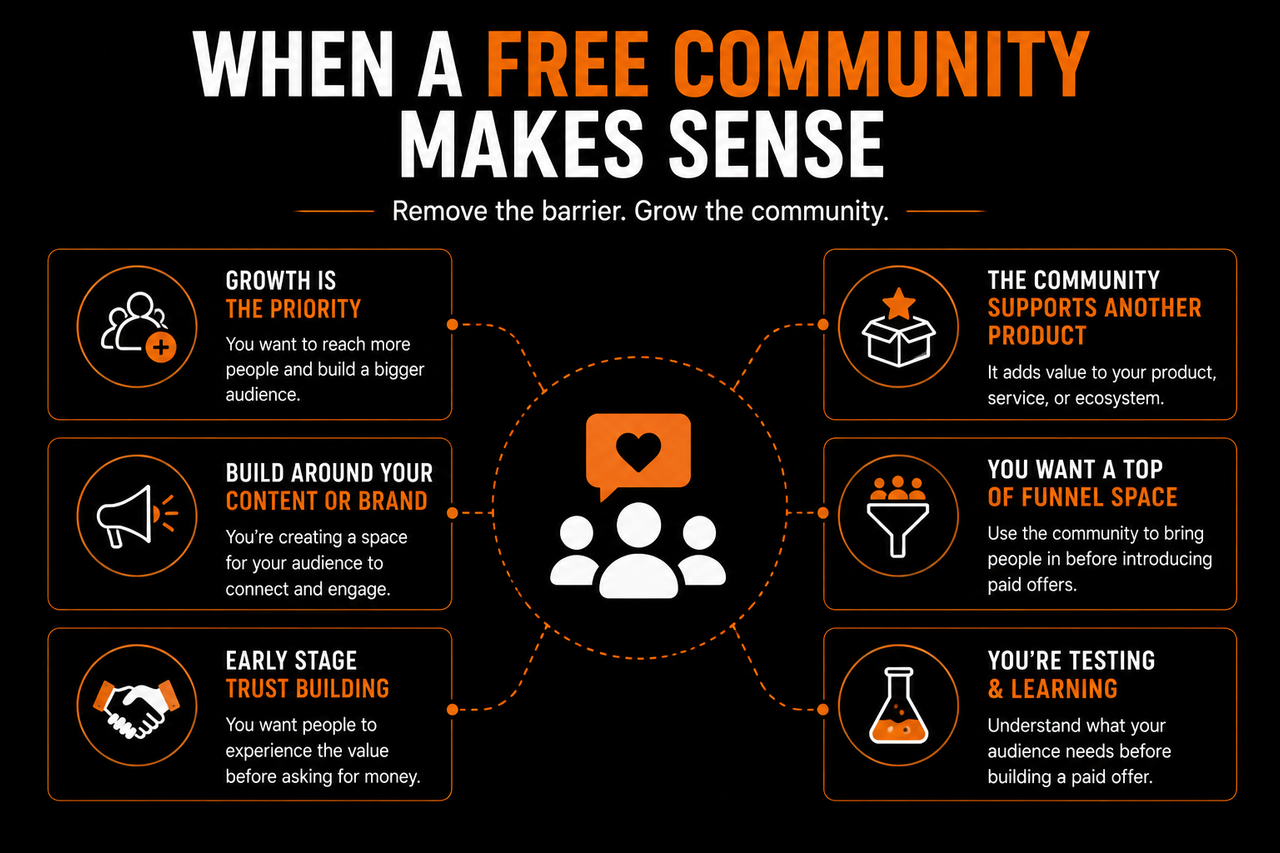
When Member Volume Creates the Value
Some communities become more useful when more relevant people participate. Networking communities are an obvious example. If the primary value comes from meeting people, sharing opportunities, exchanging knowledge, or finding collaborators, reducing the barrier to entry can help create the network required for those interactions.
Imagine launching a local creator community with paid access from day one. The first twenty members might enter and find very few people relevant to them. A free model could help the community reach enough density for useful connections to happen more frequently.
Once that network exists, the community may support other forms of monetization without charging everyone for entry. The same principle can apply to communities around products, industries, hobbies, and professional interests.
However, volume only helps when the people joining are relevant. A server with 10,000 disconnected members does not automatically have a stronger network than one with 500 people who share a clear purpose.
Free access makes growth easier.
The owner still needs to protect the quality of that growth.
When Accessibility Is Part of the Community's Purpose
Sometimes charging would directly conflict with what the community is trying to accomplish.
- A creator may want to build the largest accessible gathering around a topic.
- A brand may want customers to have somewhere to receive peer support without another purchase.
- An educational community may want beginners to participate regardless of their ability to pay.
In those situations, accessibility is not simply a growth tactic.
It is part of the value proposition.
That does not prevent the business from making money elsewhere. The creator might offer paid coaching, courses, events, products, premium memberships, or other services while keeping the broader community open.
Free access and monetization are not opposites.
The important question is what you are monetizing.
You can monetize the community itself.
Or you can use the community to strengthen an ecosystem where revenue happens through other offers.
Free Communities Still Need Investment
Keeping access free does not remove the work required to run the community.
In some ways, it can increase it.
Lower barriers can bring more inactive members, spam, self-promotion, and people who joined without understanding the purpose of the server. As the community grows:
- Moderation becomes more important.
- Onboarding becomes more important.
- The channel structure needs to remain understandable.
- New members need reasons to participate instead of becoming another number in the member count.
This is why "free" should describe the price, not the amount of effort put into the experience. A free community that nobody actively manages can quickly become a list of usernames surrounding a few occasional messages.
If the community supports your brand, products, or audience relationships, its quality still matters. The advantage is that you can optimize the experience around participation rather than needing every member to generate direct revenue.
Free Works Best When It Has a Clear Job
A free community should ultimately have a reason to exist beyond accumulating members. Maybe its job is to:
- Bring your audience together.
- Help customers get more value from another product.
- Create a network around your niche.
- Help you understand what your audience needs.
- Give people a place to build trust before exploring deeper offers.
When that job is clear, free access can be a strategic advantage rather than a temporary stage before monetization. You do not need to charge simply because the community becomes valuable.
Sometimes keeping the door open makes the entire creator business stronger.
But there are also situations where the community begins providing a level of support, access, or ongoing value that should not remain free forever. When that happens, the question changes from whether you can charge to whether the experience is ready to justify it.
That means a paid community needs a stronger value proposition and a more deliberate member experience.
The Two Models Serve Different Business Goals
A free community is often strongest when the community itself is not the primary product. It can support a larger creator or business ecosystem. Public content might bring people in, while the free community gives them somewhere to ask questions, meet others, experience the brand more closely, and build trust over time. Revenue can happen elsewhere through products, services, software, courses, sponsorships, or eventually a paid membership.
In that model, the free community is valuable because of the relationships it creates.
A paid community has a different responsibility. The membership itself needs to justify an ongoing transaction.
That does not mean every useful interaction must come directly from the owner. Members may create enormous value for each other.
But there needs to be a clear reason someone is paying to remain part of the environment. That might include:
- Direct access to expertise.
- Structured support or accountability.
- Exclusive resources or education.
- Valuable networking with a focused group.
- Regular events, workshops, or discussions.
- Access to opportunities unavailable elsewhere.
The model you choose therefore depends partly on where the community sits inside the business.
A free community can support the business.
A paid community can become part of the business itself.
And sometimes it can do both.
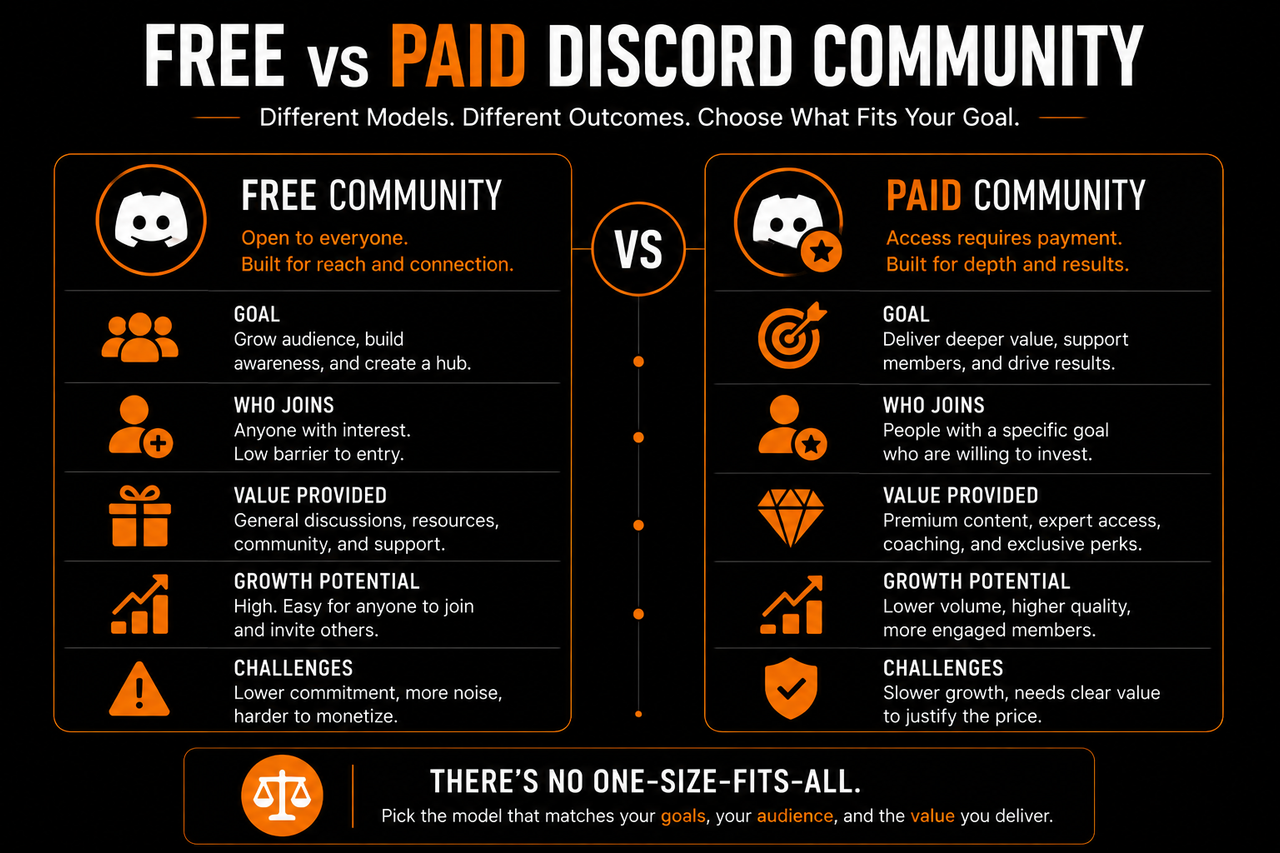
Size and Value Work Differently
Free communities often have the potential to become larger because almost anyone interested can join. That can be useful. More members can mean more conversations, more perspectives, and a larger network around the creator or brand.
But large membership numbers can also become misleading. A server with 20,000 members is not necessarily stronger than one with 500.
What matters is what those members are actually doing.
Are people participating?
Are useful conversations happening?
Do newcomers receive responses?
Do members know why they should return?
A paid community may be significantly smaller while creating more value per member. Instead of optimizing primarily for how many people enter, the owner can focus on how useful the experience is for the people already inside.
Neither approach is inherently better.
A large free community can be incredibly valuable when reach and accessibility matter.
A smaller paid community can be more effective when members need focused support or a specific outcome.
The right size depends on what the community exists to accomplish.
Paying Does Not Automatically Make a Community Better
It is easy to assume that putting a price on access will immediately create a higher-quality community.
It will not.
A price can filter who joins.
It cannot create value that was not there before.
If the free community is confusing, inactive, or poorly managed, adding a checkout page does not solve those problems. The paid version still needs a reason to exist. Members need to understand what they are getting beyond access to another Discord server.
This becomes especially important when the creator already provides valuable public content. If someone can watch your videos, read your newsletter, and participate in public conversations for free, what changes when they become a paying member?
The answer cannot simply be:
More content.
It might be:
- Deeper support.
- More direct interaction.
- A structured path toward a result.
- Access to a more relevant group of people.
- Accountability.
- Feedback.
- Opportunities.
The paid experience needs a distinction members can actually feel.
Free Does Not Mean Low Value
The opposite misconception is that free communities should hold back most of their value so members have a reason to upgrade.
That approach can backfire.
If someone's experience with the free community is empty channels, constant promotions, and locked areas they cannot access, they have learned very little about why the paid experience deserves their money.
Free members still need a reason to stay. They should be able to have useful conversations, meet people, learn something, or receive value from participating. The paid membership can then solve a deeper problem rather than simply unlocking the useful version of the community.
For example, a creator teaching business might allow free members to participate in general discussions and access selected educational resources. Paid members might receive direct feedback, structured accountability, private sessions, and deeper access to the creator or team.
Both experiences are useful.
They simply serve different levels of need.
That distinction becomes important if the creator eventually wants to run free and paid access together.
The Decision Does Not Have to Be Permanent
Choosing free or paid is not necessarily a decision you make once. A creator might start with a free community because they are still building an audience and learning what members need.
As the community develops, certain needs may become obvious.
- Members might repeatedly ask for direct support.
- A smaller group may want more structured help.
- People may request workshops, feedback, accountability, or closer access.
Those signals can eventually support a paid offer.
The opposite can happen too. A creator who begins with a paid community might later introduce a free layer to create an easier entry point for new people.
The community model can evolve alongside the business.
What matters is understanding what each layer is designed to do.
Free access works best when removing the barrier creates an advantage.
Paid access works best when the community provides enough ongoing value to justify charging for it.
And before deciding that paid access is the obvious destination, it is worth understanding the situations where keeping a community free can actually be the stronger choice.
When It's Time to Charge
A free community can create enormous value without charging members for access. But there may come a point where the experience you are building goes beyond simply giving your audience somewhere to gather.
Members want more support. They want deeper access. They want structure, feedback, accountability, or opportunities that require real time and effort to provide.
At that point, introducing a paid membership can make sense. The important distinction is that you should not charge simply because the community has grown.
You should charge when there is a clear experience valuable enough for members to pay for repeatedly.
Members Are Asking for More
One of the strongest signals can come directly from the community. Members begin asking questions such as:
Can I get more direct feedback on this?
Do you offer coaching?
Is there somewhere we can go deeper into this topic?
Could we have regular calls or accountability sessions?
These requests reveal something important.
People are not simply asking for more content.
They are asking for a deeper level of involvement.
Imagine you run a free community for freelancers. General conversations work well, members help each other, and you regularly share useful advice.
Over time, some members begin wanting more. They want:
- Their proposals reviewed.
- Help pricing projects.
- Accountability while trying to land clients.
- Direct feedback on problems specific to their businesses.
You could continue providing all of that for free, but the experience is becoming fundamentally different from an open community. There is now a group with a more specific need and a willingness to invest more effort into solving it.
That can become the foundation for paid access.
You Can Define What Members Are Paying For
Before charging, you should be able to explain the paid membership without relying on vague promises.
"Exclusive community access" is rarely enough.
What actually becomes different after someone pays? Maybe:
- Members receive regular feedback sessions.
- They enter a smaller network of people at a similar stage.
- There are weekly workshops.
- They receive structured accountability.
- They gain direct access to expertise that is unavailable in the free community.
The offer does not need twenty benefits.
It needs a clear reason to pay.
A useful test is whether you can finish this sentence:
Members pay because this community helps them ______.
The stronger and more specific the answer, the easier it becomes to build the membership around delivering it.
This also helps with pricing later. Instead of trying to calculate what access to a Discord server is worth, you can think about the value of the experience and outcome being provided.
The Experience Requires Real Resources to Deliver
Some communities naturally become expensive to operate. Not necessarily because Discord itself costs more, but because the experience requires time and people. That includes:
- Direct feedback.
- Moderation.
- Hosting workshops.
- Reviewing member work.
- Organizing events.
- Creating resources.
- Managing hundreds of members.
All of it takes time. At a certain point, asking the owner or team to continually provide deeper support for free may stop being sustainable. Charging can create the resources required to maintain the quality of the experience.
For example, membership revenue might allow you to bring in a community manager, host more frequent sessions, invite experts, improve resources, or simply dedicate more time to the members.
In that situation, monetization is not only about extracting revenue from an existing audience.
It can help fund a better community.
The key is making sure members can feel where that additional value goes.
A More Focused Group Would Be More Useful
Free communities benefit from accessibility, but accessibility also means members can arrive with very different levels of commitment.
- Some are highly active.
- Some are curious.
- Some joined for one resource.
- Some may not even remember joining.
That mix is not necessarily a problem. But certain experiences work better when participants have made a stronger commitment.
Accountability groups are a good example.
If ten people agree to work toward a goal together but seven disappear after the first week, the experience becomes weaker for the three who remain.
A paid layer creates an additional filter. It does not guarantee that every member will participate, but paying requires a more deliberate decision than clicking a free invite. That can be useful when the value depends on members showing up consistently.
Mastermind-style groups, professional networks, implementation communities, and structured programs can all benefit from having a clearer threshold for entry.
In these cases, the payment is doing more than generating revenue.
It helps define who the experience is for.
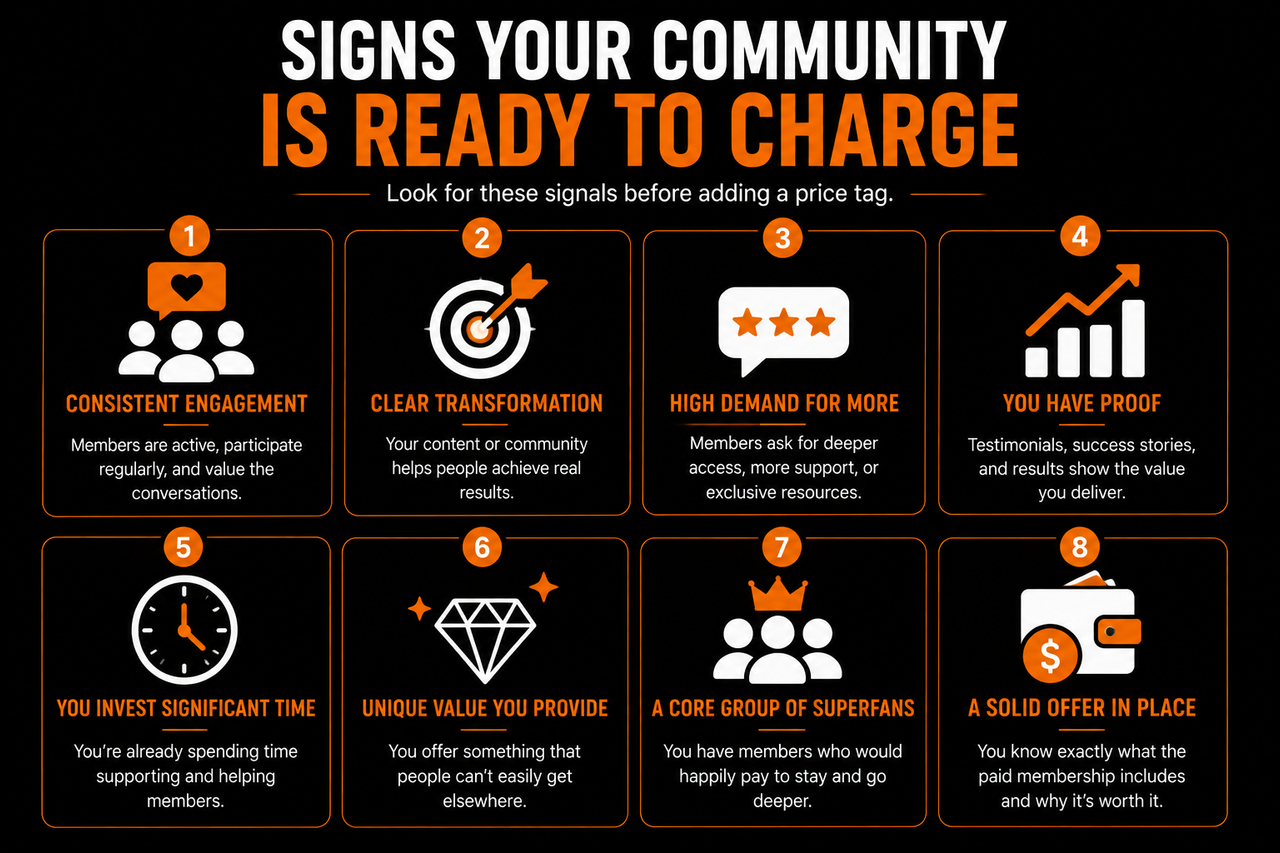
People Are Already Paying for Related Help
Another strong signal is existing demand elsewhere in the business. Maybe:
- Members already purchase your courses.
- They book consulting sessions.
- They pay for workshops.
- They regularly ask whether you offer ongoing support after buying another product.
That tells you people are already willing to spend money solving the problem your community addresses.
A paid membership can create continuity around that demand.
- Someone who finishes a course might want continued accountability.
- A coaching client may want access to a broader network after their engagement ends.
- A workshop attendee may want somewhere to keep implementing what they learned.
Instead of creating another isolated product, the community can become the ongoing layer connecting those experiences. This is often stronger than inventing a paid membership first and searching for a reason people should want it afterward.
Demand already exists.
The membership gives that demand a recurring format.
You Know How to Deliver Value Consistently
Launching a paid community creates an ongoing responsibility. Members are not only deciding whether to join. Every renewal asks them whether staying is still worthwhile.
That means you need to understand how value will continue after the first week. A huge library of resources may look impressive when someone joins, but once they have explored it, what keeps the membership useful?
This is where community can become especially powerful. The ongoing value might come from regular discussions, new relationships, feedback, events, support, accountability, or access to people who continue helping each other.
The exact format depends on the community. What matters is that the experience does not rely entirely on launch excitement.
You should have some idea of the rhythm members are entering. Maybe:
- There is a weekly call.
- Members receive monthly reviews.
- Questions receive ongoing support.
- The network itself produces new conversations and opportunities every day.
Paid membership works best when value is part of the routine rather than something the owner occasionally remembers to provide.
Do Not Put a Price on an Existing Free Experience and Call It Done
One of the easiest ways to introduce paid access is also one of the weakest.
Take everything that used to be free, lock it, and ask existing members to start paying.
Technically, you now have a paid community.
But members may reasonably ask:
What am I getting that I wasn't getting yesterday?
Introducing a paid membership should usually involve creating a deeper experience rather than simply restricting the existing one. Your free members can continue receiving the value they originally joined for. The paid tier can solve additional problems for members who want to go further.
That creates a much healthier transition.
Free members do not feel like something was taken away from them.
Paid members understand why their experience costs money.
And the owner can design each layer around a different level of need.
Charge When the Value Is Ready, Not Because the Member Count Is
There is no magic number of members where a community should become paid.
A community with 10,000 members may work best completely free.
Another with 100 highly specific members might have a strong paid opportunity.
The member count tells you very little on its own.
Look instead at what is happening inside the community.
Are members asking for deeper support?
Can you identify a clear paid experience?
Does delivering that experience require meaningful time or resources?
Would a more committed group create better outcomes?
Have members already shown willingness to pay for related help?
Can you deliver ongoing value after someone joins?
Those are stronger signals.
Charging works when the paid experience solves a real need and the community is capable of delivering on that promise consistently.
And introducing paid access does not mean the free community has to disappear. In many cases, the strongest model is not choosing one side of free vs paid community at all. It is allowing both to exist together, with each serving a different purpose.
Running Both Together
Choosing between a free and paid community does not always require choosing only one. For many creators, the two models work better together.
A free community gives people an easy way to enter the ecosystem, meet other members, and experience the community before spending anything. A paid membership can then provide a deeper experience for the people who want more support, access, structure, or involvement.
The important part is giving each layer a clear purpose. The free community should not feel like an empty waiting room for the paid one. And the paid community should offer more than a few additional channels behind a role. When both sides provide real value at different levels, members can choose the experience that makes sense for them.
Give Each Layer a Different Job
The easiest way to design a free-and-paid model is to decide what each side is responsible for.
The free community might focus on:
- General discussions.
- Introductions and networking.
- Selected resources.
- Community updates.
- Opportunities to experience the broader community.
The paid membership can go deeper through things like direct feedback, structured support, accountability, private events, advanced resources, or more focused conversations.
There can be overlap. Free and paid members may participate in the same general conversations while paying members also have access to additional spaces.
What matters is that someone considering the membership can understand what changes when they upgrade. The distinction should come from depth of experience, not from deliberately making the free community worse.
Create a Natural Path Between Them
A free community can give potential members something a landing page cannot: experience. Someone can see how the community operates before deciding whether they need the paid layer. They might:
- Join a discussion.
- Receive help from another member.
- Attend an open event.
- See the kinds of problems people are solving.
Over time, they may realize they want more support than the free community is designed to provide. That is where the paid membership becomes relevant.
The upgrade does not need to be pushed constantly. It can appear naturally when the member reaches a point where the deeper experience solves something they already need.
- Someone asking for personalized feedback can be shown where paid members receive it.
- Someone looking for accountability can learn about the structured program available inside the membership.
- Someone who wants more direct access can see what that looks like in the paid tier.
The offer becomes connected to the need rather than appearing as another promotion.
Do Not Treat Free Members Like Unfinished Customers
Not every free member will become a paying member.
They do not need to.
Someone might enjoy the community for years without needing the deeper experience.
That person can still contribute. They can:
- Answer questions.
- Participate in discussions.
- Recommend the community to someone else.
- Share your content.
They may purchase a completely different product later.
And circumstances can change. A member who does not need the paid membership today might need it six months from now.
Keeping the free experience useful allows that relationship to continue without requiring a purchase. This is why constantly pushing upgrades can damage the very thing the free community is supposed to build.
People should feel like members, not leads sitting inside a Discord server waiting to be converted.
Let Members Move Between Both
Membership status changes. Someone may begin free, upgrade when they need more support, remain paid for several months, and eventually cancel.
That should not necessarily end their relationship with the community. In a combined model, they can return to the free layer. They keep their broader connection to the group while losing access to the paid benefits tied to their subscription.
Later, they may upgrade again.
This creates a much more flexible member journey than treating free and paid access as two completely separate worlds.
The community remains the constant.
The level of access changes depending on what the member needs.
For the owner, this also means a cancellation does not automatically become a lost relationship. The member can stay connected to the ecosystem even when they are no longer paying.
Build the Model Around the Community
Free and paid communities solve different problems. Free access is powerful when you want to reduce friction, grow the network, build trust, support another product, or give a broader audience somewhere to gather. Paid access becomes valuable when members need a deeper experience and you can provide enough ongoing value to justify the membership.
Running both allows those strengths to work together.
The free community creates an accessible front door.
The paid membership gives people somewhere to go when they want more.
Neither needs to undermine the other. The free side can remain genuinely useful without giving away everything the paid membership provides. The paid side can offer meaningful additional value without locking every worthwhile interaction behind a subscription.
That is ultimately the better way to think about free vs paid community.
It is not simply a pricing decision. It is a decision about what relationship you want to build with different members and how the community fits into the larger business.
Some communities should remain free.
Some work best as paid memberships.
And for many creators, the strongest answer is both: a free community that builds relationships and a paid experience that helps the members who want to go further.