

How to Follow Up With Members Who Go Quiet
Almost nobody cancels a paid community with a bang. There's no dramatic exit message, no angry post in general chat. They cancel with a whimper, weeks after they've already stopped opening the app, muted the server, or quietly stopped reading the announcements. By the time the cancellation notice lands in your inbox, the actual decision was made a long time before, in a moment nobody was watching. (For a closer look at that earlier moment, see why new members join and then disappear.)
That's exactly why the follow-up matters more than almost anything else in a member's lifecycle. A good welcome gets someone in the door (see how to onboard new members in a paid community for that first stretch). A good follow-up is what catches them before they've mentally already left, while there's still something worth saving.
Why You Should Follow Up With Quiet Members
It's tempting to let quiet members stay quiet. They're not causing problems, they're not asking for refunds, and there's always something louder demanding attention. But letting silence sit unaddressed is expensive in ways that don't show up until later.
The economics are heavily in your favor
Reactivating someone who already knows your community, already trusts it enough to have joined once, is dramatically cheaper than acquiring and onboarding a brand new member from scratch. This isn't a new idea, Harvard Business Review has reported that acquiring a new customer typically costs five to twenty-five times more than retaining an existing one, citing research from Frederick Reichheld of Bain & Company. Email marketing data backs up the specific mechanics: turning an inactive subscriber back into an active one costs a fraction of what it takes to win a brand new customer, and the same logic holds for community members. You've already done the hard part, getting them in. Losing them silently throws that work away for nothing.
Most quiet members aren't rejecting you
There's a comforting truth buried in this: the overwhelming majority of people who go quiet aren't doing it because they hate your community. Life got busy. They lost the thread of why they joined. The server got noisy and they couldn't find their way back to what mattered to them. A well-timed, well-worded message is often genuinely all it takes to remind someone why they were excited in the first place.
Silence also has a compounding cost
There's a second, less obvious reason to follow up: every quiet member is a member who's drifting further away with each passing week. The longer the silence goes unaddressed, the harder it becomes to reverse, both because the emotional distance grows and because the specific reason they went quiet gets harder to remember and address. Catching someone at day seven is a fundamentally easier conversation than catching them at day ninety.
The cost of doing nothing shows up elsewhere too
There's a quieter, structural cost to letting quiet members simply accumulate. In email marketing, sending consistently to a large inactive segment measurably hurts deliverability for everyone else on the list, because engagement rates drop and providers take notice. Discord doesn't have an inbox reputation system in the same technical sense, but the community equivalent is real: a server that's mostly quiet, disengaged members feels less alive to everyone, including the members who are still active. Every quiet member you never address is a small drag on the perceived energy of the whole community, not just a lost opportunity for that one person.
The Right Moments to Check In
Guessing when to reach out, sending a message whenever an admin happens to remember, almost never works as well as a planned sequence. The difference between a single "hey, you good?" and a structured few touch sequence is enormous, and it's one of the most consistent findings across re-engagement research.
A sequence beats a single message
Email marketers who've run thousands of these campaigns consistently land on a similar shape: a soft, low-pressure check-in fairly early, something with more substance and value once more silence has passed, and one final, genuine attempt if the person still hasn't responded. ActiveCampaign's guidance, based on running re-engagement sequences at scale, recommends starting this kind of sequence around 30 to 60 days of inactivity, with three or more touches spaced out rather than a single blast.
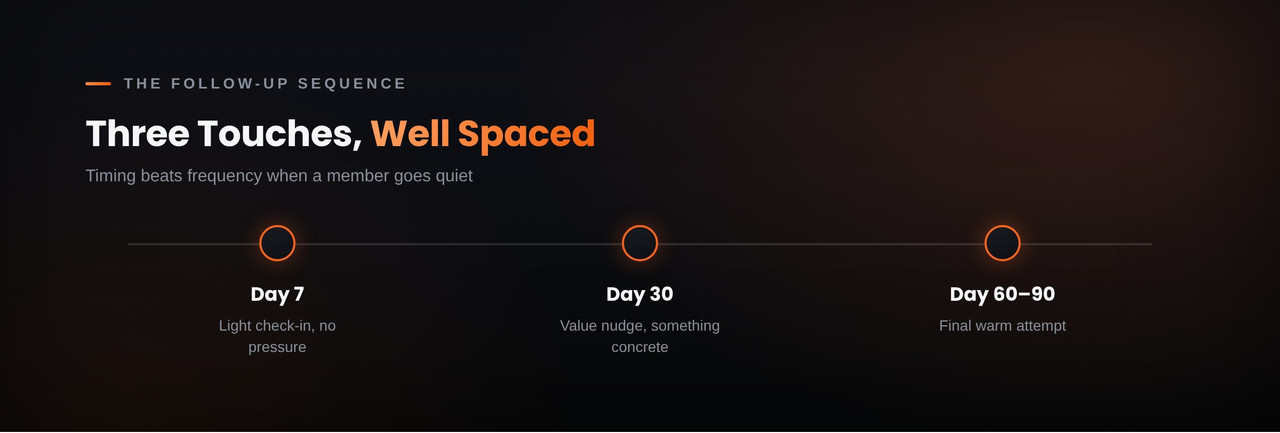
For a Discord community, that translates roughly into: a light, personal check-in around a week of silence (before things have had time to fully cool), something more substantial around the 30-day mark if they're still gone, and one last real attempt somewhere in the 60 to 90 day range before you let it rest.
What the numbers actually look like
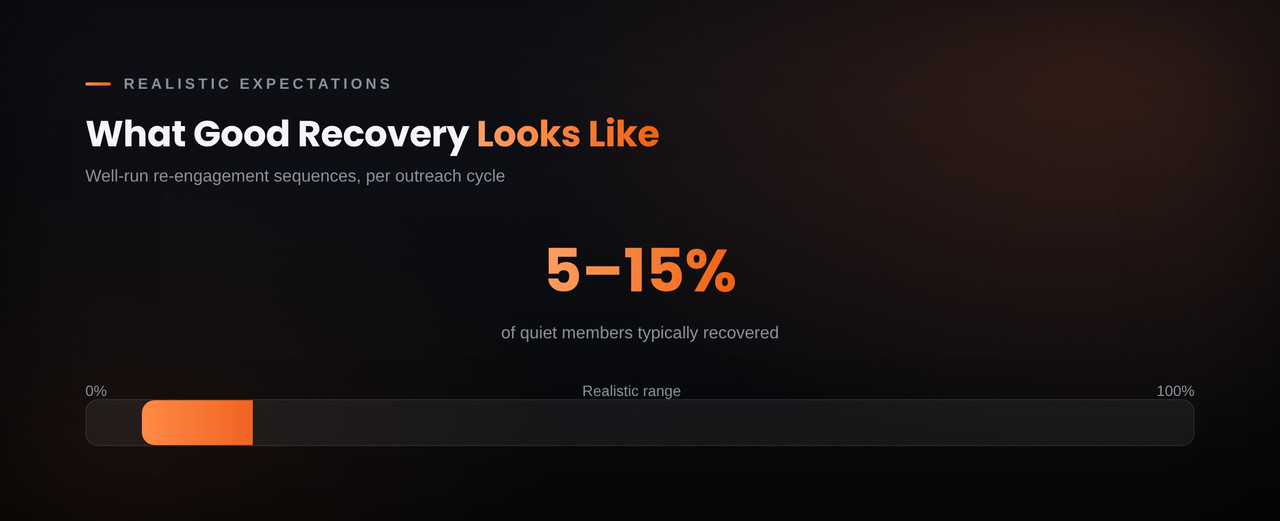
It's worth setting realistic expectations. Well-run re-engagement sequences typically recover somewhere between 5% and 15% of the people they reach, depending on how personalized the messages are and how long the person has been gone. That's not a moonshot number, but across a community of any real size it adds up fast, and it's a far better use of effort than letting the same members drift out permanently every single month.
Why timing beats frequency
One counterintuitive finding worth internalizing: sending more messages doesn't help nearly as much as sending them at the right moments. A member who's gone quiet is often more sensitive to feeling chased, not less, precisely because they already feel a little guilty about disappearing. Careful spacing, not volume, is what actually moves the needle.
Matching the message to the moment, not just the calendar
Beyond raw timing, it helps to think about what state a member is likely in at each checkpoint. At seven days, most people haven't consciously decided anything yet, they've just gotten busy, so the message should be light and assume nothing is wrong. At thirty days, some genuine reconsideration has probably started, so this is the moment to reintroduce real value, not just say hello again. By sixty to ninety days, you're often talking to someone who's forgotten specifics about what the community even offers, so this message needs to reintroduce the core value proposition almost as if they're new, without making them feel bad for having forgotten it.
Choosing the right channel for the check-in
Where a follow-up lands matters almost as much as what it says. A direct message or a continuation of an existing private thread feels personal and low-pressure. A public channel mention or an @role ping feels like a broadcast, even when it's well-intentioned, and can make a quiet member feel singled out rather than genuinely reached out to. For members who joined through a private onboarding conversation, keeping the follow-up in that same space, rather than starting fresh somewhere more public, preserves the one-to-one feeling that made the original conversation work in the first place.
Follow-Ups That Feel Like Care
The tone of these messages is what separates the ones that get a genuine reply from the ones that get muted, or worse, actively push someone toward cancelling out of mild irritation.
What to avoid entirely
Skip anything that reads like an accusation. "You haven't been active lately" technically states a fact, but it lands as a scolding, and nobody responds warmly to being scolded. Re-engagement research is consistent on this point: guilt-based messaging reliably underperforms, because it puts the recipient on the defensive instead of inviting them back in.
Also avoid vague, generic nudges. "We miss you!" with nothing else attached asks the reader to do all the work of remembering why that should matter to them. If they were already on the fence, a message with no specific hook gives them nothing to grab onto.
What actually works
A real question beats a generic prompt every time. Something that references the actual reason they joined, or something specific that's happened in the community since they left, shows the message wasn't copy-pasted to everyone at once, even if, mechanically, it was. Pairing that with something concrete, a resource, an update, a direct answer to whatever they were working through when they went quiet, gives the message a reason to exist beyond "please come back."
A simple structure that holds up
A message that acknowledges the gap without shaming it, asks one genuine question, and offers one low-friction next step tends to outperform longer, more elaborate check-ins. Quiet members generally aren't looking for a wall of text. They're looking for a low-pressure reason to re-engage without having to explain themselves first.
Winning Back the Ones Who Drifted
Not every quiet member went quiet for the same reason, and treating them all identically wastes the personalization that makes these messages work in the first place. (This section covers the follow-up sequence itself; for the fuller playbook on segmenting and reactivating a whole inactive base at once, see how to re-engage inactive members.)
Segment by why, not just by how long
Someone who got busy with work needs a different message than someone who lost interest in the topic entirely, and both need something different from someone who got a little lost in the server's structure and never found their way back. If you know the reason, even roughly, from an earlier conversation, use it. A follow-up that says "totally get that things got busy, here's the quick version of what you missed" lands very differently than a generic nudge.
The value of segmenting by inactivity length
Beyond the reason, how long someone's been gone changes what message makes sense. Someone quiet for a week just needs a light, friendly nudge. Someone quiet for two months probably needs to be reminded what the community even offers before anything else, because the details have genuinely faded from memory by then.
A worked example
Say a member joined excited about a specific trading strategy discussion, posted twice in their first week, then went quiet for three weeks. A generic "we miss you" message ignores everything you actually know about them. A better version: "Hey, noticed you've been quiet since we talked about [the specific strategy]. We've had some good follow-up discussion on that exact topic since then, happy to catch you up if you're interested." That single reference to something real, something they actually cared about, does more work than any amount of general enthusiasm in the message.
Knowing when to let go, gracefully
Not everyone comes back, and chasing indefinitely does more harm than good. Once you've made a real, thoughtful attempt and heard nothing back, one clean, final message, something that leaves the door open without demanding a response, is far better than repeated pings that start to feel like harassment. Some members simply moved on, and that's a normal, healthy outcome. What actually matters is that nobody slipped away without anyone genuinely trying first.
Three Follow-Up Messages You Can Adapt
Having a starting structure makes these easier to write consistently, even if you personalize the specifics for each member.
- The day-7 check-in (light, no pressure):
Hey [name], noticed things have been quiet on your end, hope everything's good. No pressure to reply, just wanted to flag that [specific thing relevant to why they joined] has been happening if you want to take a look.
- The day-30 value nudge (something concrete attached):
Hey [name], it's been a bit since we last talked. Since then, [specific update or resource]. Thought of you specifically because [reason tied to their original goal]. Would love to hear how things are going on your end, whenever you have a minute.
- The day-60/90 final attempt (warm, low pressure close):
Hey [name], haven't heard from you in a while, totally understand if life's just been busy. Wanted to send one last note: [reintroduce core value in one sentence]. The door's open whenever you want to jump back in, no rush at all.
Each of these works better the more specific the bracketed details actually are. A message that references the real reason someone joined will always outperform a template used exactly as written.
Common Mistakes When Following Up With Quiet Members
- Sending the same message to everyone, regardless of how long they've been gone. A member quiet for a week and a member quiet for three months are in very different headspaces, and a single generic message fails to speak to either of them well.
- Leading with an ask instead of a check-in. Messages that open with "come back and upgrade" before ever acknowledging the person read as transactional. Leading with genuine curiosity about how they're doing, before anything about the community itself, sets a completely different tone.
- Giving up after one message. A single unanswered nudge doesn't mean someone's gone for good. It often just means the timing or the specific message didn't land. A short, well-spaced sequence recovers meaningfully more people than any single attempt.
- Never actually closing the loop. Some admins keep a quiet member in a permanent "maybe" state indefinitely, neither actively following up nor letting them go. A clean final message, one that leaves things open without ongoing pressure, is healthier for both sides than an indefinite, unresolved silence.
What Good Reactivation Actually Looks Like
It's worth having a rough benchmark in mind so you can tell whether your own follow-up efforts are working or need adjustment. Across well-run re-engagement sequences generally, recovering somewhere between one in twenty and one in seven people reached is a realistic, healthy outcome, not every message will land, and that's expected. If a sequence is recovering meaningfully less than that consistently, the issue is usually tone (too generic, too salesy) or timing (too early, before someone's had a real chance to miss the community, or too late, after the relationship has fully cooled) rather than the underlying idea of following up at all. Track this per sequence, not just per message, so you can tell which specific version of your follow-up flow is actually earning replies and which one is quietly getting ignored.
Quick FAQ
- How many follow-up messages is too many?
Beyond three well-spaced attempts, additional messages tend to produce diminishing or even negative returns. If someone hasn't responded to a light nudge, a value-driven message, and a genuine final attempt, further messages usually just annoy rather than persuade.
- Should follow-ups go in the same thread they originally joined in, or a fresh DM?
Keeping it in the same private thread they already have with your onboarding flow tends to work better than a cold new DM, since it carries the context of the earlier relationship rather than starting the conversation from zero.
- What if a member went quiet right after paying?
Treat this with extra urgency. A paying member who goes quiet within the first few weeks is showing an early churn signal, and catching it here, before a full billing cycle has passed, is far cheaper than trying to win them back after they've already cancelled.
- Is it worth following up with free members who never converted, not just paying ones?
Yes, and this is where a lot of admins stop too early. A free member who went quiet mid-conversation is often someone who was genuinely close to converting before life got in the way. The same care applied to paying members tends to pay off here too.
- Should follow-up messages ever include a discount or incentive?
Sparingly, and later in the sequence rather than earlier. Leading with a discount on the first check-in signals that the relationship is primarily transactional. Saving an incentive for a later message, after a genuine check-in has already been attempted, tends to land better and preserves the incentive's actual persuasive power for when it's needed most.
- How do I know if my follow-up messages are actually working?
Track reply rate and, further down the line, reactivation rate, not just whether the message was opened or seen. A message that gets read but never gets a reply and never brings someone back isn't working, regardless of how thoughtfully it was written. Adjust tone or timing based on what the data actually shows, not on how good the message felt to write.
- What's the difference between a follow-up and a win-back campaign?
In practice, they're the same idea at different points on a spectrum. A follow-up tends to happen earlier and more personally, often as a continuation of an existing conversation. A win-back campaign usually kicks in once someone's been gone long enough that the relationship needs to be re-established almost from scratch. Both rely on the same underlying principles: timing, specificity, and a tone that invites rather than pressures.
Further Reading
- ActiveCampaign's guide to re-engagement emails — sequence structure and timing benchmarks this piece draws on
- Omnisend's win-back email research — realistic recovery rate benchmarks
- Beehiiv on re-engagement campaigns — why guilt-based messaging underperforms
- Harvard Business Review: "The Value of Keeping the Right Customers" — the original research on retention economics versus acquisition cost
Manually tracking exactly when hundreds of members went quiet, and remembering to check back in at the right moment for each of them, is a full-time job most admins don't have room for on top of everything else running a community demands.
SalesGenie remembers exactly when a member said they'd revisit a conversation and follows up automatically, in the same private thread, at the right moment for every single person. No spreadsheet, no memory required, no member quietly slipping through. Book a demo to see it in action.