

How to Keep Members Engaged in a Community
Getting members into your community is only half the battle.
By this point, you've already attracted members, onboarded them, and helped them understand what your community offers. The challenge now is keeping them engaged long enough to experience the value that convinced them to join in the first place.
This is where many communities struggle.
Not because they lack good content. Not because they lack expertise. Not because they lack resources.
They struggle because engagement doesn't happen automatically.
Many community owners assume that once enough people join, conversations will naturally take care of themselves. In reality, active communities are usually the result of deliberate effort. They have structure. They have rhythms. They have leaders who create reasons for people to return.
The good news is that engagement isn't as complicated as it sometimes appears.
The strongest communities don't necessarily have the biggest teams, the most channels, or the most advanced automation. They simply understand what keeps people coming back.
What Drives Member Engagement
A lot of community owners think engagement is the goal.
It's not.
Engagement is usually the result of several things happening correctly behind the scenes.
- When members feel connected, they're more likely to participate.
- When members find value, they're more likely to participate.
- When members know people inside the community, they're more likely to participate.
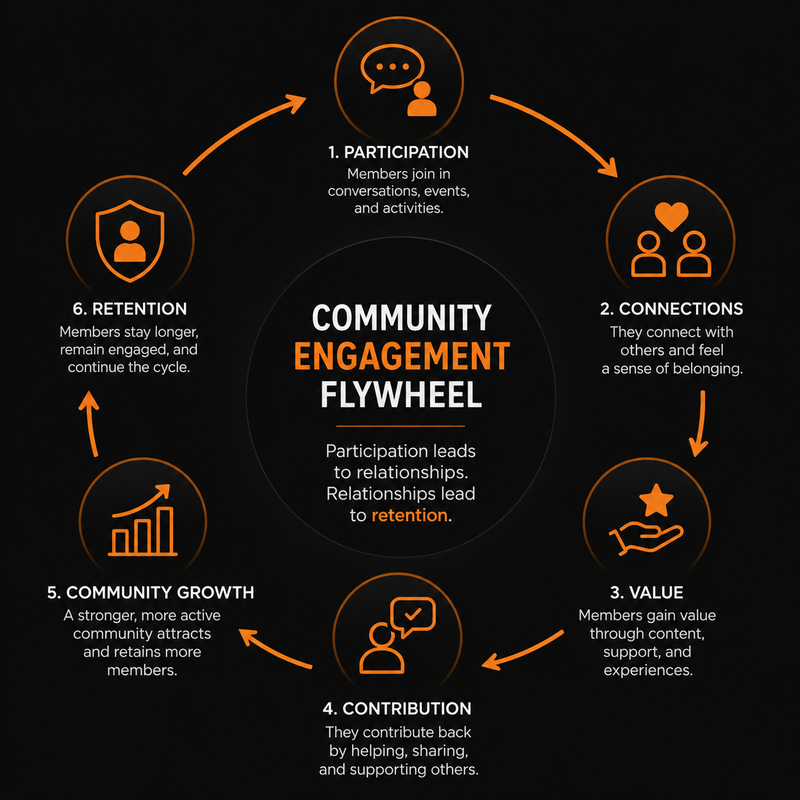
The activity you see in a thriving community is often a symptom of deeper relationships rather than the cause of them. This is why copying another community's tactics rarely works.
You can copy their channels. You can copy their events. You can copy their bots.
What you can't instantly copy are the relationships that make those things successful. Before trying to increase engagement, it's important to understand what actually drives it.
People Return for People
One of the biggest misconceptions in community management is that members stay because of content.
Content matters. Expertise matters. Resources matter.
But over time, people often remain because of the relationships they've built. Think about communities you've personally stayed active in. Chances are there were people you enjoyed interacting with.
Maybe it was the founder. Maybe it was a moderator. Maybe it was a group of members who were always active.
Whatever the reason, the human element probably played a major role. This is why communities built entirely around information often struggle with retention.
Information can be consumed. Relationships have to be experienced.
A member might join because they want access to knowledge, But they usually stay because they feel connected to the people providing it.
The Community Owner Sets the Tone
Community owners have far more influence on engagement than they often realize. Members pay attention to what the owner does.
If the owner only appears to make announcements, members notice. If the owner rarely participates in conversations, members notice. If the owner seems disconnected from the community, members notice.
The message this sends is subtle but powerful. It tells members that participation isn't particularly important.
On the other hand, when community owners regularly engage with members, answer questions, celebrate wins, and participate in discussions, they create a completely different environment.
The community feels alive. It feels active. It feels worth contributing to.
This doesn't mean you need to spend all day chatting in Discord. That's not realistic. But spending even a small amount of time interacting with members consistently can have a surprisingly large impact.
A quick reply. A thoughtful comment. A congratulations message. A short discussion.
These small interactions accumulate over time. More importantly, they signal that the community is being actively led.
Visibility Matters More Than Volume
Many founders believe engagement means constantly posting. That's not necessarily true. Members don't need dozens of messages every day. What they need is evidence that someone is paying attention.
There's a big difference between an owner who posts twenty announcements each week and an owner who spends fifteen minutes genuinely interacting with members. One creates noise whereas the other creates connection.
When community owners become overly focused on broadcasting information, the community can slowly start feeling like an audience rather than a community.
Communities thrive when conversations move in multiple directions. Not just from the owner to the members, but between members themselves.
A good community owner understands this and actively encourages it. Instead of trying to be the center of every conversation, they help create an environment where conversations happen naturally.
Engagement Starts With Participation Opportunities
One reason many communities feel inactive is because members aren't given enough opportunities to participate. Think about what happens in a typical low-engagement community.
An announcement gets posted. Members read it. Then nothing happens.
There was information, but there wasn't participation.
The strongest communities consistently create opportunities for members to contribute.
For example:
- Asking questions
- Sharing progress updates
- Participating in challenges
- Joining community calls
- Giving feedback
- Helping other members
The key distinction is that members aren't simply consuming content, They're contributing to the experience.
The more opportunities people have to contribute, the more invested they become.
Remove the Fear of Participation
Many community owners assume members aren't participating because they're uninterested.
Sometimes that's true. Often it isn't.
In many cases, members simply don't know how to participate.
Imagine joining a community filled with experienced members.
People are sharing wins. Discussing advanced topics. Talking to each other regularly.
For a new member, jumping into those conversations can feel intimidating. This is why communities should create low-pressure participation opportunities.
Simple prompts often work surprisingly well. Examples include:
- Weekly check-ins
- Progress threads
- Question of the day
- Polls
- Community discussions
These activities lower the barrier to entry. Instead of requiring members to start conversations themselves, they provide an easy way to join existing conversations. Over time, that confidence often leads to deeper participation.
Engagement Is Built Through Consistency
One of the biggest mistakes community owners make is treating engagement as something that happens during bursts of activity.
A big launch happens. Activity spikes. Then everything goes quiet again.
A major announcement gets posted. Activity spikes. Then everything goes quiet again.
Sustainable engagement works differently, as it's built through consistency. Members return because they know something is always happening, not necessarily something huge, just something worth checking in for.
Consistency creates familiarity. Familiarity creates habits.
And habits are often what keep communities active over the long term. This is why successful communities rarely rely on occasional excitement alone, instead, they focus on creating a steady rhythm that keeps members connected week after week.
Engagement Is a Long-Term Game
A common mistake is expecting engagement to happen immediately. Communities don't become active overnight.
Relationships take time. Trust takes time. Participation takes time.
Many of your most active members probably weren't highly engaged on day one. They became engaged because they repeatedly found reasons to return.
They attended events. They joined discussions. They got to know other members.
Eventually, participation became a habit. This is an important mindset shift for community owners. The goal isn't creating maximum activity today, the goal is creating an environment that encourages participation over time.
When viewed through that lens, engagement becomes much easier to understand.
It's not about forcing conversations. It's about creating conditions where conversations naturally happen.
The Rhythms That Keep a Community Alive
If engagement is the result of healthy community relationships, the next question becomes simple:
How do you consistently create opportunities for those relationships to develop?
The answer is rhythm.
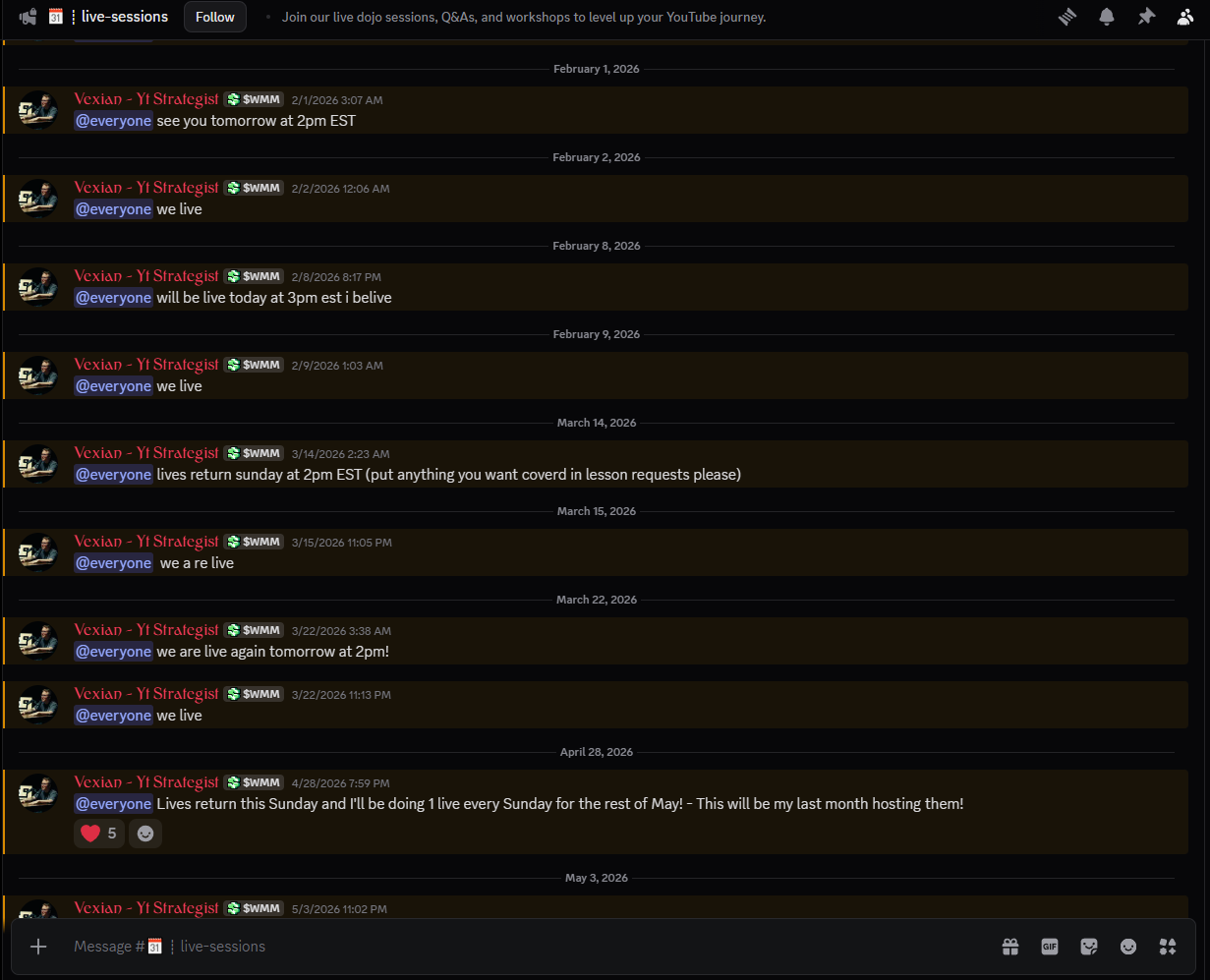
Most successful communities have predictable patterns of activity. Members know when things happen. They know when discussions take place. They know when events are running. They know when opportunities to participate will appear. That predictability is incredibly important because people are busy.
Most members aren't sitting in your Discord server waiting for something to happen. They have jobs, businesses, studies, families, and responsibilities competing for their attention. The communities that stay active understand this. Instead of expecting members to constantly check in, they create recurring reasons for members to return.
Give People a Reason to Come Back
One of the easiest ways to identify a struggling community is by looking at what happens after onboarding.
A member joins. They explore the server. They read a few messages. Then nothing pulls them back.
The problem isn't necessarily that the community lacks value. The problem is that value isn't being surfaced consistently.
People need reminders. They need opportunities. They need moments that encourage them to re-engage.
This is where recurring activities become incredibly powerful.
For example:
- Weekly Q&A sessions
- Community calls
- Progress check-ins
- Accountability threads
- Challenge weeks
- Member spotlights
- Live workshops
- Industry discussions
None of these activities are revolutionary on their own, what matters is consistency.
A community call that happens every Friday is often more valuable than a massive event that only happens every three months. Members begin building routines around recurring activities, and those routines eventually become habits.
Events Create Momentum
One of the biggest engagement mistakes community owners make is waiting for conversations to happen naturally.
Sometimes they do but most of the time they need a catalyst and events are what often provide that catalyst.
A good event gives members something to talk about before it happens, during it happens, and after it happens. Think about what occurs when a community event is announced.
Members start discussing it. Questions get asked. People share expectations. The event takes place. Conversations happen.
Afterwards, people discuss takeaways, lessons learned, and future actions.
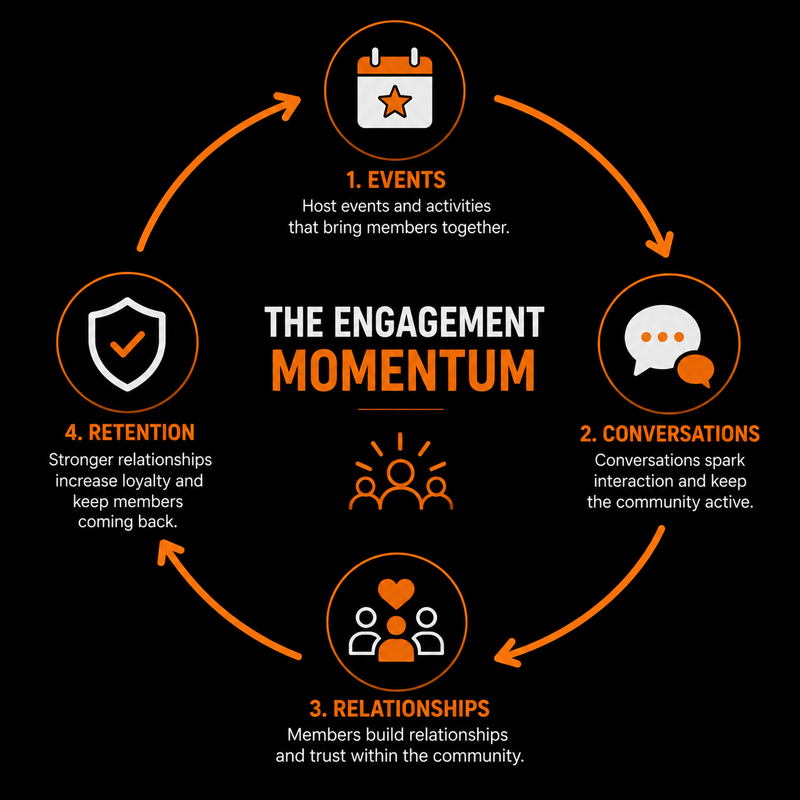
A single event can generate days of interaction. That's why events are such a valuable engagement tool. They don't just create activity during the event itself. They create momentum around it.
Founder-Led Events Matter
Whenever possible, community owners should be actively involved in events. This doesn't mean every event must be hosted by the founder forever. As communities grow, responsibilities naturally get shared across moderators, coaches, and community managers. However, founder involvement carries a different level of significance.
Many members joined because of the founder as:
- They're interested in their expertise.
- They're interested in their perspective.
- They're interested in learning directly from them.
When the founder regularly appears for Q&As, workshops, community calls, or discussions, members feel a stronger connection to the community itself. The community becomes more than a collection of channels. It becomes a place where direct interaction is possible.
This doesn't require multiple weekly events. Even a single recurring founder-led event can have a meaningful impact on engagement and retention.
Small Events Often Outperform Big Ones
A common misconception is that events need to be large productions.
They don't.
Many community owners overcomplicate engagement. They spend weeks planning major events, only to run them once before disappearing again. Meanwhile, simple recurring activities quietly outperform them.
For example:
- A weekly discussion thread.
- A Friday Q&A session.
- A monthly member spotlight.
- A recurring challenge.
- A weekly accountability check-in.
These activities don't require enormous effort, But they consistently create opportunities for participation. Members rarely remember communities because they hosted one huge event six months ago, but they remember communities because something useful was always happening.
The Importance of Shared Experiences
One thing that separates active communities from inactive ones is the presence of shared experiences.
Members need things they can collectively participate in. Without shared experiences, communities often become collections of individuals consuming information independently.
Information is valuable. Community is different. Community happens when people experience things together.
This could be:
- A challenge
- A live event
- A workshop
- A community project
- A discussion
- A competition
The specific format matters less than the shared participation. People build familiarity when they repeatedly engage with the same members around common activities, and that familiarity eventually turns into relationships.
Don't Build an Announcement Channel With Extra Steps
Many communities unintentionally become announcement channels.
The founder posts updates. Members read them. Nothing else happens.
This creates a one-way flow of communication. The problem with one-way communication is that members become spectators rather than participants.
Participation requires contribution. People need opportunities to respond, discuss, share, and interact. Before posting any update, it can be useful to ask:
Does this create a conversation, or does it simply distribute information?
Not every message needs a discussion attached to it. But if the majority of communication is one-directional, engagement will eventually suffer.
Use Questions Intentionally
Questions remain one of the simplest engagement tools available. The problem is that many communities ask weak questions. Questions like:
How's everyone doing?
usually receive minimal responses.
Questions work best when they're specific.
Instead of asking broad questions, ask questions that encourage members to share experiences.
For example:
- What's the biggest obstacle you're facing this week?
- What result are you working toward right now?
- What's something that worked well for you recently?
- If you could solve one problem today, what would it be?
Specific questions create specific answers. Specific answers create conversations. Conversations create engagement.
Create Opportunities for Member Recognition
Recognition is one of the most underutilized engagement tools in community management. People enjoy being acknowledged. Not because they want attention. Because recognition reinforces participation.
- When somebody shares a win, acknowledge it.
- When somebody helps another member, acknowledge it.
- When somebody contributes consistently, acknowledge it.
This doesn't require elaborate reward systems, often a simple message is enough.
Communities that celebrate progress create positive reinforcement loops. Members begin associating participation with positive experiences and that encourages future participation.
Build Around Community Wins
One thing you'll notice in highly engaged communities is that member successes become community successes.
A member lands a new client. The community celebrates.
A member reaches a milestone. The community celebrates.
A member achieves a goal they've been working toward. The community celebrates.
These moments matter because they demonstrate the value of the community in a way that marketing never can. They also create optimism. Progress becomes visible, and members see what's possible.
And when members see others succeeding, they're often motivated to participate more themselves.
Consistency Beats Intensity
Many engagement strategies fail because they're built around short bursts of enthusiasm.
A founder gets motivated. They post constantly for two weeks. They run events. They start discussions. Then life gets busy and everything disappears.
Members notice these fluctuations. Consistency almost always outperforms intensity.
A community that hosts one quality event every week for a year will usually outperform a community that hosts ten events in one month and then disappears for three months. The goal isn't creating the busiest week your community has ever experienced, the goal is creating a sustainable rhythm that members can rely on. When people know there's always something worth returning for, engagement becomes far easier to maintain.
Engagement as a Retention Signal
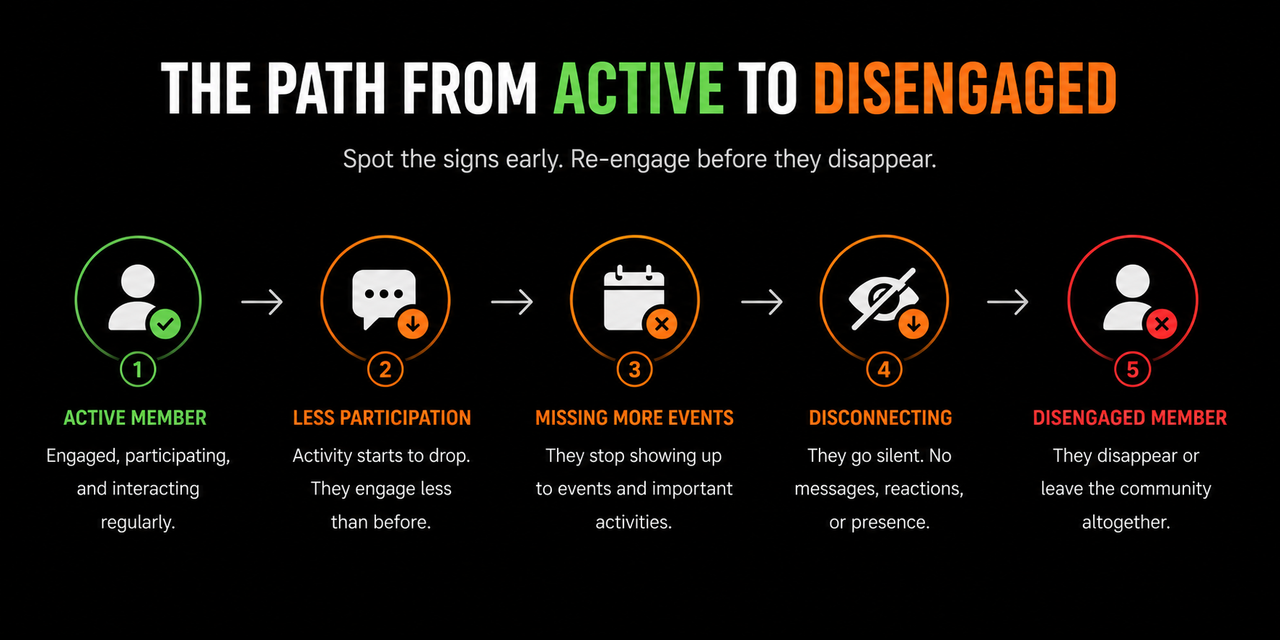
One of the biggest mistakes community owners make is treating engagement and retention as separate topics. They're closely connected. Long before a member cancels their subscription, leaves the community, or disappears entirely, engagement usually starts declining. The warning signs are often subtle at first.
- Maybe they stop attending events.
- Maybe they stop participating in discussions.
- Maybe they stop reacting to messages.
- Maybe they stop checking in altogether.
Very few members go from highly active to completely gone overnight. Most disengagement happens gradually. That's why engagement isn't just something you should encourage, It's something you should pay attention to.
Engagement Often Declines Before Members Leave
Think about your most active members. They're probably easy to identify.
- They attend events.
- They participate in conversations.
- They ask questions.
- They help others.
- They contribute regularly.
Now think about members who eventually leave. If you look closely, you'll often notice a pattern.
-Their activity starts slowing down. -They participate less frequently. -They stop showing up to things they used to attend. -They become observers rather than contributors.
Eventually, they disappear altogether. The important lesson here is that cancellations are often the final stage of disengagement, not the beginning of it. By the time somebody decides to leave, the decision has usually been forming for weeks. This is why strong community owners monitor engagement trends rather than waiting for cancellations to happen.
Don't Focus Only on Active Members
Active members naturally attract attention.
- They're visible.
- They're participating.
- They're contributing.
The challenge is that inactive members are often much harder to notice. This creates a blind spot for many communities. The loudest members receive most of the attention while quieter members slowly drift away. That doesn't mean you need to chase every inactive member, but it does mean paying attention to patterns.
For example:
- Members who previously attended events but no longer do
- Members who stopped participating in discussions
- Members who haven't engaged in weeks
- Members who used to ask questions but now remain silent
These changes often reveal more than message counts ever will. A drop in participation can signal that members aren't finding value, aren't feeling connected, or simply aren't seeing enough reasons to return, understanding why matters.
Notification Discipline Matters More Than People Think
Many community owners view notifications as an engagement tool. In reality, notifications are a trust tool.
Every notification asks members for attention. The more frequently you ask for attention, the more selective members become about giving it to you. This is why notification discipline is so important. A common mistake is assuming that low engagement can be fixed by increasing notifications.
- More pings.
- More announcements.
- More reminders.
- More alerts.
Initially, this might create a temporary increase in activity. Over time, however, it often produces the opposite effect.
Members begin ignoring notifications and eventually, they mute the server entirely. Once that happens, re-engagement becomes much harder.
Protect the Value of Notifications
Notifications should feel important. Members should believe that if a ping appears, it's worth paying attention to. The fastest way to destroy that trust is by using notifications for everything.
For example:
- ❌ New message? Ping everyone.
- ❌ Minor update? Ping everyone.
- ❌ Random discussion? Ping everyone.
- ❌ Small announcement? Ping everyone.
When everything is important, nothing feels important. A much healthier approach is being selective.
Reserve notifications for moments that genuinely deserve attention. Examples might include:
- Major announcements
- Live events
- Important deadlines
- Significant community updates
- Time-sensitive opportunities
This keeps notifications valuable. More importantly, it helps maintain trust between the community and its members.
Muted Servers Are Silent Communities
One consequence of notification abuse that many owners overlook is server muting. Most members won't complain.
- They won't send feedback. -They won't announce their frustration. -They'll simply mute the server.
From that point onward, visibility becomes dramatically lower.
- Events get missed.
- Announcements get missed.
- Discussions get missed.
- Opportunities for engagement get missed.
The community slowly disappears from their daily routine. This doesn't happen because the community lacks value. It happens because the communication strategy unintentionally trained members to ignore it. That's why fewer, higher-quality notifications often outperform constant reminders.
Suggestions Are One of the Most Valuable Engagement Tools
Many communities have a suggestions channel. Far fewer communities actually use it effectively. That's unfortunate because suggestions are one of the most useful sources of feedback available. Members often tell you exactly where friction exists.
- They tell you what's confusing.
- They tell you what's missing.
- They tell you what's difficult.
- They tell you what could be improved.
The challenge is that many suggestions channels become graveyards. Members submit ideas. Nothing happens.
- No response.
- No discussion.
- No implementation.
Eventually, members stop contributing. Not because they ran out of ideas but because they no longer believe their feedback matters.
Suggestions Reveal Community Blind Spots
Founders spend a lot of time inside their communities. That creates familiarity. And familiarity can make problems difficult to see. What feels obvious to the founder may feel confusing to a new member.This is where suggestions become valuable.
They help expose blind spots. For example, suggestions may reveal:
- Confusing onboarding processes
- Missing resources
- Poor channel organization
- Event opportunities
- Unanswered questions
- Feature requests
- Communication issues
Even when suggestions aren't implemented, they often reveal patterns worth paying attention to. When multiple members raise the same concern, it's usually worth investigating.
Acting on Feedback Creates Buy-In
One of the easiest ways to strengthen engagement is showing members that their feedback matters. People become more invested in communities they help shape. That's why implementation matters.When a suggestion leads to a meaningful improvement, people notice.
The message being communicated is simple:
We listened.
That creates trust.It also encourages future participation because members feel their input can create real change. You don't need to implement every suggestion.
That's impossible.
But you should acknowledge them, discuss them, and seriously evaluate them. Communities become stronger when members feel heard.
Build Feedback Loops Into the Community
Suggestions shouldn't be the only source of feedback. The best communities create multiple ways to understand member experiences. For example:
- Event feedback
- Polls
- Surveys
- Member interviews
- Community discussions
- Check-in threads
Different members prefer different communication styles. Some people won't post suggestions publicly but will happily answer a survey. Others won't complete surveys but will share feedback during a community call. The more opportunities you create, the easier it becomes to understand what's working and what isn't.
Measure What Actually Matters
Many communities track the wrong metrics.
- Member count is useful.
- Message count is useful.
- Growth is useful.
But none of those metrics tell the full story.
A community can have thousands of members and very little engagement. A community can generate thousands of messages that add very little value.
The more useful metrics are often behavioral.
For example:
- Are members returning consistently?
- Are events attracting repeat attendees?
- Are conversations happening without founder involvement?
- Are members helping one another?
- Are new members becoming regular participants?
These indicators often reveal far more about community health than raw activity numbers.
Strong Communities Pay Attention
Ultimately, engagement isn't just about creating activity. t's about understanding the member experience. The best community owners don't simply post content and hope for the best.
They observe. They listen. They identify patterns. They notice what members respond to. They notice what gets ignored. They notice where people get stuck.
Over time, those observations become one of the biggest competitive advantages a community can have. Because communities rarely improve by accident. They improve because somebody is paying attention.
Small Habits That Add Up
When community owners think about engagement, they often focus on big initiatives.
- Large events.
- Major launches.
- Special campaigns.
- Community-wide challenges.
While those things can absolutely help, long-term engagement is usually built through much smaller actions repeated consistently over time. The healthiest communities aren't necessarily the ones generating the most activity every single day, They're the ones creating habits that keep members connected week after week and month after month.
Over time, these habits compound.
- A small interaction becomes a conversation.
- A conversation becomes a relationship.
- A relationship becomes a reason to stay.
Celebrate Member Wins
One of the easiest ways to strengthen engagement is by highlighting member success.
People join communities because they want progress. They want results. They want momentum.
When members see others making progress, it reinforces the value of being part of the community. That's why community wins should never go unnoticed.
For example:
- A member lands a new client
- A member reaches a revenue milestone
- A member launches a product
- A member achieves a fitness goal
- A member completes a challenge
- A member accomplishes something they've been working toward
These moments deserve recognition. Not only does it make the individual member feel appreciated, but it also creates visible proof that the community is helping people move forward. Community wins often become some of the most engaging conversations inside a server because everybody enjoys seeing progress.
Giveaways Work Best as Appreciation
Giveaways can absolutely help engagement. The problem is that many communities use them incorrectly. A giveaway shouldn't exist solely to manufacture activity. Members can usually tell the difference. If every giveaway is designed to inflate message counts, the engagement created tends to be temporary.
- People show up for the prize
- Then they disappear.
A healthier approach is using giveaways as a way of giving something back to the community. Think of them as appreciation rather than manipulation. Examples might include:
- Free coaching calls
- Community merchandise
- Course access
- Software subscriptions
- Gift cards
- Event tickets
The goal isn't creating artificial engagement spikes. The goal is rewarding participation and showing appreciation for the people who make the community valuable.
Create Traditions
One thing you'll notice in highly engaged communities is that they often develop traditions. These don't have to be complicated. In fact, the best traditions are usually simple.
Examples include:
- Friday wins threads
- Monthly member spotlights
- Community awards
- Annual challenges
- Weekly accountability check-ins
- Recurring discussion topics
Over time, members begin looking forward to these activities. They become part of the community's identity.
More importantly, traditions create familiarity. People enjoy returning to experiences they recognize. This helps transform engagement from something occasional into something expected.
Make It Easy to Contribute
Many members want to participate. They just aren't sure how.
This is where community owners can make a significant difference.
Rather than waiting for people to contribute naturally, create obvious opportunities for participation.
For example:
- Ask for opinions.
- Request feedback.
- Encourage progress updates.
- Invite members to share lessons learned.
- Highlight useful member contributions.
The easier participation becomes, the more likely members are to take part.
Remember, engagement isn't always about generating huge discussions. Sometimes it's simply about reducing the effort required for somebody to join a conversation.
Build Member-to-Member Connections
A common mistake among newer community owners is believing every interaction needs to involve them.
It doesn't.
In fact, one of the healthiest signs of a growing community is seeing members help each other without requiring founder involvement. This is where communities begin creating real network effects.
- Questions get answered.
- Advice gets shared.
- Conversations happen naturally.
- Relationships form independently.
When members begin creating value for one another, engagement becomes much more sustainable. The community no longer depends entirely on the founder to generate activity. Instead, members become active participants in creating the experience. That's a powerful shift.
Engagement Should Feel Natural
One thing worth remembering is that members can sense when engagement is being forced.
- They can tell when every discussion is engineered.
- They can tell when every giveaway is designed to inflate numbers.
- They can tell when participation feels artificial.
The strongest communities don't chase engagement metrics. They focus on creating genuine value. The engagement follows naturally. This is why authenticity matters. People would rather participate in a smaller, genuine conversation than a larger conversation that feels manufactured.
Quality almost always beats quantity.
Don't Chase Activity. Build Culture.
A lot of communities become obsessed with activity.
- How many messages were sent?
- How many reactions were added?
- How many people participated?
Those metrics can be useful, but they're not the end goal.Culture matters far more.Culture determines:
- How members treat one another
- Whether new members feel welcomed
- Whether people share wins
- Whether people ask questions
- Whether members stay engaged long-term
Strong cultures naturally produce engagement. Weak cultures often require constant effort just to maintain activity. This is why community owners should spend less time worrying about message counts and more time thinking about the environment they're creating.
The Best Communities Give Members Reasons to Return
When you step back and look at successful communities, a pattern starts to emerge. Members aren't returning because somebody told them to. They're returning because they want to.
- They know there will be conversations worth joining.
- They know there will be people they enjoy talking to.
- They know there will be opportunities to learn, contribute, and make progress.
The community has become part of their routine. That's ultimately what engagement looks like at its highest level.
- Not constant activity.
- Not endless notifications.
- Not forced participation.
Just members consistently finding value and choosing to come back.
Final Thoughts
Community engagement isn't something that can be solved with a bot, a new channel, or a clever tactic. It's the result of hundreds of small decisions made consistently over time.The communities that retain members best understand this.
- They create opportunities for participation.
- They host events.
- They celebrate wins.
- They listen to feedback.
- They protect the value of notifications.
- They remain visible.
Most importantly, they give members reasons to return.
If there's one takeaway from this article, it's this:
Engagement isn't about getting members to talk more.
It's about creating an environment where members genuinely want to participate.
When that happens, activity becomes a natural byproduct of a healthy community rather than something you constantly have to chase.
And that's where long-term retention begins.