

How to Price a Paid Community Membership
Choosing a price for your paid community is one of the biggest decisions you'll make as a community owner. Price it too high, and you worry that nobody will join. Price it too low, and you risk attracting the wrong members while making it difficult to sustain the community over the long term.
It's easy to fall into the trap of copying competitors, choosing a random number that "feels right," or charging less simply because your community is new. While these approaches might seem safe, they rarely lead to sustainable growth.
The truth is, pricing has very little to do with how many Discord channels you have or how many PDFs you've uploaded. Members don't evaluate your community by counting resources. They evaluate it based on the value they believe they'll receive and the outcome they expect to achieve.
A well-priced community attracts members who are invested, engaged, and committed to making the most of their membership. It also gives you the resources to continue improving the experience through better events, stronger support, new content, and a healthier community overall.
This guide will walk you through the principles behind effective community pricing. You'll learn how to think about pricing from a value perspective, how to decide what your membership should cost, how to structure pricing tiers, and why charging too little is often a much bigger mistake than charging too much.
By the end of this guide, you'll have a clear framework for pricing your community with confidence, regardless of whether you're launching your first paid membership or revisiting your current pricing strategy.
How to Approach Community Membership Pricing
One of the most common misconceptions about pricing is that there's a "correct" number.
Community owners spend hours searching for questions like:
- How much should I charge?
- What's the average price for a Discord community?
- What are other creators charging?
- Is $25 per month too expensive?
While these questions are understandable, they're often looking in the wrong direction.
The better question is:
What value does my community create, and what is that transformation worth to my members?
Pricing becomes significantly easier when you stop thinking about Discord as the product.
Discord is simply the platform.
The real product is the outcome your members achieve after joining.
For example:
- A trading community helps members become consistently profitable.
- A fitness community helps members stay accountable and improve their health.
- A coaching community helps business owners acquire more clients.
- A networking community connects professionals with opportunities they may never have found on their own.
Those outcomes have value.
That's what people are paying for.
Price the Transformation, Not the Platform
Imagine two different communities.
The first contains:
- 80 channels
- Hundreds of PDFs
- Dozens of recorded videos
- Multiple resource libraries
The second contains:
- 12 carefully organized channels
- Weekly coaching calls
- Active discussions every day
- Experienced members willing to help newcomers
- A clear roadmap that helps members reach their goals faster
Most people would happily pay more for the second community.
Why?
Because the experience is better.
The community creates momentum.
Members receive guidance.
Questions get answered.
Relationships are formed.
Progress becomes visible.
That's where the value comes from.
Too many community owners focus on adding more content instead of improving the member experience.
In reality, a smaller, highly engaged community often delivers significantly more value than a larger server filled with unused resources.
Before deciding on a price, ask yourself:
If someone joins today, how much faster will they achieve their goal because this community exists?
The stronger your answer, the easier pricing becomes.
Don't Copy Your Competitors
One of the quickest ways to undermine your pricing strategy is by copying someone else's.
It's natural to look at similar communities and think:
"They're charging $49 per month, so I'll charge $39."
Or:
"Their membership costs $99, so mine should too."
The problem is that you don't know everything behind those numbers.
You don't know:
- How established their brand is.
- How large their audience is.
- Their operating costs.
- How much personal support they provide.
- Their retention rate.
- Their long-term business model.
Two communities in the same niche can justify completely different prices because they're delivering different experiences.
Instead of treating competitor pricing as a rule, use it only as a point of reference.
Focus on understanding:
- Who your members are.
- What problem you're solving.
- How much ongoing value you provide.
- What makes your community different.
Those factors should influence your pricing far more than what another creator happens to charge.
Your Audience Matters More Than Your Niche
Pricing isn't determined solely by what your community teaches.
It's also influenced by who your members are.
For example, imagine two communities teaching similar marketing strategies.
One primarily serves university students learning freelancing for the first time.
The other serves agency owners already generating six-figure revenue.
Although the educational topic is similar, the value perceived by each audience is very different.
Someone looking to build a side income may have a very different budget than someone who views your community as an investment in growing an existing business.
Understanding your audience allows you to price confidently without assuming that every market expects the same monthly fee.
Ask yourself:
- Who is my ideal member?
- What stage are they at?
- What outcome are they trying to achieve?
- How valuable would achieving that outcome be?
Communities that understand their audience almost always make better pricing decisions than those that simply imitate competitors.
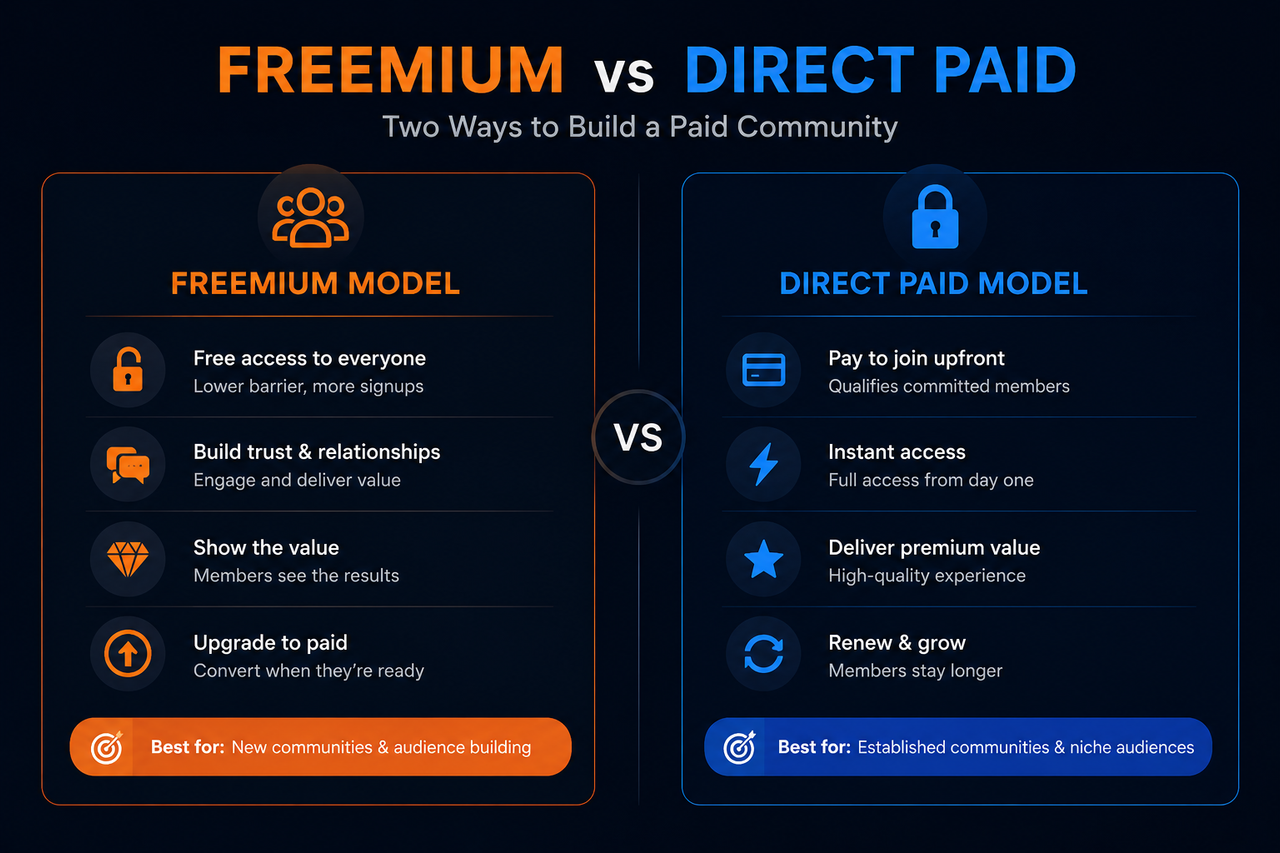
Should You Start With a Free Community?
Not every successful community begins behind a paywall.
In fact, many thriving communities use a freemium model to build trust before introducing paid memberships.
Under this approach, new members can join a free version of the community where they experience the culture, participate in discussions, and see the value your community provides.
Once members become familiar with the community, upgrading to a paid plan feels much more natural because they're no longer making a decision based on promises alone.
They're making a decision based on firsthand experience.
This approach offers several advantages.
Members can:
- Explore the community before committing.
- Build trust with other members.
- Experience the quality of discussions.
- See real success stories.
- Understand what they're upgrading into.
For community owners, a freemium model also creates a larger pool of potential future customers.
Rather than asking every visitor to make an immediate purchase, you give them an opportunity to become part of the community first.
That doesn't mean every community should be free.
Highly specialized communities, premium coaching groups, or exclusive mastermind programs may choose to remain paid from the very beginning.
The important point is that pricing isn't only about deciding how much people should pay.
It's also about deciding when they should pay.
Build Trust Before Asking for Money
Whether your community is entirely paid or includes a free tier, trust remains one of the biggest factors influencing conversion.
People rarely subscribe because they saw a list of premium channels.
They subscribe because they believe your community can help them achieve something meaningful.
Trust is built through consistent value.
Examples include:
- Educational content.
- Helpful discussions.
- Success stories from existing members.
- Free resources.
- Live workshops.
- Community events.
- Helpful responses to questions.
When members repeatedly experience value before purchasing, pricing becomes much less of an obstacle.
Instead of wondering whether your community is worth the investment, they begin asking themselves whether they can afford to miss out.
That's a far stronger position to be in.
Setting a Price People Happily Pay
Once you've established the value your community delivers, the next challenge is deciding what that value is worth.
This is where many community owners become uncomfortable.
They worry that charging too much will reduce sales.
As a result, they often choose a lower price simply because it feels safer.
Ironically, pricing too low can create just as many problems as pricing too high.
Members naturally associate price with perceived value.
When a community promises significant transformation but costs only a few dollars each month, people often begin questioning the quality of the experience before they've even joined.
The goal isn't to choose the cheapest price.
It's to choose a price that accurately reflects the value your community provides while remaining accessible to the audience you're trying to serve.
The strongest pricing strategies balance confidence, clarity, and value, giving members a clear understanding of what they're paying for and why it's worth the investment.
Think in Value, Not Affordability
One of the biggest pricing mistakes new community owners make is asking:
"What's the highest price people will pay?"
A much better question is:
"What value will members receive every single month?"
When your focus shifts toward creating ongoing value, pricing naturally becomes easier to justify.
A member who lands a new client, improves their business, develops valuable skills, or builds meaningful relationships through your community isn't evaluating their subscription based solely on the monthly fee.
They're evaluating it based on the progress they're making.
That's exactly where your attention should be as a community owner.
Price follows value.
Value creates retention.
Retention builds recurring revenue.
Use Pricing to Attract the Right Members
Price doesn't just determine how much revenue your community generates.
It also influences the type of members you attract.
A community that's priced too low often attracts people looking for the cheapest option rather than those who are genuinely committed to achieving results. These members may consume resources without participating, expect extensive support for very little investment, or cancel their membership after a short period because they never intended to stay long-term.
On the other hand, members who make a meaningful financial commitment are generally more invested in making the most of the opportunity. They're more likely to attend events, participate in discussions, complete challenges, and contribute to the community because they've chosen to invest in their own progress.
This doesn't mean expensive communities are automatically better.
It means your pricing should reflect the level of commitment you expect from your members.
When price and value are aligned, everyone benefits.
Psychological Pricing Matters More Than You Think
Small pricing decisions can have a surprisingly large impact on how members perceive your community.
One of the oldest pricing strategies is psychological pricing, where prices end in numbers such as 7 or 9 instead of rounded figures.
For example:
- $27 instead of $30
- $49 instead of $50
- $97 instead of $100
- $197 instead of $200
The actual difference is small.
The perceived difference, however, is often much larger.
People naturally process these prices as being noticeably lower, even though the gap may only be a few dollars.
This isn't about tricking potential members.
It's about presenting your offer in a way that feels approachable while still reflecting the value you're providing.
That said, psychological pricing isn't mandatory.
Some premium brands intentionally use rounded pricing because it communicates simplicity and confidence.
The important takeaway is consistency.
Choose a pricing style that matches your brand and stick with it.
Avoid Competing on Price Alone
Many new community owners assume they need to be cheaper than everyone else to attract members.
In reality, competing on price is one of the fastest ways to create a race to the bottom.
If someone joins your community purely because it's the cheapest option available, they're also the most likely to leave when another cheaper option appears.
Instead of asking:
"How can I charge less?"
Ask yourself:
"How can I make my community worth more?"
That might involve:
- Better onboarding.
- More active discussions.
- Exclusive live events.
- Personalized support.
- Networking opportunities.
- Accountability systems.
- Better educational resources.
Communities rarely become successful because they're the least expensive.
They become successful because members consistently feel they're receiving more value than they're paying for.
Focus on improving the experience rather than reducing the price.
Monthly vs Annual Memberships
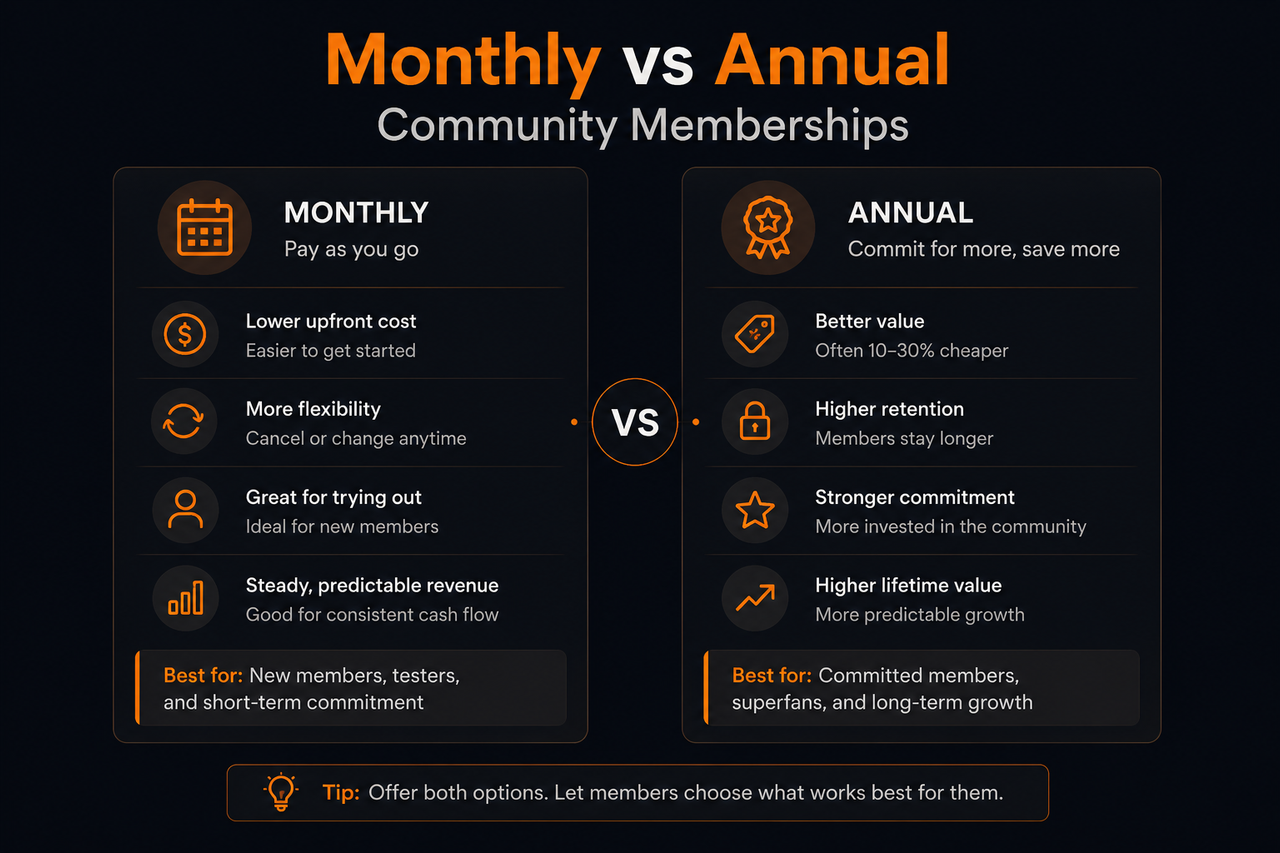
One question every community owner eventually faces is whether to offer monthly memberships, annual memberships, or both.
There isn't a universal answer, but each option offers distinct advantages.
Monthly memberships create a lower barrier to entry.
Members can join with a relatively small commitment, making them ideal for people who are still exploring your community.
The downside is that members evaluate whether to renew every single month.
That creates more opportunities for churn.
Annual memberships work differently.
Although the upfront cost is higher, they encourage a longer-term commitment while improving cash flow for the business.
Many communities successfully offer both options by rewarding members who choose an annual subscription.
For example:
- Monthly Membership: $29/month
- Annual Membership: $290/year
Members effectively receive two months free for committing to a full year.
The benefit isn't simply financial.
Longer commitments often lead to stronger relationships, better engagement, and significantly lower churn because members have more time to integrate into the community.
Should You Offer Discounts?
Discounts can be extremely effective when used strategically.
They become much less effective when they're always available.
If your community is permanently "50% off," members quickly learn that the listed price isn't the real price.
Instead of creating urgency, constant discounts reduce trust.
A better approach is to reserve promotions for specific occasions.
Examples include:
- Black Friday
- Cyber Monday
- New Year promotions
- Community anniversaries
- Creator milestones
- Seasonal campaigns relevant to your audience
Because these promotions are genuinely limited, members feel a stronger sense of urgency to join before the offer expires.
Just as importantly, your standard pricing retains its credibility.
Think of discounts as occasional marketing campaigns, not permanent pricing strategies.
Increase Value Instead of Lowering the Price
When communities struggle to attract members, the instinct is often to reduce the price.
In many cases, a better solution is to increase the value.
Rather than offering a cheaper membership, consider including something members genuinely care about.
Examples include:
- A monthly group coaching session.
- Exclusive templates and resources.
- Private networking opportunities.
- Members-only workshops.
- Office hours with the creator.
- Accountability groups.
- Early access to new content.
- Bonus recordings from live events.
Notice that none of these require dramatically lowering your price.
Instead, they strengthen the overall experience.
The conversation shifts from:
"Why is this community so expensive?"
to:
"Look at everything that's included."
Value creates confidence.
Confidence creates conversions.
Bundle Offers to Increase Perceived Value
One effective strategy for increasing average revenue without raising your subscription price is bundling.
Instead of selling only access to the community, combine your membership with valuable one-time or recurring bonuses.
For example:
- Community membership + 30-minute onboarding call.
- Community membership + monthly group coaching.
- Community membership + premium template library.
- Community membership + exclusive workshops.
- Community membership + implementation sessions.
Bundles allow members to perceive significantly greater value without requiring permanent discounts.
They're also an excellent way to differentiate higher membership tiers later on.
The key is ensuring the bundled offers genuinely help members achieve their goals faster.
Every additional benefit should reinforce the transformation your community promises rather than simply increasing the number of items on a sales page.
Test, Measure, and Improve
Pricing shouldn't be viewed as a permanent decision.
Communities evolve.
Member expectations change.
Your reputation grows.
The value you provide increases over time.
As a result, your pricing should evolve as well.
Don't be afraid to experiment.
You might test:
- Different pricing pages.
- Annual discounts.
- Trial offers.
- Bundle combinations.
- Promotional campaigns.
- Membership benefits.
Pay attention to more than just conversion rates.
Also monitor:
- Member retention.
- Engagement levels.
- Churn.
- Renewal rates.
- Average revenue per member.
- Feedback from existing members.
Sometimes a slightly higher price attracts fewer members but significantly increases long-term revenue because those members stay engaged for much longer.
The goal isn't to maximize sign-ups.
It's to build a healthy, sustainable community that delivers exceptional value while supporting your business for years to come.
The next step is deciding what members actually receive once they've subscribed.
Not every member wants the same level of access, and not every community benefits from offering a single membership plan.
That's where thoughtful membership tiers become incredibly valuable.
Tiers and What Goes in Each
Not every member joins your community for the same reason.
Some are looking for guidance.
Some want accountability.
Others simply want to network with like-minded people.
Trying to satisfy every type of member with a single membership plan often leaves everyone feeling like they're paying for features they don't need.
That's why many successful paid communities eventually introduce membership tiers.
The goal isn't to create as many pricing options as possible.
It's to create clear paths for members with different needs while keeping the decision-making process simple.
Keep Your Tier Structure Simple
One of the biggest mistakes new community owners make is offering too many membership options.
Imagine landing on a pricing page with:
- Bronze
- Silver
- Gold
- Platinum
- Diamond
- Elite
- Founder
- VIP
Instead of making the decision easier, the visitor becomes overwhelmed.
More choices rarely lead to more conversions.
In fact, they often create decision paralysis.
For most communities, two or three tiers are more than enough.
Even larger communities rarely need more than four.
A simple structure could look like this:
- Community
- Premium
- VIP
Or:
- Starter
- Pro
- Elite
The names themselves aren't important.
What matters is that members immediately understand the difference between each tier.
If someone needs several minutes to compare pricing options, your pricing page is probably too complicated.
Every Tier Should Solve a Different Problem
Many pricing pages simply remove or add random features.
For example:
Starter
- 12 channels
Premium
- 18 channels
VIP
- 25 channels
Very few people decide to upgrade because they gained access to six additional text channels.
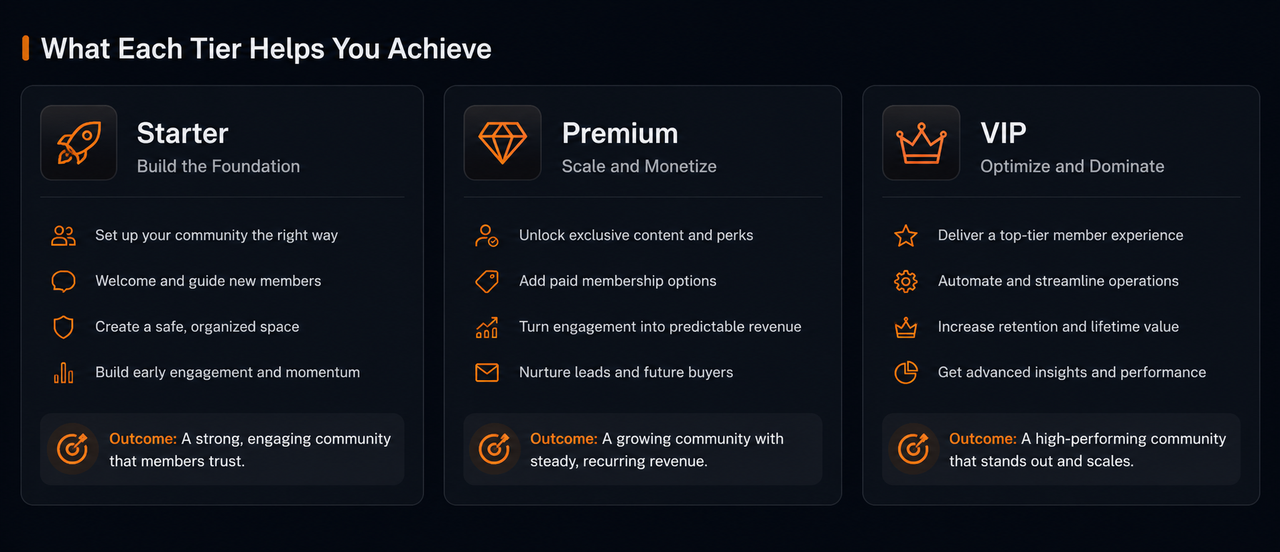
Instead, every tier should represent a different experience.
Think about the problems each member wants solved.
For example:
Starter
Ideal for people who want to learn.
Includes:
- Community access
- Discussion channels
- Resource library
- Weekly announcements
- Community events
Premium
Ideal for members who want more guidance.
Includes everything in Starter, plus:
- Weekly coaching calls
- Premium workshops
- Accountability groups
- Exclusive resources
- Member-only recordings
VIP
Ideal for members who want direct support.
Includes everything above, plus:
- One-on-one coaching
- Priority support
- Private mastermind channels
- Small group mentoring
- Early access to new programs
Notice the progression.
You're not selling additional channels.
You're selling deeper levels of support.
That's significantly easier for members to understand and justify.
Don't Lock Basic Features Behind Expensive Plans
Sometimes community owners become so focused on encouraging upgrades that they accidentally make lower tiers feel incomplete.
For example:
Basic members can't participate in discussions.
They can't attend events.
They can't introduce themselves.
They can't ask questions.
At that point, the lower-tier membership no longer feels valuable.
Instead, it feels like an extended advertisement for the higher plans.
Every paid member should feel like they're receiving a worthwhile experience.
Higher tiers should add value, not fix a deliberately limited lower tier.
A good rule of thumb is this:
Every tier should be valuable enough that members feel happy with their purchase, even if they never upgrade.
When lower-tier members enjoy the community, they're much more likely to remain subscribers and eventually move into higher tiers naturally.
Premium Should Mean More Access, Not More Channels
One of the easiest ways to improve higher membership tiers is by increasing interaction instead of increasing content.
Members place far more value on experiences than additional downloads.
For example, instead of adding another PDF or another hidden channel, consider offering:
- Monthly office hours.
- Weekly group coaching.
- Live workshops.
- Community masterminds.
- Project reviews.
- Hot seat sessions.
- Live feedback.
- Networking calls.
These experiences are difficult to replicate elsewhere, making them much stronger reasons to upgrade.
As a result, members begin viewing higher tiers as opportunities for greater access rather than simply larger content libraries.
Make Upgrading Feel Like the Next Logical Step
The best membership tiers don't pressure members into upgrading.
They naturally guide them there.
Imagine someone joins your Starter membership.
Over the next month they:
- Attend community discussions.
- Complete beginner resources.
- Meet other members.
- Build confidence.
- Start seeing progress.
At that point, upgrading feels natural because they're ready for additional support.
Compare that to immediately pushing every new member toward your most expensive membership before they've experienced any value.
The second approach creates resistance.
The first creates curiosity.
Members should feel like upgrading unlocks the next stage of their journey rather than correcting a bad purchasing decision.
Let Members Grow Into Higher Tiers
Your community should evolve alongside your members.
Someone joining today probably doesn't need the same level of support they'll want six months from now.
As members become more experienced, they'll naturally seek:
- More personalized advice.
- Direct access to experts.
- Advanced discussions.
- Smaller networking groups.
- Specialized coaching.
Your tier structure should reflect that progression.
Instead of viewing upgrades as additional sales opportunities, think of them as helping members continue moving forward.
When members consistently experience growth inside your community, upgrading often becomes an easy decision.
Founder Pricing Can Reward Early Supporters
If you're launching a brand-new community, founder pricing can be an excellent way to reward your earliest members.
For example:
Founding Members
$39/month for life
Once your community reaches a certain milestone, that offer disappears permanently.
Founder pricing creates urgency while recognizing the people who supported your community during its earliest stages.
However, use this strategy carefully.
Founder pricing should be genuinely limited.
If new "founding members" continue appearing every few months, the offer quickly loses credibility.
Transparency builds trust.
Avoid Creating Tiers Just to Increase Revenue
Sometimes communities introduce additional membership levels simply because they believe more pricing options will generate more income.
Unfortunately, that often has the opposite effect.
Every additional tier introduces another decision.
Every decision creates friction.
If a new membership level doesn't clearly serve a different audience, it probably doesn't need to exist.
Before introducing another tier, ask yourself:
- Does this solve a different problem?
- Does it serve a different type of member?
- Is there a meaningful increase in value?
- Will members immediately understand the difference?
If the answer is no, simplifying your pricing page will almost always perform better.
Review Your Membership Structure Regularly
Your community won't remain the same forever.
As new resources are added, events become more frequent, and member needs evolve, your pricing structure should evolve too.
Set aside time every few months to review:
- Which tier attracts the most members?
- Which tier has the highest retention?
- Where do members upgrade most often?
- Which benefits receive the most engagement?
- Which features are rarely used?
These insights help you improve your membership experience while ensuring every tier continues delivering meaningful value.
Remember, pricing isn't something you set once and forget.
It's part of an ongoing process of understanding your members and improving the experience you provide.
A well-designed pricing structure helps members choose the plan that's right for them.
But even the best membership tiers won't solve one of the biggest pricing mistakes community owners make.
Charging too little.
Many creators believe lower prices make growth easier.
In reality, underpricing often creates far more problems than people realize.
Why Underpricing Hurts Most
When new community owners think about pricing, they usually worry about charging too much.
Very few worry about charging too little.
At first glance, lower prices seem like a safe option.
Lower price.
More members.
More sales.
Simple.
Unfortunately, communities rarely work that way.
Underpricing creates problems that aren't immediately obvious, and many of them become more difficult to fix as your community grows.
While a low price may increase initial sign-ups, it often reduces long-term engagement, lowers retention, and makes it significantly harder to build a sustainable business.
The goal isn't to charge as much as possible.
The goal is to charge enough that both your members and your business can succeed.
Cheap Doesn't Always Feel Like a Bargain
People naturally associate price with quality.
Imagine you're choosing between two business communities.
One costs $12 per month.
The other costs $79 per month.
Without knowing anything else, most people will immediately assume the second community provides more value.
That assumption may not always be correct.
But perception matters.
When pricing appears unusually low, potential members often begin asking questions like:
- Why is it so cheap?
- Is anyone actually active?
- Will I get support?
- Is the content outdated?
- Is this community serious?
Ironically, reducing your price too much can actually reduce trust.
Instead of making your offer more attractive, it may cause people to question its quality before they've even joined.
Low Prices Often Attract Low Commitment
Price isn't just about revenue.
It's also a filter.
Members who make a meaningful investment are generally more motivated to participate because they've committed both financially and mentally.
Someone paying $50 every month is much more likely to:
- Attend community events.
- Join discussions.
- Complete challenges.
- Ask thoughtful questions.
- Build relationships with other members.
They want to maximize the return on their investment.
Compare that with someone who joins simply because the membership was extremely cheap.
If they never participate, cancelling their subscription feels insignificant.
The financial commitment was small.
So is the emotional commitment.
This doesn't mean every inexpensive community struggles.
It simply means lower pricing often attracts a larger percentage of casual members who aren't fully invested in achieving results.
Underpricing Makes Growth More Difficult
Every community has operating costs.
Examples include:
- Discord moderation.
- Staff salaries.
- Community managers.
- Guest speakers.
- Software subscriptions.
- Event hosting.
- CRM platforms.
- Automation tools.
- Design work.
- Content creation.
When pricing is too low, funding these improvements becomes increasingly difficult.
As a result, community owners often experience a cycle that looks like this:
Low pricing leads to lower revenue.
Lower revenue limits investment.
Less investment reduces the member experience.
Lower member satisfaction increases churn.
Higher churn creates pressure to attract even more members.
Eventually, growth begins relying entirely on acquiring new subscribers instead of retaining existing ones.
Healthy communities work differently.
Strong retention creates predictable recurring revenue.
Predictable revenue allows owners to invest back into the community.
Those improvements increase member satisfaction, which further improves retention.
It's a positive cycle rather than a negative one.
Don't Be Afraid to Raise Your Prices
Many creators hesitate to increase prices because they're worried members will leave.
Sometimes that concern is justified.
Often, it isn't.
If your community has grown significantly since launch, you've probably added:
- More resources.
- Better onboarding.
- More events.
- Improved support.
- New coaching opportunities.
- Stronger networking.
- More experienced members.
In other words, you've increased the value.
It makes sense for pricing to evolve alongside that value.
Price increases don't need to happen frequently.
But they also shouldn't be viewed as something to avoid forever.
The important part is communicating clearly.
Explain:
- What's changing.
- Why it's changing.
- What additional value members are receiving.
Most members appreciate honesty.
Especially when they've already experienced the improvements themselves.
Reward Existing Members
If you decide to increase pricing, consider rewarding members who've supported your community from the beginning.
Many communities choose to grandfather existing members.
This simply means current members continue paying their original price while new members join at the updated rate.
For example:
Current Members
- $39/month
New Members
- $59/month
This approach accomplishes two things.
First, it rewards loyalty.
Second, it creates urgency for prospective members because they know pricing may increase again in the future.
People appreciate being rewarded for supporting a community early.
It's a simple gesture that builds goodwill while maintaining trust.
Don't Compete in a Race to the Bottom
Every industry has competitors willing to charge less.
If your pricing strategy is based entirely on being the cheapest option, someone else can always undercut you.
That isn't a sustainable advantage.
Instead, compete on:
- Better support.
- Better onboarding.
- Better community culture.
- Better events.
- Better accountability.
- Better member outcomes.
Communities that consistently deliver results rarely struggle to justify their pricing.
The conversation changes from:
"Why is this community more expensive?"
to:
"This community clearly provides more value."
That's exactly where you want to be.
Pricing Is Only One Part of the Decision
Many community owners spend weeks trying to find the perfect monthly price.
The reality is that pricing is only one part of the buying decision.
Potential members also consider:
- Do I trust this creator?
- Are members actually active?
- Will this help me achieve my goals?
- Is the community welcoming?
- Does the onboarding process make sense?
- Can I see real success stories?
Notice how many of those questions have nothing to do with price.
Someone who fully believes your community can help them is far less likely to spend weeks debating whether it's worth an extra ten or twenty dollars each month.
That's why improving your community often has a greater impact than reducing your pricing.
Value drives confidence.
Confidence drives conversions.
Pricing Should Evolve With Your Community
Your first pricing model probably won't be your last.
As your audience grows and your community matures, you'll naturally discover:
- Which membership tiers perform best.
- Which benefits members value most.
- What support members actually use.
- Where upgrades happen most frequently.
- Which offers generate the highest retention.
Those insights should influence future pricing decisions.
Successful communities treat pricing as something they continuously improve rather than a one-time decision made during launch.
Don't be afraid to test.
Don't be afraid to learn.
And don't assume your initial pricing has to remain unchanged forever.
The strongest communities evolve because they're constantly listening to their members and improving the experience they provide.
What You Should Do Next
Start by evaluating your community from the perspective of the value it delivers rather than the number of channels or resources it contains. Ask yourself what transformation members are paying for, how your pricing reflects that value, and whether your current membership structure supports different types of members without becoming overly complicated.
If you're just getting started, keep things simple. Launch with a clear pricing model, one or two well-defined membership tiers, and focus on delivering an exceptional experience before adding more complexity. As your community grows, review your pricing regularly, listen to member feedback, and make adjustments based on the value you're providing rather than what competitors happen to charge.
Remember, successful communities aren't built by being the cheapest option available.
They're built by consistently helping members achieve meaningful outcomes, creating an experience that's worth returning to every month, and pricing that experience with confidence.