

How to Reduce Member Churn in a Paid Community
Churn is one of those numbers that feels abstract until you actually run it forward. A community losing 6% of its members every month isn't losing "just a few people here and there." It's quietly losing about half its base over the course of a year, which means half your growth effort every single year is spent just replacing people who left, before you've made any real progress at all. (If you're still catching members earlier in that slide, why new members join and then disappear covers the onboarding-stage version of this same problem.)
The good news, and it is genuinely good news, is that churn isn't random. It follows patterns, most of those patterns are visible weeks before anyone actually cancels, and a fair amount of it is cheaper to fix than most admins assume.
What Really Drives Member Churn
Before fixing anything, it's worth being precise about what's actually driving cancellations, because the fix for a disengagement problem looks nothing like the fix for a billing problem, even though both end in the same result.
Engagement and perceived value lead by a wide margin
Across membership communities specifically, the largest share of cancellations traces back to low engagement, members who've simply stopped participating, followed closely by a sense that the value no longer matches the cost. Together these two account for the clear majority of voluntary cancellations, which means most churn-reduction effort should point at engagement and value delivery, not at pricing tweaks. (For the fuller breakdown of these drivers, see why members cancel, and how to keep them.)
Billing structure quietly shapes churn too
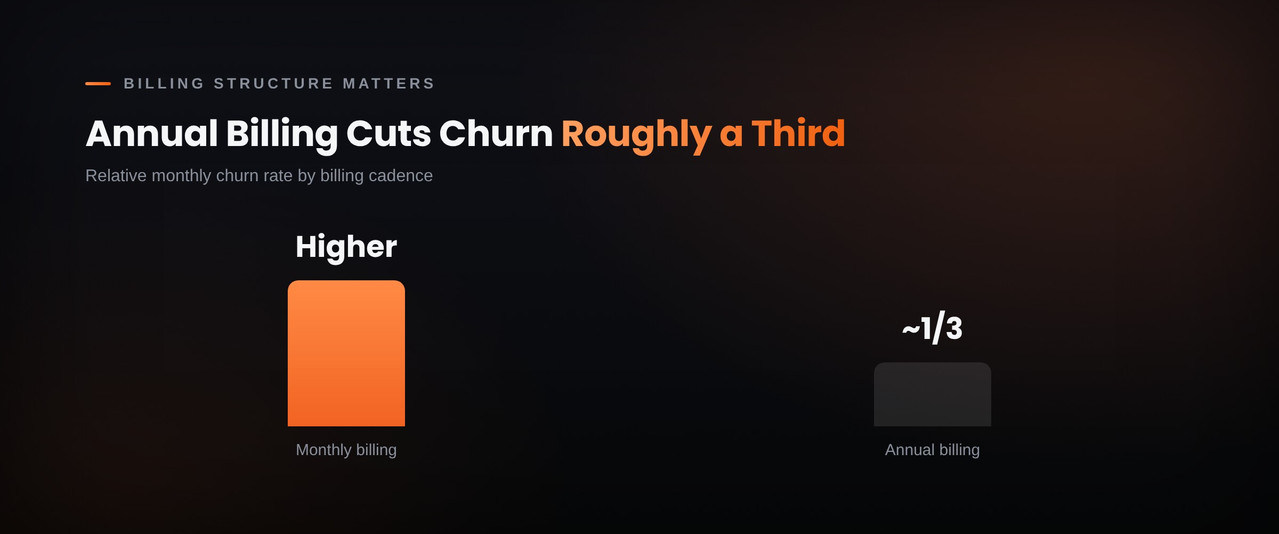
How you bill members changes how often they're forced to make a "should I keep this?" decision. Communities offering an annual option tend to see churn at roughly a third the rate of monthly-only plans, largely because the natural cancel-decision moment simply arrives far less often. If your community is monthly only, you're creating twelve separate opportunities a year for someone to reconsider, instead of one.
Why this matters more than it first appears
Consider two otherwise identical communities, one monthly-only, one offering an annual option at a modest discount. The monthly community effectively asks every member "is this still worth it?" twelve times a year. The one with an annual option asks that question once for the members who choose it. Over a year, that difference alone can meaningfully change total retained revenue, even before any other retention work happens, simply by reducing how often the cancel decision gets revisited.
A real slice of churn isn't a decision at all
It's easy to assume every cancellation was a deliberate choice, but a meaningful portion of subscription churn across industries is involuntary: a card expired, a payment failed, and the member never actually decided to leave, the system just quietly stopped billing them. This is, encouragingly, one of the cheapest problems on this entire list to fix, since it doesn't require winning anyone back emotionally, just catching a technical failure before it becomes permanent.
Structural friction quietly drives churn too
There's a category of churn worth naming separately: friction caused by the platform itself rather than by anything about the community's content or culture. Being asked to juggle a login for a separate app, remember yet another password, or navigate a genuinely confusing structure creates what's sometimes called structural churn, members disengaging not because they lost interest but because the mechanics of staying engaged got in the way. For a Discord-based community, this usually shows up as an overly complex channel structure or an onboarding flow that asks for too much too fast, both of which are entirely within an admin's control to fix.
Spotting the Warning Signs Early
Churn rarely arrives as a genuine surprise if you're watching the right signal, and that signal is behavior, not the billing calendar.
Engagement trends are a leading indicator, not a lagging one
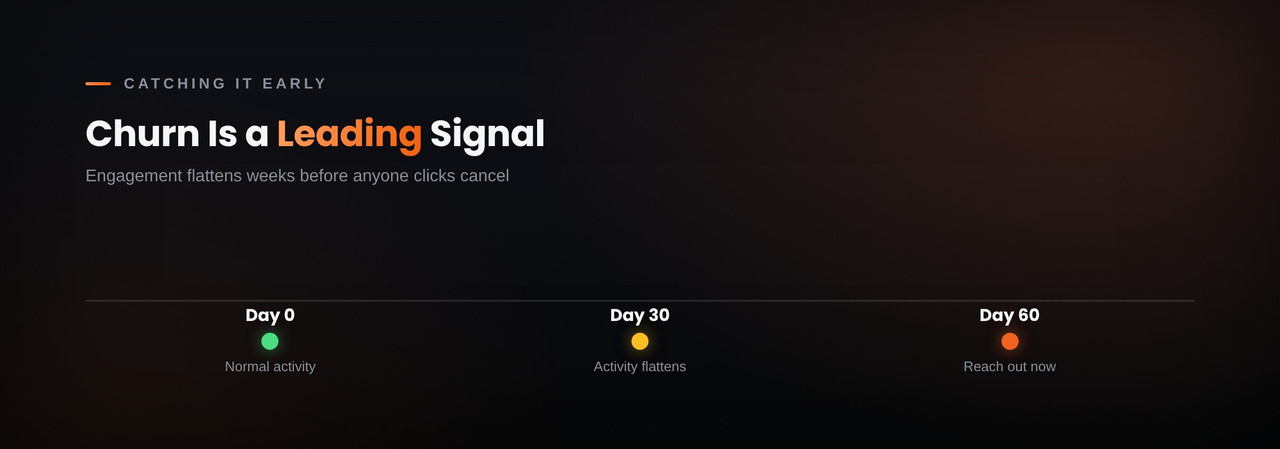
A member whose message activity, event attendance, or thread replies flatten out over a 30 to 60 day stretch is telling you something important well before they ever consider hitting cancel. Treating engagement data as a leading indicator, something to act on now, rather than a lagging report to review after the fact, is the single biggest mindset shift that separates communities that catch churn early from ones that only ever react to it.
The concrete version of a warning sign
In practice, this looks like: someone who stopped replying in threads they used to be active in, someone who's skipped the last two or three events they'd normally attend, someone who hasn't opened a DM or follow-up in weeks. None of these individually mean much. Together, over a few weeks, they paint a clear picture.
Don't wait for the monthly churn report
If the first time you learn about a churn problem is a monthly report showing the number went up, you're structurally always a month behind. Building a habit of checking in on individual engagement trends, even informally, catches problems while there's still time to do something about them.
A simple way to track this without dedicated software
For most communities, a lightweight approach works fine: once a week, scan for members who were previously active and have gone unusually quiet, roughly two weeks or more without a message, reaction, or event attendance. Even a manually maintained list, updated weekly, catches the majority of at-risk members well before they'd otherwise show up in a churn report. Larger communities eventually want this automated, but the underlying discipline, checking regularly rather than waiting for a monthly aggregate, matters more than the tooling used to do it.
Small Moves That Reduce Churn
None of the moves that actually work here are dramatic. That's the encouraging part, and also the reason they're easy to skip when things get busy.
Reach out at the first sign of a slowdown
A personal check-in the moment engagement starts dipping catches far more people than any mass "we miss you" blast sent later. The earlier the outreach, the more it reads as genuine attention rather than a save attempt, because from the member's side, nothing dramatic has happened yet.
Offer an annual option, even at a modest discount
Removing a chunk of the recurring cancel-decision moments by offering annual billing is one of the highest-leverage structural changes available, and it doesn't require changing anything about the community itself, just the billing cadence.
Give people a pause, not just a cancel button
This one is underused and surprisingly effective. Recurly, one of the larger subscription billing platforms, found in its own research that offering a "pause before cancel" option increased pause usage by 337%, with three out of four of those subscribers returning within months, compared to a much smaller share of people who fully cancel. A pause preserves the account, the payment method, and the habit, turning what would have been a permanent loss into a recoverable break. If your only options are "stay" or "cancel," you're forcing an all-or-nothing decision that a pause button would have avoided.
Fix the involuntary churn first, it's the cheapest win available
Before touching engagement strategy or pricing, make sure failed payments are actually being addressed. A well-timed, friendly reminder asking someone to update their payment info recovers a meaningful share of these cancellations, since the member usually never intended to leave. A team of subscription growth specialists who'd previously worked on retention at Hulu and Crunchyroll documented exactly this test in their Yem Jam newsletter: a simple payment-failure email, styled after the one Spotify sends, recovered payment info from roughly 14% of the subscribers it reached, turning what looked like a cancellation into a saved subscriber with a single well-timed message. Automated retries and a short grace period before access is cut off catch a good portion of the rest.
A worked example of the involuntary churn fix
Say a community has 400 paying members and sees roughly 20 cancellations a month. If even a third of those are involuntary, cards expiring, banks flagging a renewal as suspicious, payment providers briefly declining a charge, that's six to seven members a month who never actually chose to leave. A simple three-touch dunning sequence (an email or DM the day a payment fails, a reminder three days later, and a final notice with a short grace period before access is cut) typically recovers a meaningful share of that group with almost no ongoing effort once it's set up. Compare that to the work required to win back six voluntary cancellations through engagement and outreach, and it becomes obvious why this is usually the first fix worth making, not the most exciting one, but the one with the best return for the least effort.
Light structure and recognition go further than expected
Rotating your best past content back into visibility, giving members small recognition for participation, and building in modest milestones people can reach all give members a reason to open the server that isn't just "in case I miss something." None of this needs to be elaborate gamification. It just needs to give people a reason to show up on a rhythm. (How to keep members engaged in a community covers this rhythm in more depth.)
Winning Back Cancellations
Some members will still cancel no matter how well you run the middle of the journey, and that's a normal, unavoidable part of running any paid community. What separates communities that recover some of these members from ones that don't is what happens immediately after.
Address the actual reason, not a generic pitch
If you know why someone left, even roughly, use it. A member who left because the server felt stale needs a fundamentally different re engagement message than one who left over a moderation issue. A generic "come back, we miss you" ignores the specific thing that pushed them out in the first place, and it shows.
Offer the lighter option before assuming it's a full goodbye
A pause, a lower tier, or a short trial back at a reduced rate can recover members who weren't looking for a permanent exit, just a break or a lower commitment. Assuming every cancellation is final closes a door that, for a meaningful share of members, was never actually meant to be closed for good.
Know when to stop chasing
Once you've made one genuine, specific attempt and heard nothing back, let it rest. Continuing to chase past that point rarely changes the outcome, and it tends to make the exit feel worse for the member than it needed to, which isn't a great note to end a relationship on, even a lapsed one.
Common Mistakes Communities Make When Trying to Reduce Churn
- Fixing engagement and ignoring billing mechanics. Admins often pour effort into content and community culture while a steady trickle of involuntary churn from failed payments goes completely unaddressed, quietly undoing a chunk of that engagement work every month.
- Treating every cancellation as equally worth chasing. Not every lapsed member is a good candidate for win-back effort. Someone who left because the community genuinely wasn't the right fit for them isn't going to be persuaded by a better offer. Spending equal effort on every cancellation instead of focusing on the ones with a real, identifiable, fixable reason wastes energy that could go toward preventing the next round of churn instead.
- Only offering an all-or-nothing cancel flow. Without a pause option, members who just need a temporary break are forced into a full cancellation, permanently ending a relationship that a lighter option would have preserved. This is one of the simplest structural fixes on this entire list and one of the most commonly skipped.
- Waiting for a churn spike before acting. Reactive churn management, where nothing changes until the monthly number looks alarming, misses the weeks of warning signs that came before it. By the time the aggregate number moves, the individual members behind it were disengaging in plain sight for a while.
Quick FAQ
- What's considered a "good" monthly churn rate to aim for?
Broadly, somewhere in the 3% to 7% range is treated as healthy for membership-style businesses. Anything meaningfully above that is usually a sign of a specific, addressable issue rather than an unavoidable cost of running a community.
- Does cutting churn in half really double revenue growth?
Not exactly double revenue, but it does dramatically change the math on monthly recurring revenue. Going from something like 10% monthly churn down to 5% means far fewer members need replacing just to stand still, which frees up growth effort to actually grow the base instead of patching leaks in it.
- Is involuntary churn (failed payments) really worth fixing before anything else?
Usually yes, because it's the cheapest and most mechanical problem on the list. Unlike a member who's genuinely lost interest, someone with a failed payment often never intended to leave at all, which makes a simple reminder disproportionately effective compared to the effort it takes.
- How do I know if my churn problem is really about onboarding, not retention?
Look at when the cancellations are happening. If most cancellations cluster in the first 30 to 60 days, the real issue is almost always onboarding, not ongoing retention. If they're spread more evenly across a member's lifetime, that points more toward engagement and value delivery over the longer haul.
- Should I offer a discount to members who threaten to cancel?
Only as a secondary option, offered after understanding why they're actually leaving. A discount addresses a pricing objection, but since price is rarely the true driver, leading with a discount often just delays a cancellation that was really about disengagement, without fixing the underlying issue.
- Is a pause option complicated to set up for a Discord-based community?
Not particularly. In practice, it can be as simple as a "paused" role that retains a member's spot and history without active billing, paired with a clear process for reactivating when they're ready. The complexity is far lower than the retention benefit it typically produces.
- How much time should I realistically spend on churn reduction each week?
Even a modest, consistent weekly habit, an hour or two scanning engagement trends and sending a handful of personal check-ins, produces meaningfully better results than periodic, larger pushes done only when the number looks bad. Consistency matters more than intensity here.
Further Reading
- RetentionCheck's churn benchmarks for membership communities — driver percentages and healthy churn ranges cited throughout
- Yem Jam's subscription retention notes — the payment-recovery test referenced above, from a team that worked on retention at Hulu and Crunchyroll
- Recurly's research on cancellation flows — the pause-versus-cancel return-rate data cited above
Catching a disengaging member before they churn requires noticing a quiet shift in behavior, across potentially hundreds of conversations happening in parallel, which is more than any single admin can realistically track by hand. But the communities that manage it consistently aren't relying on luck, they're watching engagement as closely as they watch revenue, and acting on the dip well before it shows up as a cancellation.