
How to Turn Free Members Into Paying Ones
Most paid communities don't have a conversion problem.
They have a value visibility problem.
A lot of community owners assume free members aren't upgrading because the price is too high. While pricing can occasionally be a factor, it's rarely the main reason somebody decides not to buy. The real issue is usually much simpler.
People don't clearly understand what they're getting. They don't fully understand how the paid experience differs from the free one. They don't know what outcome they're working toward. They haven't experienced enough value yet to justify making a commitment.
As a result, they stay where they are. Not because they're uninterested, but because they aren't convinced.
The communities that convert free members consistently understand this. They don't rely on aggressive sales tactics. They don't pressure people into upgrading. They don't turn every conversation into a pitch. Instead, they focus on helping people make progress. The conversion becomes a natural next step.
Why Free Members Don't Convert by Default
One of the biggest mistakes community owners make is assuming that people automatically understand the value of a paid membership.
- You understand it.
- Your moderators understand it.
- Your existing paid members understand it.
But a new free member doesn't.
They're seeing your community for the first time. They're trying to understand how everything works. They're figuring out whether this is something worth investing more time into. Expecting them to immediately upgrade is often unrealistic. Before someone buys, they usually need answers to a few questions:
- Is this community legitimate?
- Are people actually getting results?
- Is the founder trustworthy?
- Can this help me solve my problem?
- Is the paid experience worth the investment?
If those questions remain unanswered, conversions become difficult. This is why simply placing a payment link inside your server rarely works. People don't buy because a payment page exists. People buy because they understand the value waiting behind it.
People Buy Progress, Not Features
One reason many communities struggle to convert members is because they focus on features rather than outcomes. For example, a founder might explain their paid membership like this:
- Private Discord channels
- Weekly calls
- Downloadable resources
- Exclusive content
- Premium support
Those things aren't bad. The problem is that members don't wake up wanting any of those things. What they actually want is progress.
- They want to make more money.
- They want to improve a skill.
- They want accountability.
- They want faster results.
- They want guidance.
The channels, calls, and resources are simply vehicles that help them get there. This is an important distinction because it changes how you communicate value. Instead of saying:
Premium members get weekly coaching calls.
You can say:
Premium members get direct feedback that helps them avoid costly mistakes and move forward faster.
One describes a feature. The other describes an outcome. Outcomes conver, Features explain.
Free Members Need to Experience Value First
Trust is difficult to create through marketing alone. It becomes much easier when people experience value firsthand. This is one reason free communities can be so powerful.
A well-run free community allows members to see how you operate. They get to observe discussions. They get to consume content. They get to see member wins. They get to understand the culture you're building. All of this reduces uncertainty. The more uncertainty disappears, the easier it becomes for somebody to upgrade.
Unfortunately, some communities approach free tiers the wrong way.
-They lock everything behind a paywall. -They hide all useful information. -They remove every opportunity for members to experience progress.
The intention is usually good. They're trying to increase paid conversions. In reality, they often create the opposite effect. If people can't experience value, they have no reason to believe additional value exists behind the paywall.
Free Should Create Progress
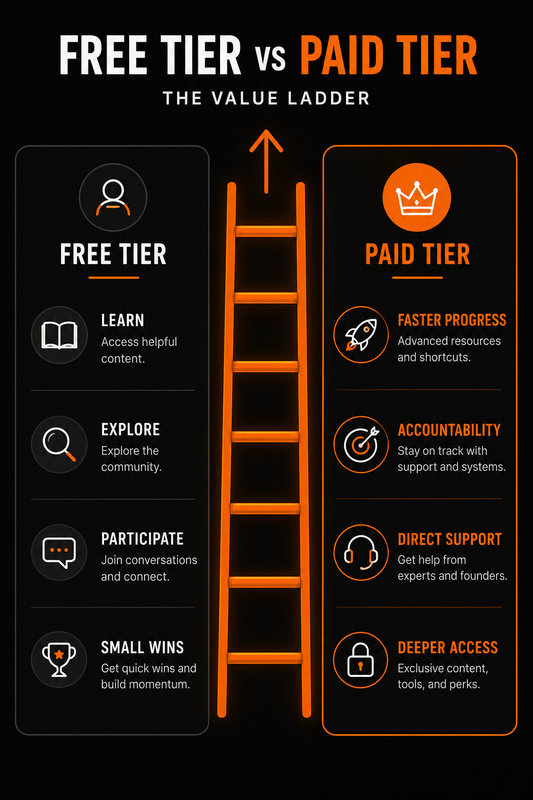
This doesn't mean giving away everything. There should absolutely be meaningful differences between free and paid experiences. The goal isn't making both tiers identical. The goal is making both tiers valuable.
A healthy free tier helps members move forward. A healthy paid tier helps members move forward faster. That's an important difference. Think of the free experience as proof.
- It demonstrates your expertise.
- It demonstrates your community culture.
- It demonstrates the quality of support members can expect.
When done correctly, the free tier becomes one of the strongest sales tools a community can have. Not because it sells. Because it helps.
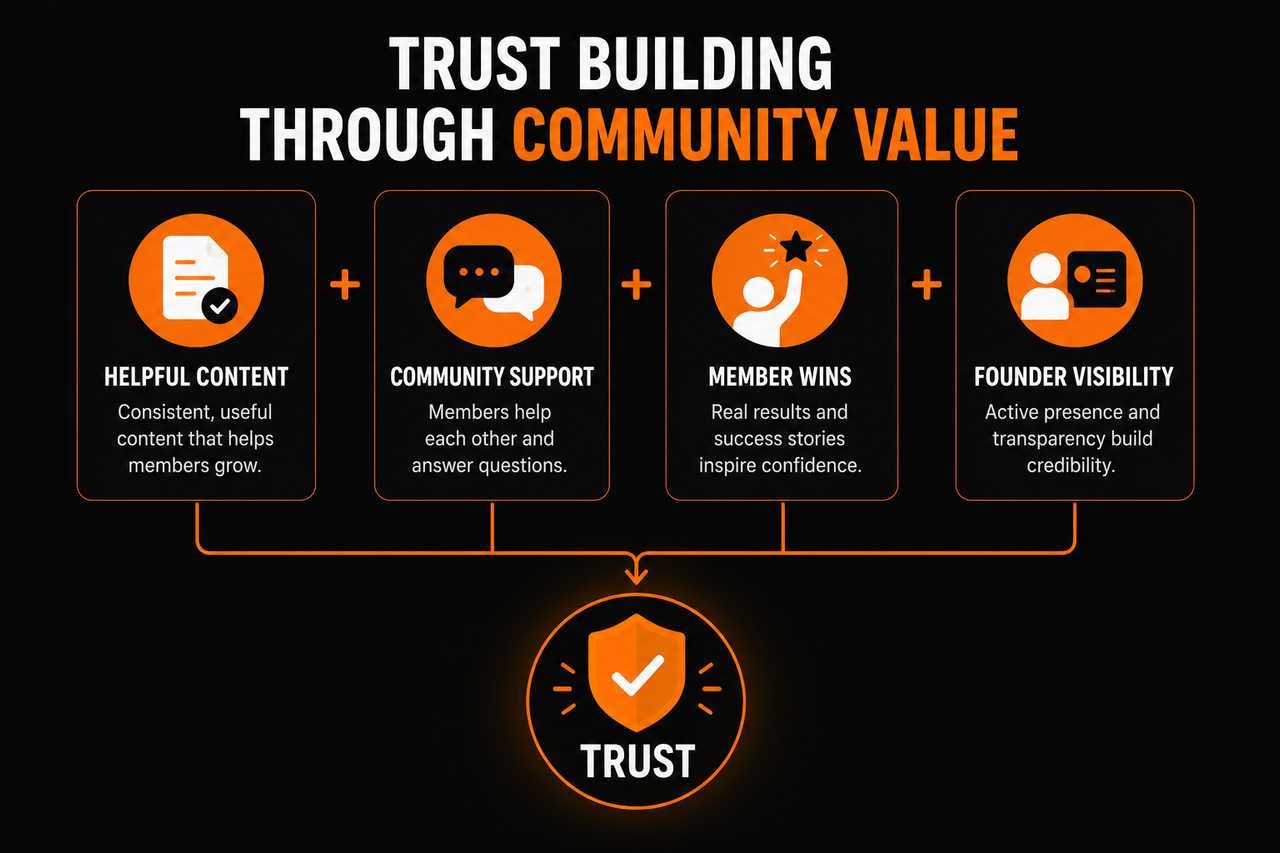
Trust Usually Comes Before Conversion
Many founders think members upgrade because they understand the offer. That's only partially true. People often upgrade because they trust the person behind the offer. This is why founder visibility matters.
If your only interaction with free members is posting announcements, conversions become harder.
- Members don't know you.
- They don't understand how you think.
- They don't feel connected to the community.
Compare that to a founder who:
- Answers questions
- Participates in discussions
- Hosts community calls
- Shares experiences
- Helps members solve problems
Trust develops naturally. Once trust exists, the decision to upgrade becomes significantly easier. This doesn't mean becoming available twenty-four hours a day. It simply means remaining visible.
People are far more likely to invest in communities when they feel connected to the people leading them.
Most Free Members Are Not Saying No
A mistake many community owners make is assuming every non-buyer has rejected the offer. That's rarely true. In many cases, people simply aren't ready yet.
- Maybe they're still evaluating options.
- Maybe they're busy.
- Maybe they're waiting for a better time.
- Maybe they don't currently have the budget.
The important thing to understand is that "not now" and "never" are completely different responses. Treating them the same often costs communities future customers. When someone isn't ready to buy, continue helping them.
- Answer their questions.
- Provide useful resources.
- Point them toward relevant content.
- Help them achieve a small win.
These actions build goodwill. More importantly, they demonstrate that your community is genuinely focused on helping people rather than extracting money from them.
Ironically, some of the highest-quality paid members are people who spent months inside a free community before eventually upgrading.
Relationships Convert Better Than Pitches
Think about the communities you've personally paid for. Chances are you didn't buy because somebody sent ten sales messages.
- You probably bought because you spent time observing the community.
- You saw people getting results.
- You trusted the founder.
- You believed the membership could help you.
In other words, a relationship existed before the transaction happened. The same principle applies inside your own community. The strongest conversions happen when people feel understood, when they feel supported and when they believe upgrading is the logical next step in their journey, not when they're pressured into making a purchase.
This is why community building and conversion are so closely connected. Good communities naturally create trust, trust naturally creates conversions and conversions built on trust tend to produce far better long-term members than conversions built on pressure.
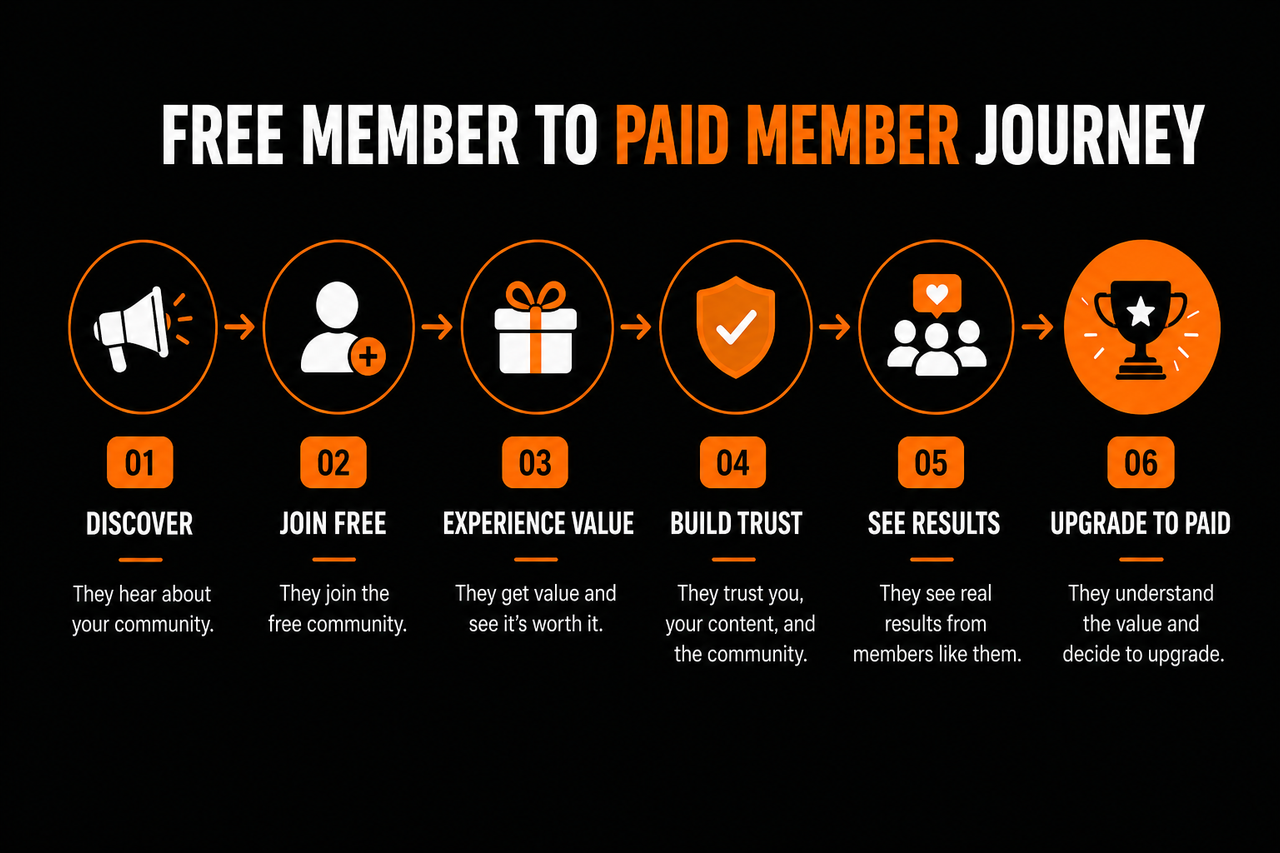
The Free-to-Paid Journey, Step by Step
One of the biggest misconceptions about conversions is that people move from free to paid because they suddenly decide to buy. In reality, conversions are usually the result of a journey.
Very few people discover a community, join it, and immediately pull out their credit card. Most members move through several stages before they ever consider upgrading. The problem is that many community owners only focus on the final stage.
- They think about the sale.
- They think about the payment.
- They think about the subscription.
Meanwhile, the member is still trying to determine whether the community is worth paying attention to.Understanding this journey is important because it changes how you think about conversions. Instead of asking:
How do I get people to buy?
You start asking:
What does somebody need to experience before buying feels natural?
That question usually leads to much better outcomes.
Stage 1: Discovery
Every paid member starts as a stranger. They discover your community through content, social media, referrals, YouTube videos, X posts, newsletters, podcasts, existing members, or simple word of mouth. At this stage, they aren't evaluating your paid offer, they're evaluating your credibility. They're asking questions like:
- Is this community legitimate?
- Do people actually get results here?
- Is the founder trustworthy?
- Is this worth my time?
Most people won't say these questions out loud. They're happening quietly in the background. This is why content matters so much. Long before somebody joins your community, they're often evaluating the people running it. The stronger that initial impression is, the easier the rest of the journey becomes.
Stage 2: Joining the Free Community
The next step is usually joining the free version of the community. This is where many founders immediately make a mistake. They view free members as incomplete customers. People who haven't converted yet or people who need to be sold.
That's the wrong mindset. A free member is still a member. They're trusting you with their time and attention. Those things are valuable.
Treating free members well often creates more future revenue than aggressively pushing them toward a paid plan. The goal at this stage isn't conversion, the goal is creating a positive first experience.
Members should immediately understand:
- What the community is about
- Where to start
- What value exists
- How to participate
- What success looks like
Confusion kills momentum, and clarity creates engagement.
Stage 3: Experiencing a Small Win
One of the fastest ways to increase future conversions is helping people achieve a small win. Not a massive transformation. Not a life-changing breakthrough. Just progress. Something that makes them think:
This was useful.
That small win could come from:
- A useful resource
- A conversation
- A piece of advice
- A community discussion
- A recommendation
- A live event
The specific format doesn't matter. What matters is that the member experiences value directly. This is important because people rarely buy based on promises alone. They buy based on evidence. A small win becomes evidence. It proves the community can help them. Once that happens, future upgrades become much easier.
Stage 4: Building Trust
After experiencing value, members begin paying attention differently.
They're no longer asking:
Is this useful?
Now they're asking:
Can this consistently help me?
Trust begins developing through repeated positive interactions. This is where founder visibility becomes extremely important.
Members notice:
- How questions are answered
- How problems are handled
- How active the community is
- How members treat each other
- Whether promises are actually delivered
Trust isn't built through a single interaction. It's built through consistency. The more consistently members experience value, the stronger that trust becomes.
Stage 5: Building Relationships
At some point, members stop interacting exclusively with the founder. They begin interacting with other members. This is where communities become significantly more powerful. Relationships create emotional investment. People start recognizing familiar names.
- They join conversations.
- They attend events.
- They help others.
- They receive help themselves.
The community begins feeling less like a resource and more like a place they belong. This is an important shift because belonging often increases retention and conversion simultaneously. People are naturally more willing to invest in environments where they feel connected.
Stage 6: Seeing Social Proof
One thing that accelerates conversions dramatically is visibility. Members need to see evidence that the paid experience works. This is where community wins become valuable. Imagine you're a free member. Every week you see people sharing:
- Success stories
- Results
- Milestones
- Testimonials
- Progress updates
Over time, a pattern emerges. You begin realizing that people are genuinely benefiting from the community. That changes how you think about upgrading. The conversation shifts from:
Is this worth paying for?
To:
Could this help me too?
That's a completely different mindset. And it's often where serious buying consideration begins.
Stage 7: Understanding the Paid Experience
A surprising number of communities make the paid offer difficult to understand. Members know a paid tier exists. They just don't know what it actually does. That's a problem. People shouldn't have to investigate your offer like a detective solving a mystery. The upgrade path should be obvious.
Not pushy.
Not aggressive.
Just clear.
Members should understand:
- What exists in the paid tier.
- Who it's designed for.
- What outcomes it helps create.
- Why people upgrade.
- What makes it different from free.
Remember, you're not trying to convince people through pressure. You're trying to help them make an informed decision. Clarity is one of the strongest conversion tools available.
Stage 8: Continued Value
One mistake community owners make is assuming every member should convert quickly. That's rarely true.
- Some people convert in a week.
- Some convert in a month.
- Some convert in six months.
- Some take even longer.
The timeline varies. That's why continuing to provide value matters. If somebody isn't ready to buy today, that doesn't mean they're lost forever.
- Continue helping them.
- Continue supporting them.
- Continue creating opportunities for progress.
The more value members experience, the more likely they are to remember your community when they're ready. A lot of future customers are simply present-day free members who haven't reached the right moment yet.
The Journey Matters More Than the Sale
The strongest communities don't obsess over conversion tactics.
- They focus on member experiences.
- They focus on helping people succeed.
- They focus on reducing friction.
- They focus on building trust.
- They focus on creating progress.
The sale eventually happens because those things were done well. This is why community conversions often feel different from traditional sales. You're not convincing strangers to buy something they don't understand. You're helping people move deeper into an experience they've already benefited from.
The payment is simply one step in a much larger journey. And when viewed through that lens, converting free members becomes significantly easier.
Timing the Ask Without the Pressure
A lot of community owners understand the importance of value, they understand the importance of trust, they understand the importance of relationships, and then they ruin all of it by asking for the sale too aggressively.
This usually doesn't happen because they're trying to be pushy. It happens because they're eager.
- They've built something valuable.
- They know the paid membership can help people.
- They want more members inside.
Unfortunately, good intentions don't always create good outcomes. When every interaction starts feeling like a sales conversation, members notice and once that happens, trust begins to erode.
Not Every Conversation Needs to Lead to a Sale
One of the easiest ways to damage a community is turning every interaction into a conversion opportunity. A member asks a question, you pitch the paid tier. A member shares a problem, you pitch the paid tier. A member joins a discussion, you pitch the paid tier.
Eventually, members stop feeling like people. They start feeling like leads. That's a dangerous place for any community to be. The strongest communities understand that not every conversation needs a commercial outcome.
Sometimes the best thing you can do is simply help.
Answer the question.
Provide the resource.
Point somebody in the right direction.
Offer useful advice.
The immediate result may not be a conversion. The long-term result is trust. And trust tends to convert far better than pressure.
Members Buy When They're Ready
One thing you'll notice when studying successful communities is that conversions often happen unexpectedly. Not because somebody delivered a perfect sales pitch but because the member reached a point where upgrading made sense.
- Maybe they achieved their first win and wanted more support.
- Maybe they attended several community events.
- Maybe they developed relationships with paid members.
- Maybe they saw enough results to feel confident investing further.
Whatever the reason, readiness was the deciding factor. This is why timing matters so much. Trying to force somebody into a decision before they're ready usually creates resistance whereas helping them become ready creates momentum. Those are very different experiences.
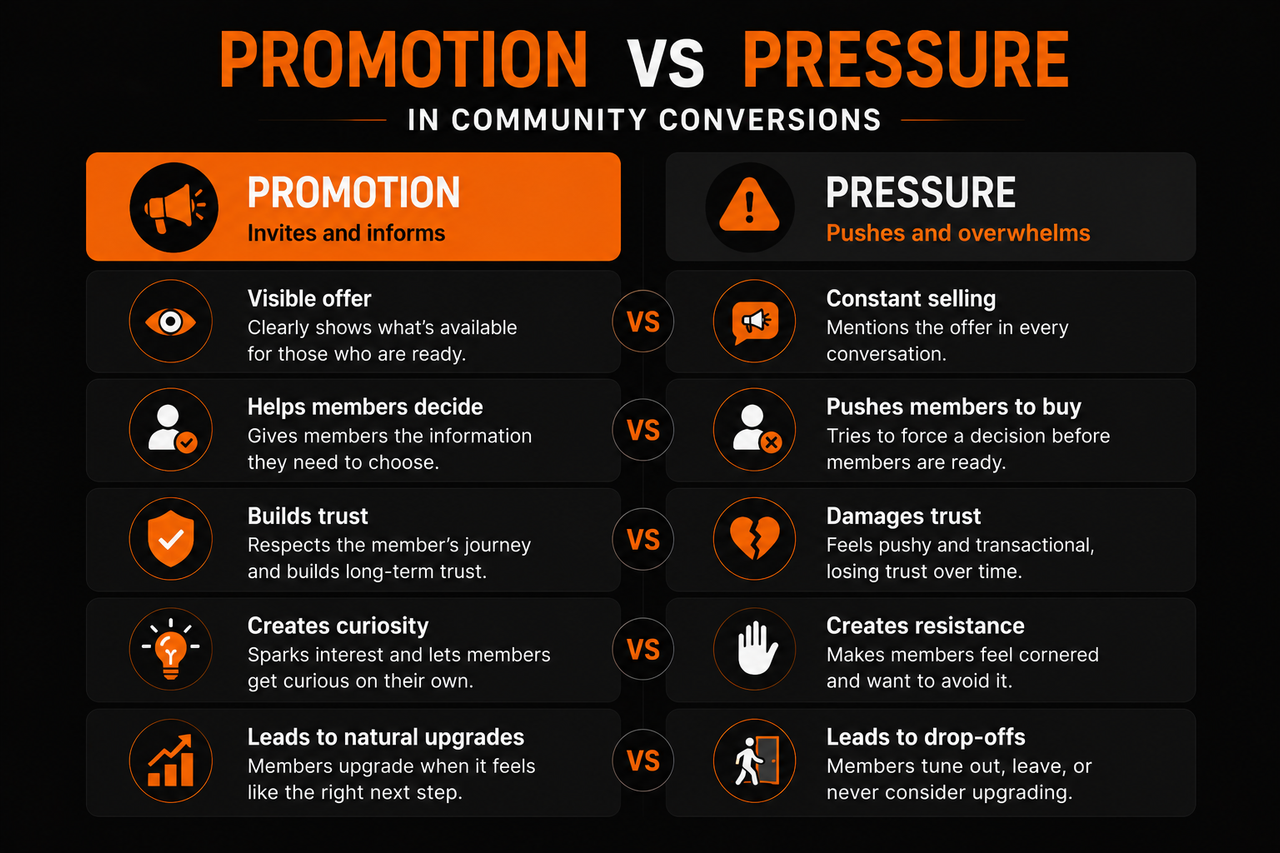
The Difference Between Promotion and Pressure
Community owners sometimes avoid mentioning paid offers altogether because they're worried about sounding salesy. That's also a mistake. Members can't upgrade into something they don't know exists.
The solution isn't avoiding promotion.
The solution is promoting responsibly.
Promotion says:
Here's an opportunity that might help you.
Pressure says:
You need to buy this right now.
Members respond very differently to those approaches. A healthy community makes the paid offer visible without making it unavoidable. People should understand what exists, they shouldn't feel chased by it.
Let Curiosity Do Some of the Work
One of the most effective conversion mechanisms inside a community is curiosity. People naturally become interested in things that appear valuable. This is why visible member success matters so much. When free members consistently see:
- Valuable discussions
- Positive experiences
- Member wins
- Helpful interactions
- Successful outcomes
They become curious, and they begin wondering:
What exactly is happening inside the paid side?
That curiosity often creates stronger buying intent than any direct sales message ever could. Instead of trying to convince people, you're allowing them to discover reasons to upgrade on their own. The result feels significantly more natural.
Give Members a Clear Upgrade Path
While pressure hurts conversions, confusion hurts them too. A surprising number of communities make upgrading more difficult than it needs to be. Members aren't sure:
- Where to upgrade
- What happens after upgrading
- What benefits they'll receive
- Whether the offer is right for them
This uncertainty creates friction. And friction kills conversions. The solution isn't more persuasion. It's more clarity.
People should immediately understand:
- What the paid membership includes.
- Who it's designed for.
- What outcomes it helps create.
- How to join.
Simple offers often outperform complicated ones because they're easier to understand.
Use Promotions Sparingly
Promotions can absolutely help increase conversions. The problem is that many communities use them too frequently. When discounts become permanent, they stop feeling like opportunities. Members quickly learn that another promotion is always around the corner.
Urgency disappears.
This is why limited-time promotions work best when they're used intentionally. Examples include:
- Community anniversaries
- Seasonal promotions
- Launch periods
- Special events
- Milestone celebrations
These moments create legitimate reasons to run an offer. More importantly, they create a natural deadline. Deadlines matter because they encourage action and without them, many people continue delaying decisions indefinitely.
Urgency Should Be Real
One mistake worth avoiding is artificial urgency. Members are becoming increasingly good at recognizing manufactured scarcity. If every promotion claims to be the last chance ever, people stop believing it. Trust suffers. Real urgency comes from genuine circumstances, for example:
- A promotion ending on a specific date
- Founder pricing for early members
- Limited event access
- Seasonal discounts
- Launch offers
These opportunities feel credible because they have legitimate boundaries. The goal isn't creating panic. The goal is helping people make decisions instead of endlessly postponing them.
Sometimes the Best Response Is More Value
A member expresses interest.
- They ask questions.
- They clearly like the community.
- Then they tell you they can't buy right now.
What happens next matters. Many founders immediately stop investing attention in that person.
That's a mistake.
If somebody isn't ready to buy, continue helping them. Share a useful resource. Answer their question. Point them toward something valuable. Help them solve a problem.
These moments often create long-term loyalty. People remember who helped them when there was nothing to gain from doing so. Ironically, many future customers are created during these interactions. Not because they were sold to. Because they were supported.
Good Communities Play the Long Game
A recurring theme throughout this article is patience. That's because communities operate differently from traditional sales funnels. The goal isn't maximizing conversions this week , the goal is building relationships that continue creating value over time. Some members upgrade immediately while others need months. Some might leave and come back later. Some may recommend the community to somebody else before becoming paying members themselves.
All of these outcomes are possible when relationships are prioritized. Communities that focus exclusively on short-term conversions often damage the trust that drives long-term growth. Communities that focus on helping people tend to benefit from both.
Conversion Should Feel Like the Next Step
When everything is working correctly, upgrading doesn't feel like a sales event. It feels like progression. The member understands the value.
- They trust the founder.
- They've experienced wins.
- They've built relationships.
- They know what exists behind the paywall.
At that point, the decision feels obvious.
Not because somebody convinced them. Because the next step makes sense. And those are usually the best conversions a community can earn.
Letting the Value Do the Convincing
A lot of community owners spend their time looking for better sales tactics.
- Better copy.
- Better promotions.
- Better funnels.
- Better conversion rates.
While those things can help, the strongest communities often grow in a completely different way. They make the value so visible that members begin convincing themselves.
This is an important distinction.
People naturally trust their own conclusions more than somebody else's sales pitch.
When members repeatedly see evidence that a community is helping people achieve results, they start imagining what those results could look like for themselves.
That shift is powerful, because now the conversation is no longer:
Should I buy this?
It's:
Am I ready to take advantage of this?
Member Wins Are More Powerful Than Marketing
One reason member wins are so valuable is because they're difficult to fake. A landing page can make promises, a sales message can make claims. A member sharing a genuine result carries a completely different level of credibility. People pay attention when they see real outcomes. Not because they're impressed by the achievement itself. Because they're looking for proof.
- Proof that the system works.
- Proof that people are succeeding.
- Proof that the community creates value.
This is why member wins should be visible whenever possible. Not in a forced way, not in a way that feels promotional. Simply as part of the community culture.
When somebody achieves something meaningful, celebrate it. Let people see what's possible.
Success Creates Momentum
Success has a habit of creating more success. When members see others making progress, they often become more engaged themselves. A member lands a new client, someone else decides to take action. A member reaches a milestone, others begin pursuing their own goals. A member shares a breakthrough, the conversation inspires additional participation.
These moments create momentum. More importantly, they create belief. People become far more likely to invest in communities when they can clearly see outcomes being produced. The strongest communities understand this. They don't hide member success stories. They highlight them.
Social Proof Should Be Natural
When people hear the phrase "social proof" they often think about testimonials. Testimonials can absolutely help.
But social proof inside a community goes much deeper than that. Social proof can include:
- Member wins
- Success stories
- Community discussions
- Event participation
- Accountability updates
- Shared experiences
- Helpful conversations
Every time a member sees evidence of value, social proof is being created. The important thing is authenticity. People can usually tell the difference between genuine community activity and manufactured marketing.
Authenticity builds trust.
Artificiality damages it.
The goal isn't creating marketing material. The goal is allowing members to see what naturally happens inside the community.
Show the Outcome, Not Just the Offer
One reason some communities struggle to convert members is because they spend too much time talking about the offer itself. The offer matters, but the outcome matters more.
For example, imagine two founders describing the exact same membership. The first founder says:
You get weekly calls, exclusive resources, private channels, and direct access.
The second founder says:
Members use these calls and resources to stay accountable, get feedback faster, and avoid common mistakes that slow progress.
Both descriptions are technically accurate but only one focuses on the result. People don't join communities because they want more channels. They join because they want a better outcome. The clearer that outcome becomes, the easier conversion becomes.
Make Paid Members Visible
One of the easiest ways to strengthen the free-to-paid journey is ensuring free members can see the benefits paid members are experiencing. This doesn't mean constantly telling people to upgrade. It means creating visibility, for example:
- Share member wins.
- Highlight community achievements.
- Celebrate milestones.
- Showcase event takeaways.
- Share success stories.
Over time, free members begin seeing patterns.
- They notice people progressing.
- They notice people remaining active.
- They notice people staying subscribed.
Eventually, many begin asking themselves an important question:
What are these members doing differently?
That's often where genuine buying interest starts.
A Great Community Doesn't Need to Hide Its Value
Some founders believe the best way to increase conversions is hiding everything valuable behind a paywall.
The logic seems reasonable.
If people can't access value for free, they'll have to pay for it. In practice, this often creates the opposite effect. People become hesitant to buy because they haven't seen enough evidence. The strongest communities operate differently. They allow members to experience value before asking for a commitment.
- The paid experience remains better.
- The paid experience remains deeper.
- The paid experience remains more effective.
But the free experience still demonstrates competence.
- It still creates progress.
- It still helps people move forward.
This reduces uncertainty and makes future upgrades feel significantly safer.
Every Positive Experience Compounds
One reason community conversions often outperform traditional sales funnels is because members experience value repeatedly.
- A helpful discussion.
- A useful resource.
- A productive event.
- A meaningful conversation.
- A useful piece of feedback.
Individually, these experiences may seem small. Collectively, they become powerful.
- Every positive interaction increases confidence.
- Every positive interaction strengthens trust.
- Every positive interaction makes upgrading feel more reasonable.
This is why successful community owners focus so heavily on member experience. They're not trying to create one perfect sales moment. They're creating dozens of valuable moments.
The conversion becomes a natural result of those experiences accumulating over time.
Focus on Helping First
If there's one theme that runs through every successful community, it's this: The communities that help the most often sell the most.
Not immediately.
Not overnight.
But consistently.
People gravitate toward communities that genuinely improve their situation. They remember communities that helped them solve problems, they recommend communities that created value. And when they're finally ready to invest further, they usually invest where trust already exists. That's why the best conversion strategy often looks surprisingly simple.
Help people.
Create progress.
Build relationships.
Stay visible.
Celebrate wins.
Listen to feedback.
The rest tends to follow.
Final Thoughts
Free members do not become paid members because they were pressured. They become paid members because they experienced enough value to believe the investment makes sense. That's an important distinction.
The goal isn't convincing people to buy something they don't need.
The goal is helping people understand how the paid experience can help them reach their goals faster, more effectively, or with greater support.
When communities focus exclusively on sales tactics, conversions often suffer. When communities focus on helping members succeed, conversions become significantly easier. The strongest communities understand that the free-to-paid journey is a relationship.
It starts with trust.
It grows through value.
It develops through consistent positive experiences.
And eventually, for the right members, it leads to a purchase.
Not because they were sold to, but because they decided it was the right next step.