

How to Use Lead Magnets to Grow a Community
Growing a community is often described as a marketing problem.
People focus on reaching more viewers, publishing more content, running more advertisements, or posting more frequently on social media.
Those activities certainly help people discover your work.
But discovery alone doesn't build a community.
A community grows when the right people choose to become part of it.
That distinction is important.
Large audiences don't automatically become active communities.
Thousands of followers don't guarantee meaningful discussions.
Hundreds of website visitors don't necessarily become paying members.
Before someone joins your community, they usually need a reason to trust you.
They need to experience your expertise.
They need to believe that becoming part of your community will genuinely help them achieve something they care about.
This is where lead magnets become valuable.
A lead magnet is a free piece of value offered in exchange for a small commitment, such as an email address or joining a free community.
That value might be:
- A checklist.
- A template.
- A guide.
- A resource library.
- A workshop.
- A mini course.
- A toolkit.
On the surface, lead magnets appear to be simple marketing tools.
In reality, they're much more than that.
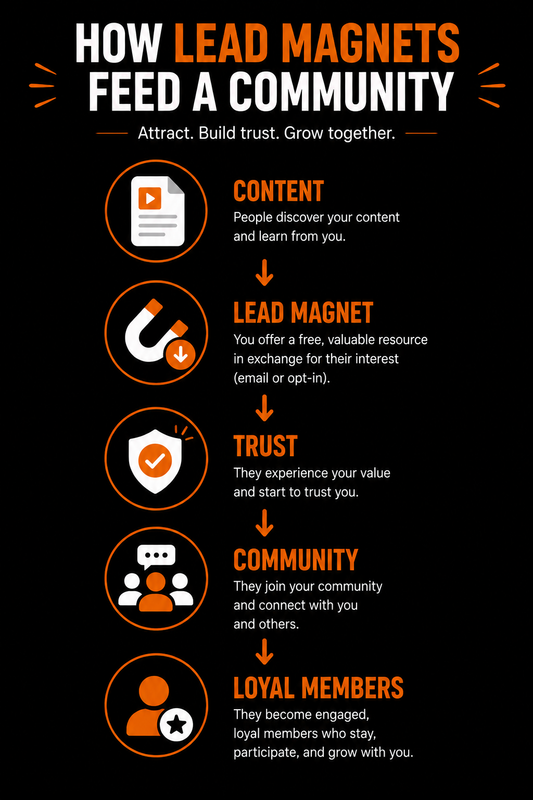
A good lead magnet acts as the bridge between discovering your content and becoming an engaged community member.
Instead of asking people to immediately purchase a membership, you're giving them an opportunity to experience your approach, solve a small problem, and begin building trust.
That makes the transition into a community feel natural rather than forced.
The best lead magnets don't try to convince everyone to join.
They help the right people realize they're in the right place.
This article explores how lead magnets support community growth, what makes one genuinely valuable, how they connect with your onboarding process, and how to measure whether they're attracting the people you actually want inside your community.
What Lead Magnets Do for a Community
Many people associate lead magnets with email marketing.
Download a PDF.
Receive a newsletter.
Eventually receive promotional emails.
While that approach still exists, communities benefit from lead magnets in a slightly different way.
Rather than simply generating leads, they help qualify future members.
Every community has an ideal member.
Someone who genuinely wants the outcome your community helps people achieve.
Someone who enjoys participating.
Someone who benefits from conversations with other members.
Someone likely to remain involved over time.
Lead magnets help those people identify themselves.
Instead of asking strangers to immediately commit to a membership, you're giving them an opportunity to experience a small part of the value first.
That creates a much healthier starting point for the relationship.
Trust Before Commitment
Joining a paid community requires trust.
People aren't simply purchasing access.
They're investing their time.
They're choosing to become part of a group.
They're deciding whether your guidance, resources, or members are worth engaging with.
For someone who has only recently discovered your work, that's a significant decision.
Lead magnets reduce that uncertainty.
Imagine discovering two creators teaching the same subject.
The first immediately asks you to purchase a monthly membership.
The second offers a practical checklist that helps you solve one small problem today.
Which creator feels easier to trust?
Most people naturally choose the second.
Not because the checklist is particularly valuable on its own.
Because receiving useful help before being asked for anything creates confidence.
Lead magnets shift the relationship from:
"Please buy my community."
to:
"Here's something useful. If you find it valuable, there's much more inside the community."
That feels significantly more authentic.
They Filter the Right Audience
One misconception about lead magnets is that their purpose is attracting as many people as possible.
In reality, the opposite is often true.
A successful lead magnet attracts the right people.
Imagine a paid community for freelance designers.
Offering a generic productivity checklist might generate thousands of downloads.
But many of those people may have little interest in freelancing or design.
Now imagine offering:
"The Freelance Client Proposal Template That Helped Me Close My First 20 Projects."
The audience immediately becomes more focused.
People downloading that resource are far more likely to share the same goals as the community itself.
This matters because communities thrive when members have common interests.
Lead magnets should therefore qualify future members rather than simply increasing traffic.
Quality almost always matters more than quantity.
Solve One Specific Problem
Many creators attempt to fit everything they know into one enormous free guide.
The result is usually overwhelming.
A better lead magnet solves one clear problem.
Examples include:
- A creator teaching YouTube growth offers a thumbnail checklist.
- A fitness coach shares a beginner workout plan.
- A business consultant provides a pricing calculator.
- A community for writers publishes a content planning template.
Each resource delivers one quick win.
That matters because small successes build trust.
People don't need to experience your entire methodology immediately.
They simply need enough value to believe your approach works.
The paid community can then expand on that foundation.
Give Away the "What," Keep the "Journey"
Some creators worry that free resources will reduce paid memberships.
"If I explain everything for free, why would anyone join?"
In practice, communities rarely succeed because they hide information.
People don't usually join paid communities because information is unavailable elsewhere.
They join because they want:
- Structure.
- Accountability.
- Feedback.
- Support.
- Relationships.
- Consistency.
A lead magnet can comfortably explain what someone should do.
The community helps them actually do it.
For example:
A free guide might explain the five stages of launching a newsletter.
Inside the community, members receive feedback, answer questions together, share progress, and learn from people implementing the same framework.
The lead magnet introduces the destination.
The community supports the journey.
Every Piece of Content Can Become a Lead Magnet
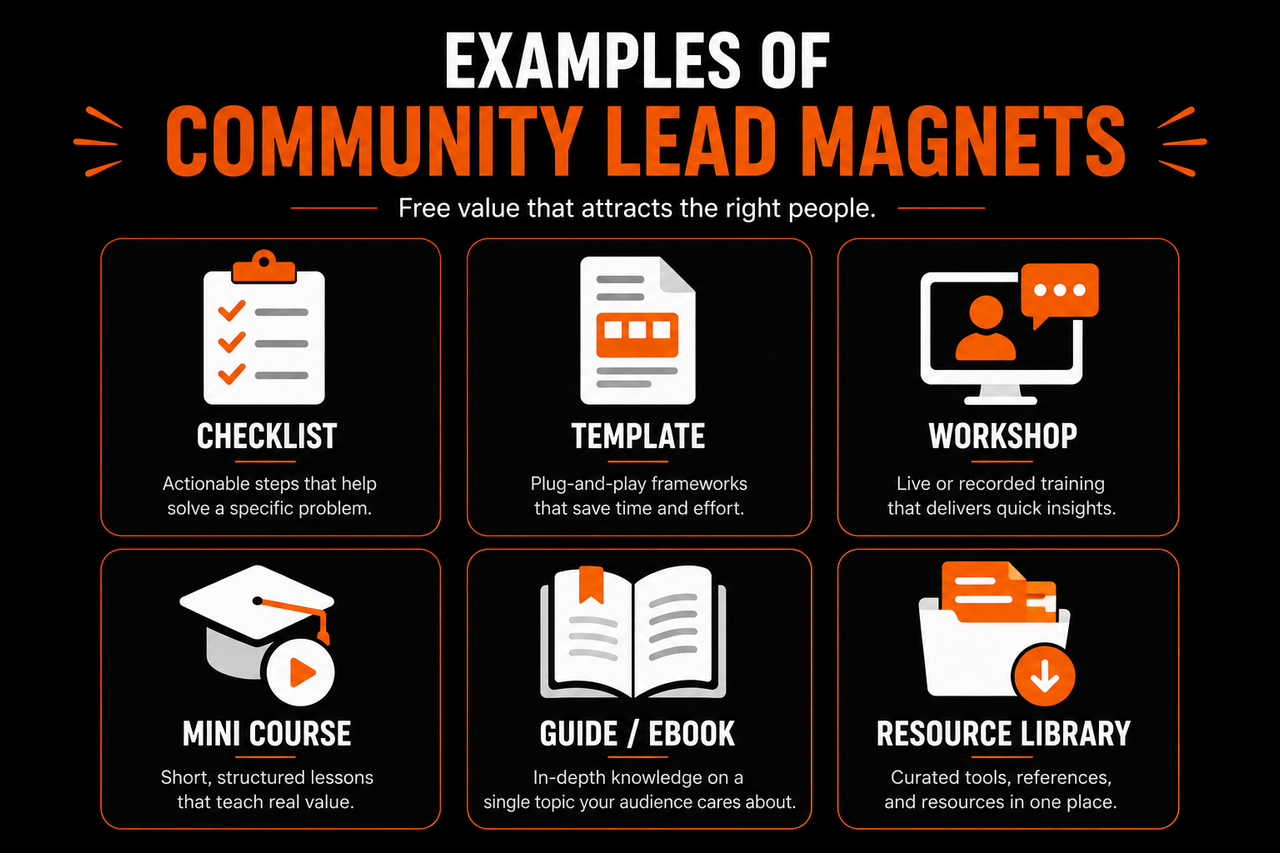
One mistake is thinking lead magnets must always be downloadable PDFs.
Today's communities use many different formats.
For example:
- Interactive calculators.
- Live webinars.
- Email challenges.
- Templates.
- Swipe files.
- Mini courses.
- Video tutorials.
- Community workshops.
- Resource libraries.
The format matters much less than the outcome.
Ask yourself:
What small problem can I help someone solve in the next fifteen minutes?
That answer often becomes a much stronger lead magnet than a lengthy ebook few people finish reading.
People appreciate resources that create immediate progress.
Your Lead Magnet Should Match Your Community
One of the strongest indicators of a successful lead magnet is how naturally it connects with your community.
Imagine a paid community focused on building online businesses.
Offering a free social media calendar makes sense because it introduces topics members will continue exploring later.
Offering a generic recipe book does not.
The closer the lead magnet aligns with your community's purpose, the easier the transition becomes.
Members shouldn't feel like they're entering a completely different world after joining.
Instead, the lead magnet should feel like the first chapter of a much larger experience.
That continuity creates stronger expectations and attracts members who genuinely care about what the community offers.
Think Beyond Email Collection
It's easy to measure lead magnets by the number of email addresses they generate.
While email capture is useful, it shouldn't become the primary objective.
A lead magnet should create momentum.
It should encourage people to continue learning.
To explore more resources.
To participate.
To eventually become part of your community because doing so feels like the obvious next step.
When viewed this way, lead magnets become much more than marketing assets.
They're the beginning of a relationship.
They're the first meaningful interaction many future members will have with your brand.
The better that first experience is, the easier every step that follows becomes.
The next challenge is deciding what kind of lead magnet actually attracts those future members instead of simply generating large numbers of downloads.
Lead Magnets That Attract the Right People
Not every lead magnet grows a community.
Some generate thousands of downloads without producing a single engaged member.
Others attract fewer people but consistently bring in members who participate, contribute, and eventually become paying customers.
The difference is rarely the design.
It isn't the number of pages.
It isn't whether the resource is a PDF, video, or template.
The difference is usually who the lead magnet is designed to attract.
Many creators make the mistake of optimizing for volume.
They ask:
"How can I get as many people as possible to download this?"
A better question is:
"How can I attract the people my community is built for?"
Communities are not social media platforms.
Success isn't determined by reaching everyone.
It's determined by bringing together people who share similar goals, interests, and motivations.
A lead magnet should therefore act as a filter just as much as it acts as a source of value.
Start With the Problem Your Community Solves
Every successful community exists because it helps people move from one situation to another.
Someone wants to:
- Build a business.
- Learn a skill.
- Improve their health.
- Grow an audience.
- Find accountability.
- Meet people with similar interests.
That outcome should shape your lead magnet.
Instead of brainstorming free resources first, begin by asking:
What problem convinces someone they need this community?
For example, imagine your paid community helps freelancers build sustainable businesses.
People rarely wake up thinking:
"I need another Discord server."
They think:
- I can't find clients.
- I don't know what to charge.
- My proposals aren't converting.
- I feel like I'm figuring everything out alone.
Those are real problems.
A lead magnet that helps solve one of them naturally attracts people who are likely to benefit from the community itself.
The closer the lead magnet aligns with your community's core purpose, the higher the quality of members it will attract.
Focus on Immediate Wins
One reason lead magnets work so well is because they create momentum.
Someone downloads a resource.
They apply it.
They see progress.
That progress builds confidence.
If the lead magnet promises a massive transformation, most people never finish it.
A 120-page ebook may contain incredible information, but many readers won't make it past the first chapter.
Compare that with:
- A one-page checklist.
- A pricing calculator.
- A proposal template.
- A content planning worksheet.
- A five-day email challenge.
These resources are easy to consume.
More importantly, they're easy to use.
People experience value quickly.
That first success makes them much more open to continuing the journey inside your community.
Small wins create curiosity.
Curiosity creates engagement.
Engagement eventually leads to commitment.
Make the Resource Practical
Information is everywhere.
People can watch tutorials, search forums, or ask AI assistants almost instantly.
Simply providing more information is rarely enough.
Instead, think about creating resources people can immediately put into practice.
For example:
Instead of:
"The Ultimate Guide to Productivity"
Create:
"Weekly Planning Template for Solo Creators."
Instead of:
"Everything You Need to Know About Content Marketing"
Create:
"30 Content Hooks You Can Copy Today."
Instead of explaining concepts, help people take action.
Communities naturally become more valuable when members arrive having already experienced a practical result from your work.
Match the Format to the Audience
Different audiences prefer different ways of learning.
Some communities naturally respond to downloadable templates.
Others engage more with live workshops.
Some audiences enjoy short email courses.
Others prefer interactive tools.
The important question isn't:
"Which format converts best?"
It's:
"Which format helps my audience achieve a quick result?"
A business community might benefit from calculators, proposal templates, or financial spreadsheets.
A design community may appreciate editable design files.
A fitness community might prefer workout plans or meal trackers.
The format should support the outcome rather than becoming the focus itself.
Don't Give Away Everything
There is a common fear among creators that giving away too much value will reduce paid memberships.
In reality, most communities are not built around exclusive information.
They're built around implementation.
Think about learning to play the guitar.
You can find almost every technique online for free.
Yet millions of people still purchase courses, coaching, and memberships.
Why?
Because information alone rarely creates progress.
People need:
- Structure.
- Accountability.
- Feedback.
- Community.
- Consistency.
A lead magnet can solve a meaningful problem while naturally leading into deeper support.
For example:
A free checklist might help someone launch their first newsletter.
The community helps them publish consistently, receive feedback, improve their writing, and stay accountable over the following months.
The free resource demonstrates expertise.
The community supports long-term growth.
Those two experiences complement each other instead of competing.
Create a Natural Next Step
One weakness of many lead magnets is that they end too early.
Someone downloads the resource.
They finish reading it.
Nothing happens next.
The relationship simply stops.
A stronger lead magnet naturally points toward another stage.
Perhaps it recommends joining a free community.
Perhaps it introduces a beginner challenge.
Perhaps it invites readers to a live workshop.
Perhaps it encourages them to continue learning through your paid membership.
The transition shouldn't feel like a sales pitch.
It should feel like the obvious continuation.
Imagine reading a guide that solves one problem while introducing three new questions.
Joining the community suddenly feels logical because it's where those questions are answered.
The lead magnet hasn't forced anyone into the community.
It has simply shown them why continuing makes sense.
Every Lead Magnet Shapes Expectations
Something many creators overlook is that lead magnets don't only attract people.
They also communicate what your community is like.
A polished workbook suggests structure.
A live workshop suggests interaction.
A detailed template suggests practicality.
A challenge suggests accountability.
People begin forming expectations before they ever join.
Those expectations should match the actual community experience.
If your lead magnet promises intensive coaching but the community is primarily self-paced, new members may feel disappointed.
Likewise, if your free resource emphasizes collaboration, the community should genuinely encourage member interaction.
Consistency between the lead magnet and the community builds trust.
Think Long-Term, Not Viral
It's tempting to chase lead magnets that generate huge spikes of attention.
A viral template.
A trending AI prompt.
A downloadable resource tied to the latest platform update.
While these can produce impressive numbers, they often attract people interested only in that specific trend.
Communities benefit more from evergreen resources.
Problems like:
- Finding clients.
- Staying consistent.
- Building habits.
- Learning new skills.
- Improving workflows.
- Growing a business.
These challenges remain relevant year after year.
Lead magnets built around enduring problems continue attracting qualified members long after they're published.
That makes them valuable assets rather than short-term marketing campaigns.
The Best Lead Magnets Start Relationships
Ultimately, a lead magnet should never feel like a transaction.
Someone doesn't exchange an email address for a PDF.
They begin a relationship with your brand.
The resource demonstrates your teaching style.
It shows the quality of your thinking.
It helps someone achieve a meaningful result.
Most importantly, it establishes trust before any purchase is involved.
That trust is what makes communities grow sustainably.
Because joining no longer feels like taking a risk.
It feels like continuing a journey that has already begun.
The next step is making sure that journey doesn't stop after someone downloads your lead magnet.
Once they've experienced that first win, they need a clear path into your community—one that welcomes them, builds momentum, and helps them become active members instead of passive subscribers.
Handing Off Into Onboarding
A lead magnet has done its job when someone experiences value.
But that doesn't automatically mean they've become part of your community.
This is where many creators unknowingly lose potential members.
Someone downloads a guide.
They complete a workshop.
They save a template.
Then... nothing.
No next step.
No follow-up.
No introduction to the community.
The relationship quietly ends before it has a chance to grow.
A successful lead magnet isn't the finish line.
It's the beginning of a journey.
The transition from free resource to community should feel natural, not like switching between two completely different experiences.
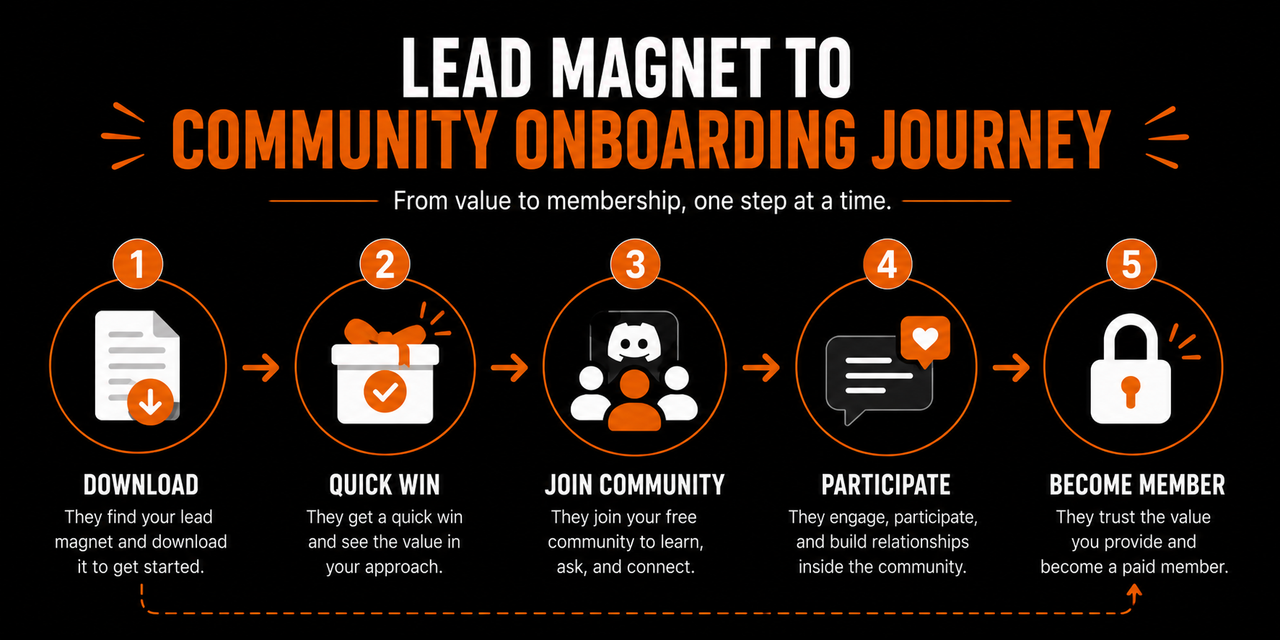
Instead of thinking about lead magnets and onboarding as separate systems, think of them as two parts of the same member journey.
The lead magnet creates trust.
Onboarding builds on it.
Momentum Is Strongest Immediately After Value
Think about the moment someone finishes your lead magnet.
They've just solved a problem.
They've experienced a small success.
They're motivated.
This is exactly when people are most open to taking the next step.
Unfortunately, many creators wait too long.
They might send another email a week later.
Or hope the person remembers to revisit the website.
By then, the momentum has disappeared.
Good onboarding begins while excitement is still high.
That doesn't mean immediately asking someone to buy.
It means continuing to help them.
Perhaps they receive another useful resource.
Perhaps they're invited into a free community.
Perhaps they're shown how others have applied the same framework.
The important thing is maintaining progress.
People naturally continue moving forward when each step builds on the last one.
Give People One Clear Next Step
One mistake many creators make is presenting too many options after the lead magnet.
Someone downloads a checklist and immediately sees:
- Join the Discord server.
- Subscribe to the newsletter.
- Watch a webinar.
- Follow on YouTube.
- Book a consultation.
- Read the blog.
- Buy the course.
- Upgrade to the membership.
Every option may be valuable.
Together, they become overwhelming.
Instead, ask yourself:
What is the single best next step for someone who just completed this lead magnet?
For community-focused businesses, the answer is often straightforward:
Join the community.
Not because you're trying to make a sale.
Because the community is where someone can continue making progress.
Reducing decisions makes taking action easier.
Make Joining Feel Like a Continuation
The handoff should never feel like moving into a completely different experience.
Imagine downloading a guide about growing a newsletter.
Inside the guide, readers see examples taken directly from discussions inside your community.
Members are mentioned naturally.
Community conversations are referenced.
At the end, readers are invited to continue those conversations themselves.
Joining now feels logical.
They're simply continuing something they've already started.
Compare that with a completely unrelated sales page appearing immediately after the download.
The transition feels abrupt.
The relationship changes too quickly.
Good onboarding avoids that disconnect.
Every step should feel like the next chapter rather than a completely new story.
Remove Friction From the Process
Every additional step gives people another opportunity to leave.
Imagine this onboarding journey:
Download guide.
Verify email.
Visit another website.
Create an account.
Confirm account.
Join Discord.
Connect Discord.
Accept invite.
Read instructions.
Assign roles.
Introduce yourself.
Find the right channels.
While none of these tasks are individually difficult, together they create significant friction.
The smoother the transition, the more people complete it.
Ask yourself:
- Can unnecessary forms be removed?
- Can invitations be clearer?
- Can setup instructions be simplified?
- Can the first action inside the community be obvious?
Small improvements at each stage often produce much better conversion rates than creating entirely new lead magnets.
The First Few Minutes Matter Most
Joining a community is a very different experience from downloading a resource.
Inside the community, people immediately begin forming opinions.
They notice:
- Whether conversations are active.
- Whether navigation is clear.
- Whether people are welcoming.
- Whether the environment feels organized.
- Whether they know what to do next.
Those first impressions shape whether someone continues participating.
A confusing onboarding experience can undo the trust your lead magnet worked so hard to build.
That's why onboarding should focus on helping members achieve one early success.
Perhaps they introduce themselves.
Perhaps they download another useful resource.
Perhaps they ask their first question.
Perhaps they attend an upcoming event.
Small interactions build confidence.
Confidence encourages participation.
Participation builds long-term engagement.
Keep Helping Instead of Selling
Many creators worry about converting leads into paying members.
That concern often causes onboarding to become overly promotional.
Every email promotes the membership.
Every message highlights pricing.
Every interaction points toward upgrading.
Ironically, this usually slows conversion.
People rarely join communities because they're repeatedly told to.
They join because they continue receiving value.
Instead of asking:
"How do we convince people to buy?"
Ask:
"How do we keep helping them?"
That mindset completely changes onboarding.
The focus shifts toward education.
Encouragement.
Small wins.
Useful conversations.
When members consistently experience progress, upgrading often feels like their own decision rather than the result of persuasion.
Different People Move at Different Speeds
Not everyone joins your paid community immediately.
Some people download a lead magnet today and become members tomorrow.
Others spend months reading newsletters, watching videos, and participating in a free community before deciding they're ready.
Both journeys are perfectly normal.
The mistake is expecting everyone to follow the same timeline.
Good onboarding respects individual pace.
Some members simply need more time to build confidence.
Others need to solve another problem first.
Some want to observe before participating.
That doesn't mean the lead magnet failed.
It simply means the relationship is still developing.
Communities grow sustainably when they allow trust to develop naturally instead of forcing urgency at every opportunity.
Use Automation to Maintain Consistency
As communities grow, manually guiding every new lead becomes unrealistic.
Automation can help ensure every person receives a consistent experience.
For example:
Someone downloads a template.
They receive a welcome email.
A few days later they're introduced to another useful resource.
Next they're invited to join the community.
Later they receive examples of member success stories.
Finally they're encouraged to explore the paid membership if it aligns with their goals.
Notice that this sequence doesn't feel aggressive.
It simply continues delivering value.
Automation isn't replacing relationships.
It's making sure everyone receives the same thoughtful introduction regardless of when they entered your ecosystem.
Onboarding Doesn't End After Someone Joins
One of the biggest misconceptions about onboarding is that it ends the moment someone enters the community.
In reality, joining is simply the beginning.
People still need to:
- Find useful conversations.
- Meet other members.
- Understand community culture.
- Discover resources.
- Attend events.
- Build habits around participation.
The stronger your onboarding process, the more likely members are to become regular contributors instead of silent observers.
Lead magnets begin the relationship.
Onboarding strengthens it.
Community experiences sustain it.
Together, they create a continuous journey instead of isolated interactions.
The final piece is understanding whether that journey is actually working.
It's not enough to know how many people downloaded your lead magnet.
You also need to understand how many became engaged community members, how many eventually converted into paying members, and where people tend to drop off along the way.
Those insights allow you to improve the entire growth system rather than relying on guesswork.
Measuring What Converts
Creating a lead magnet is only the first step.
Getting people to download it is the second.
But neither of those automatically grows a community.
The real question is much simpler:
Does your lead magnet attract people who eventually become engaged community members?
Many creators celebrate download numbers.
A guide receives five thousand downloads.
A template goes viral.
An email list grows rapidly.
Those numbers certainly feel encouraging.
However, they don't necessarily tell you whether your community is growing in a meaningful way.
Imagine two lead magnets.
The first generates 10,000 downloads.
Only 20 people ever join the community.
The second generates 500 downloads.
One hundred people become active community members.
Which one performed better?
From a community-building perspective, the answer is obvious.
The goal isn't collecting leads.
The goal is attracting future members.
That's why measuring the right metrics matters far more than chasing impressive-looking numbers.
Start With the Entire Journey
One of the biggest mistakes creators make is measuring only the first conversion.
Someone downloads a resource.
Success.
But that only measures the beginning of the relationship.
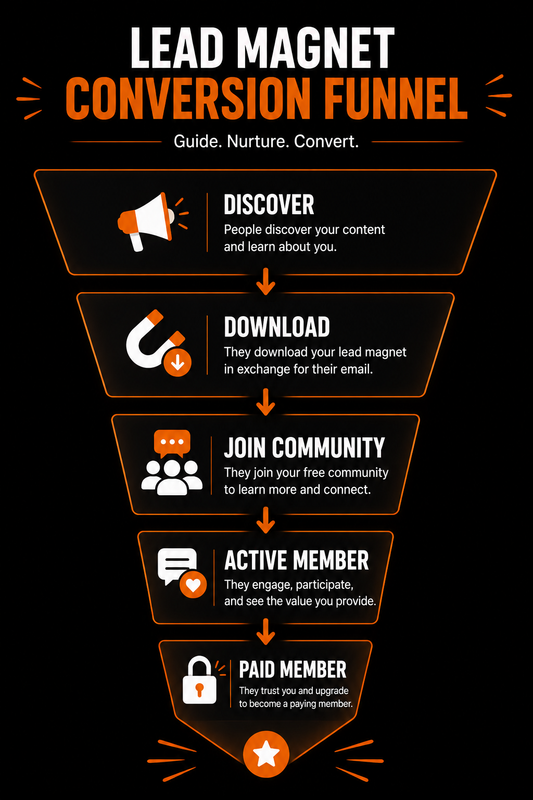
Instead, think of your lead magnet as the first stage in a larger funnel.
For example:
- Someone discovers your content.
- They download a lead magnet.
- They receive follow-up emails.
- They join your free community.
- They begin participating.
- They become a paying member.
- They renew their membership.
Looking at the entire journey provides much more useful information than focusing on a single step.
It helps answer questions like:
- Where are people dropping off?
- Which lead magnets attract the best members?
- How long does someone usually take to join the community?
- Which resources lead to the highest conversion rates?
These insights allow you to improve the whole system rather than guessing which part needs attention.
Measure Community Quality, Not Just Growth
Growing quickly feels exciting.
Growing well is far more important.
A lead magnet that attracts thousands of people with no real interest in your community creates extra work without creating much value.
Moderators answer questions from people who never participate.
Email lists become larger but less engaged.
Community discussions become less focused.
Instead, pay attention to quality indicators.
For example:
- Do people introduce themselves after joining?
- Are they asking thoughtful questions?
- Do they attend events?
- Are they returning regularly?
- Are they becoming paying members?
- Are they renewing their subscriptions?
Those behaviors reveal whether your lead magnet is bringing in people who genuinely belong in the community.
Communities thrive because members share common goals.
The closer your lead magnet aligns with those goals, the healthier the community usually becomes.
Compare Different Lead Magnets
Many creators eventually produce multiple lead magnets.
Perhaps they have:
- A template.
- A webinar.
- A checklist.
- A mini-course.
- A calculator.
- An email challenge.
Rather than assuming they're equally effective, compare them.
You might discover that your webinar produces fewer sign-ups but significantly more paying members.
Perhaps your checklist attracts many downloads but very little engagement.
Maybe your template consistently brings in members who stay subscribed longer than average.
Without measurement, all lead magnets appear equally successful.
With measurement, you begin understanding which resources actually support community growth.
Those insights help you invest more time in creating resources that consistently attract the right people.
Understand Where People Stop
Every community has points where people naturally leave the journey.
Some discover your content but never download the lead magnet.
Some download it but never open it.
Others consume the resource but don't join the community.
Some join the community but never participate.
Others become active before eventually cancelling their membership.
Each of these stages provides useful information.
For example:
If many people download your guide but never join the community, perhaps the transition isn't clear enough.
If members join but rarely participate, the onboarding process may need improvement.
If people participate actively but don't renew, the long-term member experience might require attention.
Looking at the journey this way makes it much easier to identify opportunities for improvement.
Attribution Isn't Always Immediate
One challenge with measuring lead magnets is that people rarely make decisions instantly.
Someone might:
- Download your checklist today.
- Read your newsletter for three months.
- Join your free Discord.
- Attend two workshops.
- Purchase a membership six months later.
If you only measure immediate conversions, that lead magnet appears unsuccessful.
In reality, it may have started the relationship that eventually produced a loyal member.
Communities are relationship-based businesses.
Relationships develop over time.
That means success should be evaluated over weeks and months, not just the first few days after someone downloads a resource.
Ask Members How They Found You
Not every insight needs to come from analytics.
Sometimes the simplest approach is also one of the most valuable.
Ask new members:
- How did you discover us?
- Which resource brought you here?
- What convinced you to join?
- What almost stopped you from joining?
These conversations often reveal patterns that dashboards cannot.
Perhaps members repeatedly mention one particular webinar.
Perhaps everyone references the same template.
Perhaps they tell you the lead magnet wasn't actually the deciding factor—it was the community testimonials they saw afterward.
Those qualitative insights help explain the numbers you're seeing elsewhere.
Don't Optimize for Vanity Metrics
It's easy to become attached to numbers that look impressive.
Downloads.
Subscribers.
Followers.
Website visitors.
While all of those can indicate growing awareness, they don't necessarily indicate a growing community.
A community becomes healthier when more members:
- Participate.
- Build relationships.
- Stay engaged.
- Renew memberships.
- Recommend the community to others.
Those outcomes are far more meaningful than simply increasing traffic.
Always ask yourself:
Does this metric help us build a better community?
If the answer is no, it probably deserves less attention than you think.
Measure, Learn, Improve
The purpose of analytics is not to create elaborate dashboards.
It is to make better decisions.
Every lead magnet teaches you something.
Some topics attract highly engaged members.
Others generate curiosity but little long-term participation.
Some onboarding sequences work exceptionally well.
Others create unnecessary friction.
The more you measure, the less you need to rely on assumptions.
Over time, small improvements begin compounding.
A slightly stronger lead magnet.
A smoother onboarding process.
A clearer transition into the community.
A better understanding of member behavior.
Individually, these changes seem minor.
Together, they create a much healthier growth system.
What You Should Do Next
If you don't currently use lead magnets, don't start by creating the biggest resource you can think of.
Start by identifying one problem your ideal community member faces.
Then create something practical that helps them solve it.
It doesn't need to be a lengthy ebook or an expensive production.
A checklist, template, calculator, worksheet, or short guide is often enough to create a meaningful first impression.
Once your lead magnet is live, pay attention to what happens next.
Don't just count downloads.
Follow the entire journey.
Are people joining your community?
Are they participating?
Are they finding value?
Are they eventually becoming paying members?
Those answers matter far more than the number of email addresses you collect.
Remember that a lead magnet isn't simply a marketing asset.
It's the first conversation many future members will have with your brand.
When that conversation is genuinely helpful, the transition into your community feels natural.
And when your lead magnet, onboarding process, and community experience work together, growth becomes much more sustainable because you're not just attracting more people—you're attracting the right ones.