
How to Welcome New Members Automatically
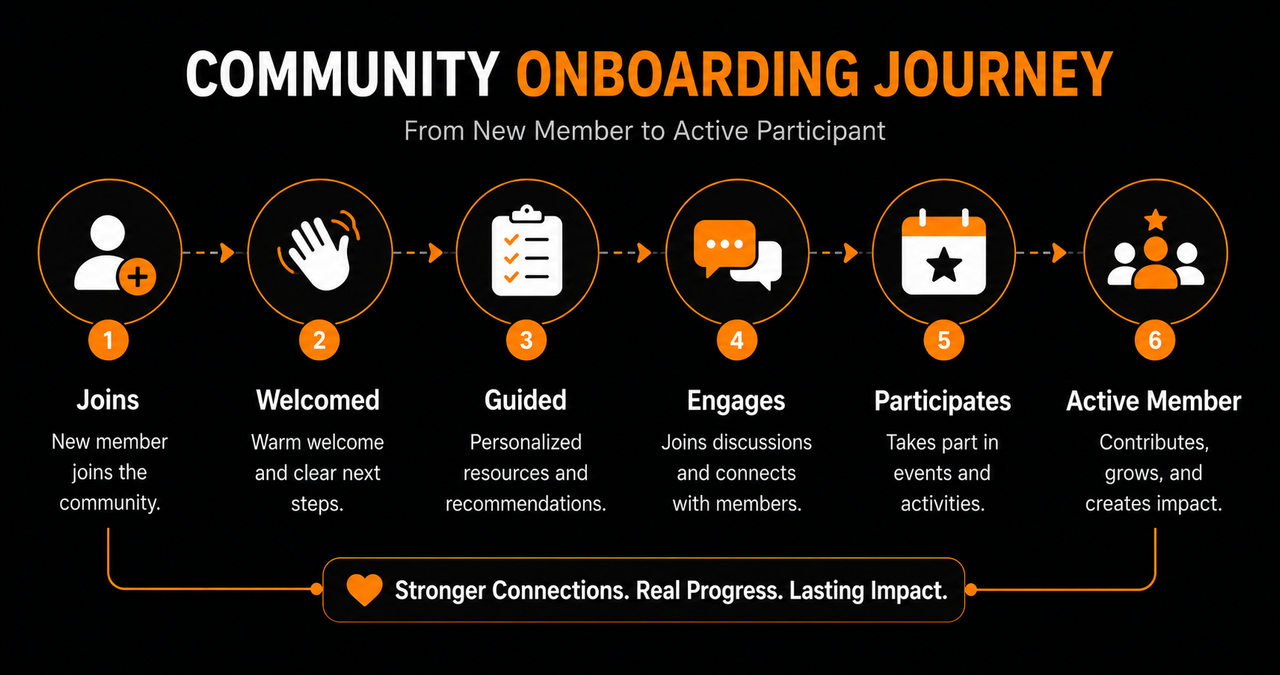
Most community owners understand the importance of onboarding. The challenge is maintaining a great onboarding experience as the community grows.
When there are only a few new members each week, it's easy to personally welcome everyone. As membership increases, that becomes much harder to sustain. This is where many communities fall into the trap of relying on generic welcome messages, automated role assignments, and onboarding processes that feel transactional rather than helpful.
The good news is that automation doesn't have to come at the expense of personalization. With the right systems in place, you can welcome new members at scale, help them find value faster, and create an onboarding experience that feels intentional from the very first interaction.
Why the Welcome Moment Matters
When somebody joins a paid community, they're taking a small leap of faith. They've decided to spend money, time, attention, or all three because they believe the community can help them achieve something they care about. Maybe they want to grow their business. Maybe they want to improve a skill. Maybe they want accountability. Maybe they simply want to connect with people who understand the challenges they're facing.
Whatever the reason, they've arrived with expectations. The moment they join, they begin evaluating whether those expectations will be met.
Most community owners assume this process happens over weeks. In reality, it starts almost immediately.
New members are paying attention to things you might not even notice. They look at the channel structure. They look at recent conversations. They check whether people are active. They see whether members are helping each other. They try to understand where they're supposed to start.
They're subconsciously asking:
Did I make the right decision joining this community?
The answer isn't determined by a single message. It's determined by the experience they're having.
That's why the welcome moment matters so much. It's not about saying hello. It's about helping members feel confident that they belong here.
The Problem With Most Welcome Channels
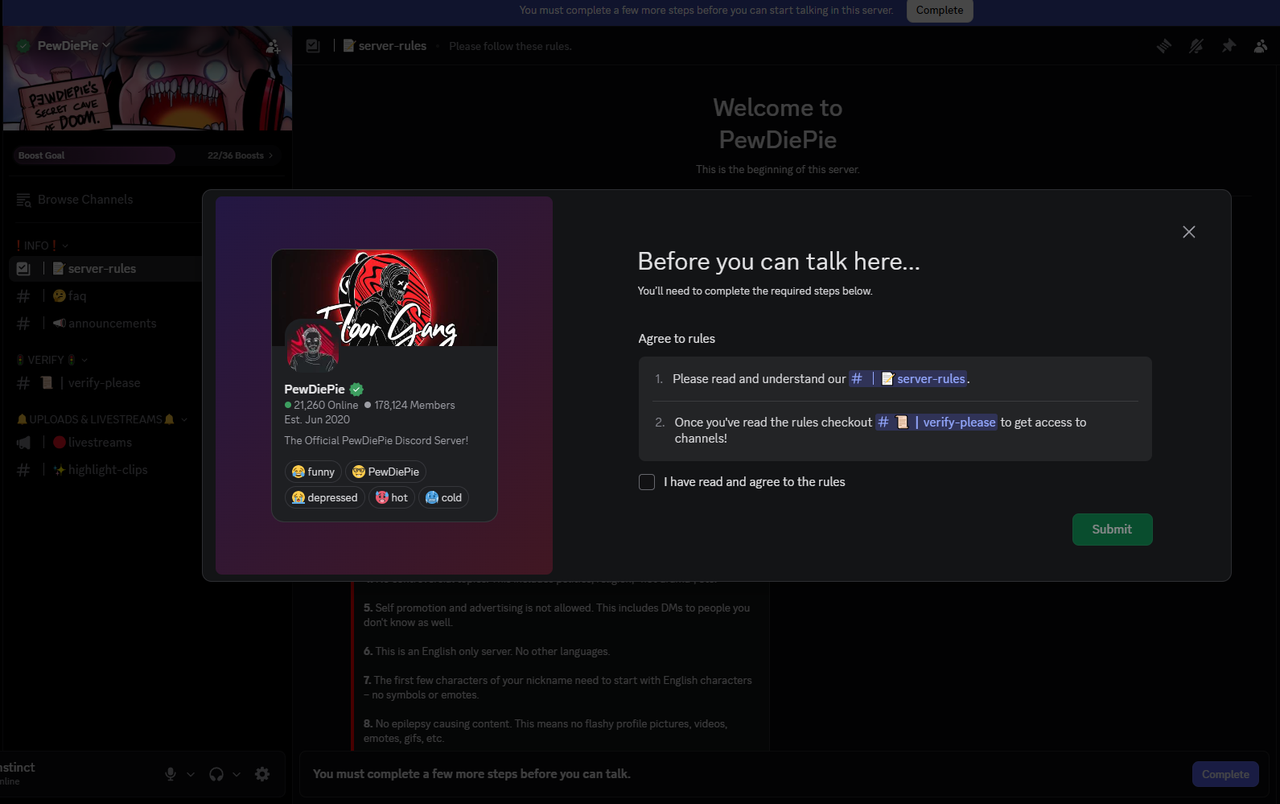
Take a look at the average Discord welcome channel.
It usually looks something like this:
Welcome to the community!
Please read the rules.
Introduce yourself.
Enjoy your stay.
Now imagine joining a paid community you've never seen before. You open the welcome channel. You read the message. Then you ask yourself:
What now?
Most community owners assume the welcome message has done its job. The reality is that many members are already feeling lost.
They're looking for direction. They're looking for clarity. They're looking for some indication of where they should begin.
Instead, they're often greeted with generic instructions that could belong in almost any Discord server on the internet.
The problem isn't that the message exists. The problem is that it doesn't answer the questions new members are actually asking.
Questions like:
- What should I do first?
- How do people usually get value here?
- Who should I talk to?
- Where can I find help?
- What are other members doing?
- How do I avoid feeling lost?
If your welcome process doesn't answer those questions, members are forced to figure everything out themselves. Many won't.
The First Few Minutes Matter More Than You Think
One of the biggest misconceptions in community management is that retention starts after onboarding. In reality, retention starts the moment somebody joins.
Think about your own experiences.
You've probably joined communities where everything immediately felt intuitive. You knew where to go. You knew what to do. You knew who to talk to. Within minutes, you felt comfortable.
You've probably also joined communities where the opposite happened. Too many channels. Too many categories. No guidance. No direction. No obvious starting point.
The difference between those two experiences often determines whether somebody becomes an active member or quietly disappears.
Community owners sometimes assume inactive members simply weren't committed. That's not always true.
Many members disappear because they're overwhelmed. Others disappear because they're confused. Some disappear because they never found the value they were promised. Many disappear because nobody helped them take the first step.
The challenge isn't getting people through the door. The challenge is helping them move once they're inside.
Why New Members Rarely Ask For Help
An interesting thing happens when people join a new community. Even if they need help, many won't ask for it.
Community owners often assume members will speak up if they're confused. Most don't.
They observe. They read. They watch conversations. They try to understand the culture. They're attempting to figure out whether they fit in.
This is especially true in paid communities where members don't want to appear inexperienced.
Imagine joining a community filled with successful agency owners. A new member who's just starting out may hesitate to ask basic questions. Not because they don't need help. Because they don't want to look foolish.
The same thing happens in creator communities, coaching communities, trading communities, and almost every other niche.
People often stay quiet until they feel comfortable.
That's why relying on members to initiate engagement is risky. A good welcome process reduces uncertainty before members need to ask for help.
Every Community Has a Hidden Drop-Off Point
Most community owners track new signups. Some track cancellations. Very few track what happens in between.
But that's where some of the most important insights live.
For example, a member joins. They look around. They don't introduce themselves. They don't ask questions. They don't attend events. They don't participate in discussions.
A month later, they cancel.
From the outside, it looks like a retention problem.
In reality, it was an onboarding problem.
The member never became part of the community. They joined. They observed. Then they left.
The dangerous thing about this type of churn is that it happens quietly. Nobody complains. Nobody announces they're leaving. They simply disappear.
That's why community owners should pay close attention to the first interactions members have after joining. Those interactions often determine whether somebody becomes active or remains invisible.
The Difference Between Joining and Belonging
Joining a community is a technical action. Belonging is an emotional one.
A member can technically join your Discord server in seconds. Feeling like they belong takes longer.
That feeling develops when people:
- Receive a response
- Have a conversation
- Meet other members
- Receive help
- Share progress
- Participate in something meaningful
The strongest communities understand this distinction.
They don't treat onboarding as a checklist. They treat onboarding as a bridge.
The goal isn't simply getting somebody into the server. The goal is helping them become part of the community.
That's a very different objective, and it's one of the reasons the best communities spend so much time refining the new member experience.
A Welcome Is the Beginning of the Relationship
Many community owners think of welcomes as administrative tasks. Something that happens after a member joins.
The strongest communities think about welcomes differently.
They see them as the start of a relationship.
A new member isn't just another subscription. They're a person with goals, challenges, questions, and expectations.
The welcome process is your first opportunity to learn about those things.
The more context you gather early, the easier it becomes to help members succeed later.
You learn:
- Why they joined
- What they're hoping to achieve
- How experienced they are
- What challenges they're facing
- What success looks like for them
This information becomes incredibly valuable as the community grows.
Because once you understand your members better, you can guide them more effectively. And members who receive relevant guidance tend to stay longer.
Think Beyond the Welcome Message
A welcome message is useful. But it's only one piece of the experience.
The real question community owners should ask is:
What happens after the welcome?
Do members know where to go?
Do they know what to do?
Do they know how to get value?
Do they know who can help them?
Do they feel like somebody notices they're there?
Those questions matter far more than the wording of a welcome message.
The communities with the best retention rarely succeed because they wrote a clever greeting. They succeed because they created a clear path for members to follow.
When somebody joins, they know exactly what comes next. And when members know what comes next, they're far more likely to stick around long enough to experience the value that convinced them to join in the first place.
Generic Auto-Roles vs a Real Welcome
At some point, every growing community runs into the same problem. The founder can no longer personally greet every new member.
When there are only a handful of joins each week, it's manageable. You can send a message, start a conversation, answer questions, and help people settle in. But as the community grows, that approach becomes difficult to sustain.
That's usually when community owners begin looking for automation.
The problem is that many communities automate the wrong thing. Instead of automating repetitive tasks, they automate the entire welcome experience. The result is a process that feels efficient for the community owner but forgettable for the member.
Why Most Automated Welcomes Fail
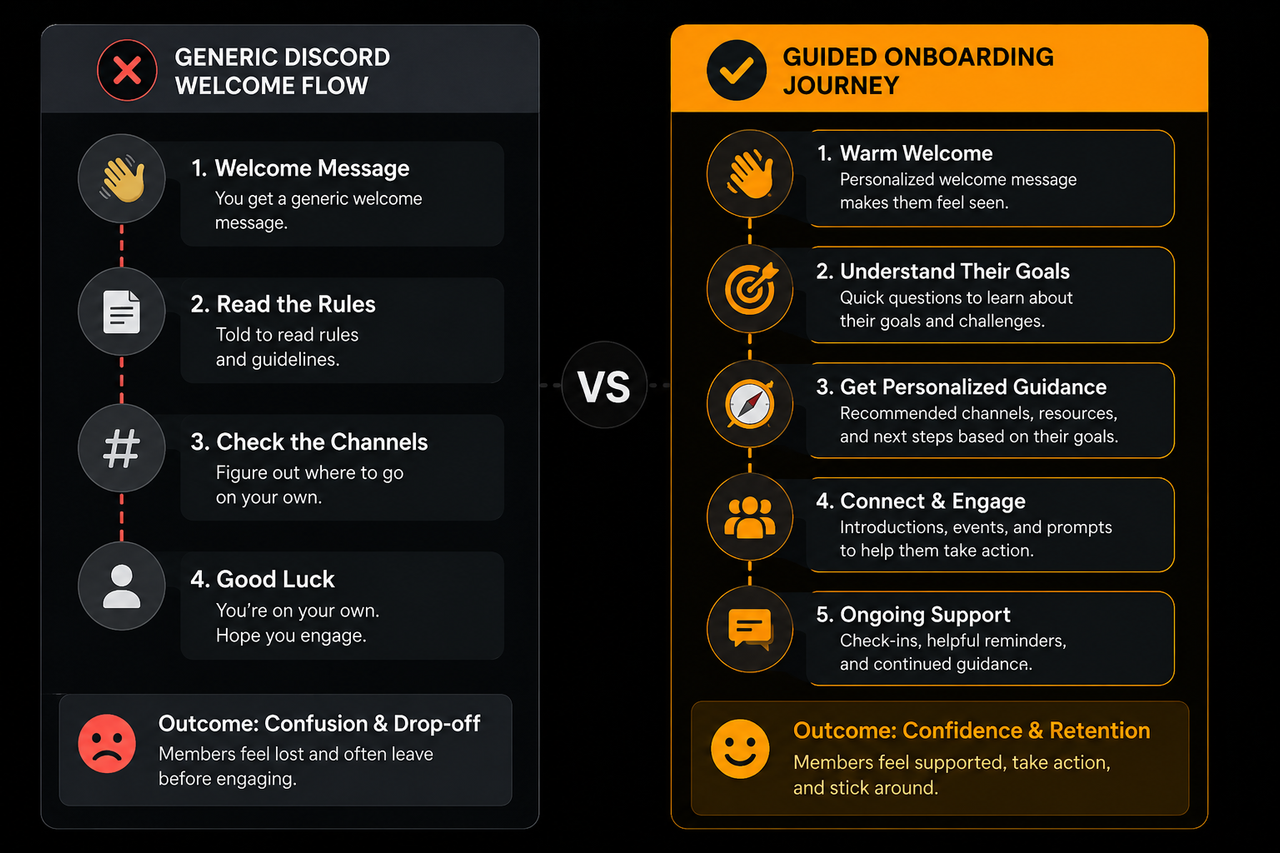
Think about the last few Discord communities you joined. Chances are you received some variation of the same message:
Welcome to the community.
Read the rules.
Check the channels.
Enjoy your stay.
You probably didn't respond. You probably didn't remember it. You may not have even read the entire thing.
That's because generic welcome messages are designed to deliver information, not create engagement. Information isn't the problem. Most new members don't join wondering where the rules channel is. They're wondering how to get value, where they should start, who they should talk to, and what they should do first.
Unfortunately, most automated welcomes never answer those questions. Instead, they focus on administrative tasks such as role assignment, permissions, server access, and channel visibility. All of those things are important, but none of them make somebody feel welcomed.
That's the distinction many communities miss.
Automation Isn't the Problem
It's important to clarify something before going further.
Automation itself isn't bad. In fact, automation becomes essential as communities grow. The issue is how automation gets used.
Many founders treat automation as a replacement for community building. The best communities use automation to support community building. Those are two very different approaches.
For example, assigning roles automatically is useful. Giving members access to the correct channels is useful. Collecting onboarding information automatically is useful. Helping members find relevant resources is useful.
All of those things reduce manual work.
What they don't do is create connection.
Connection still requires intentional design.
That's why some communities with sophisticated automation feel cold, while others using similar tools feel welcoming and personal. The difference isn't the software. The difference is the experience being created.
The Auto-Role Trap
One of the most common onboarding mistakes is assuming role assignment equals onboarding.
A member joins. They receive a role. Additional channels become visible. The onboarding process is considered complete.
From the community owner's perspective, everything worked perfectly.
From the member's perspective, nothing happened.
They gained access to more channels.
That's it.
The problem is that access isn't value. Visibility isn't value. Permissions aren't value. Those things are infrastructure. They're necessary, but they're not the reason somebody paid to join.
Imagine paying for access to a coaching community. You join. A bot assigns your role. Fifteen new channels appear. Nobody speaks to you. Nobody asks why you joined. Nobody points you in the right direction.
Technically, the onboarding succeeded.
Practically, it failed.
The member still feels lost.
This is why community owners should think carefully about what happens immediately after a role is assigned. The role should be the beginning of the journey, not the entire journey.
What a Real Welcome Looks Like
A real welcome helps members take action. Instead of simply providing access, it provides direction. Instead of dumping members into the community, it guides them through it.
For example, a real welcome might help members:
- Introduce themselves
- Share their goals
- Identify their biggest challenge
- Find the most relevant resources
- Connect with the right people
- Take a meaningful first step
Notice how none of those things require a human to be manually available twenty-four hours a day.
They simply require intention.
A member who immediately knows where to go is far more likely to engage than a member who has to figure everything out alone. That's the real purpose of onboarding. Not information delivery. Direction.
Why Context Matters
One of the biggest differences between a generic welcome and an effective welcome is context.
Most communities know almost nothing about new members. They know a username joined. That's about it.
But every member arrives with a different goal.
One member may be trying to get their first client. Another may already be running a successful business. One member may be a complete beginner. Another may have years of experience.
Treating those members identically rarely creates the best experience.
The more context you gather early, the better you can guide people toward what matters most.
Simple questions can reveal valuable information:
- What brought you here?
- What are you hoping to achieve?
- How experienced are you?
- What's your biggest challenge right now?
The answers create opportunities for more relevant onboarding. Instead of sending everybody through the same path, you can help members find the resources, discussions, and people most relevant to their situation.
That's where onboarding starts becoming genuinely useful.
The Communities People Remember
Think back to communities you've genuinely enjoyed joining. There's a good chance the experience felt intentional.
Maybe somebody reached out. Maybe you were asked about your goals. Maybe you were guided toward the right resources. Maybe somebody introduced you to other members.
Whatever happened, you probably didn't feel like another number entering a database. You felt noticed.
That feeling matters more than most community owners realize.
People naturally engage more when they feel acknowledged. They participate more. They ask more questions. They attend more events. They stay longer.
The strongest communities understand that onboarding isn't about processing members.
It's about helping members feel like they belong.
The Goal Isn't a Welcome Message
Many founders spend time optimizing the wording of their welcome message. While messaging matters, it's rarely the thing that determines success.
The goal isn't creating the perfect welcome message.
The goal is creating momentum.
A new member should finish onboarding knowing exactly what to do next. Maybe that's introducing themselves. Maybe that's attending a call. Maybe that's completing a challenge. Maybe that's booking an onboarding session.
The specific action matters less than the clarity.
Confused members disappear.
Members with a clear next step tend to engage.
That's why the best onboarding experiences always answer a simple question:
What's the next thing this member should do?
When that answer is obvious, participation becomes much more likely.
Learning From Real Communities
One pattern that consistently appears across successful communities is that they don't leave the new member experience to chance. The process is intentional.
We've seen this with communities like Senne Jackson's. As the community expanded, the challenge wasn't simply welcoming more people. The challenge was maintaining the feeling of a personal welcome while handling increasing member volume.
Instead of relying entirely on generic welcome channels, the onboarding process focused on understanding who members were, where they came from, and what they hoped to achieve.
That information helped create a more guided experience.
Members weren't simply dropped into a server and expected to figure things out.
They received direction.
And direction is often the difference between engagement and inactivity.
Stop Thinking About Messages. Start Thinking About Journeys
A welcome isn't a message.
It's a journey.
The message is simply the first step.
The communities that retain members best understand this. They don't ask:
What should our welcome message say?
They ask:
What should happen during a member's first hour?
What should happen during their first day?
What should happen during their first week?
Those questions lead to much stronger onboarding experiences because they focus on outcomes rather than messages.
Ultimately, that's what new members care about.
They don't remember the exact wording of your welcome message. They remember how the community made them feel. They remember whether they found value. They remember whether they felt like they belonged.
That's the difference between an automated process and a real welcome.
How to Welcome New Members at Scale
Most community owners don't struggle with onboarding because they don't care about new members. They struggle because growth creates a practical problem.
When ten people join each month, it's easy to personally welcome everyone. You can start conversations, answer questions, and guide people toward the right resources without much effort. When fifty or one hundred people start joining each month, the process becomes much harder to sustain.
This is where many communities make a critical mistake. They assume the solution is removing humans from the onboarding process entirely. In reality, the goal should be removing repetitive work while keeping the parts that actually create connection.
The best onboarding systems aren't designed to replace community managers. They're designed to free community managers to focus on higher-value interactions.
Think in Systems, Not Individual Tasks
Imagine welcoming a new member manually. You explain where to start. You point them toward useful resources. You answer the same introductory questions. You explain how the community works. You tell them about upcoming events.
Now imagine doing that fifty times every month.
The problem isn't the effort required for a single conversation. The problem is repeating the same process over and over again.
Most of the information being shared remains identical. The member changes. The onboarding process doesn't.
This is why successful communities build systems around common onboarding actions. Not because they want onboarding to feel automated, but because endlessly repeating the same tasks isn't a good use of anyone's time.
Think about the tasks that happen every single time a member joins:
- Explaining how the community works
- Directing people toward key resources
- Highlighting important channels
- Sharing upcoming events
- Collecting onboarding information
- Answering common questions
These activities can be standardized without making the experience feel robotic. Doing so creates more time for conversations that actually require human involvement.
Create a Guided First Experience
One of the biggest differences between successful communities and struggling communities is how they handle a member's first few interactions.
Many communities assume members will naturally discover value on their own. The founder understands the channel structure. Moderators understand the channel structure. Long-term members understand the channel structure.
New members don't.
That's why guidance matters.
Imagine joining a creator community with channels covering content strategy, monetization, editing, analytics, sponsorships, networking, accountability, and audience growth. The founder knows exactly where somebody should begin.
The new member doesn't.
From their perspective, every channel appears equally important. Instead of taking action, they spend their first few minutes trying to understand how everything fits together.
A strong onboarding process removes that uncertainty.
Rather than presenting members with dozens of options, it points them toward the next logical step. That might be introducing themselves. It might be watching a recommended training. It might be joining an upcoming call. It might be completing a short onboarding questionnaire.
The specific action matters less than the clarity.
Members don't need twenty options when they first join. They need one clear next step.
Reduce Friction Wherever Possible
One thing community owners often underestimate is how easily small obstacles reduce participation.
Every additional decision creates friction. Every unnecessary step creates friction. Every moment of uncertainty creates friction.
Individually, these issues seem small.
Collectively, they create enough resistance to stop members from engaging altogether.
Consider two onboarding experiences.
In the first community, a member joins and immediately sees thirty channels spread across multiple categories. They aren't sure which channels matter, where to begin, or what resources are relevant to them.
In the second community, a member joins and receives a simple path that explains exactly what to do first.
The difference isn't complexity.
The difference is clarity.
Strong onboarding experiences reduce mental effort. Members shouldn't have to work hard to figure out how your community works. The easier it is to get started, the more likely people are to participate.
Use Onboarding to Learn About Members
Most founders spend months trying to understand their audience. Ironically, many communities fail to ask new members the very questions that would provide those answers.
Every new member arrives with a reason for joining. The onboarding process is the perfect opportunity to discover what that reason is.
Simple questions can reveal a surprising amount of information:
- What brought you here?
- What are you hoping to achieve?
- What challenge are you currently facing?
- Where did you discover the community?
Individually, these answers help you understand a specific member.
Collectively, they help you understand the community itself.
Patterns begin to emerge. You discover which acquisition channels perform best. You learn what goals members care about most. You identify recurring challenges and opportunities.
This information becomes valuable far beyond onboarding. It can influence content, events, resources, community strategy, and future offers.
The best onboarding systems don't just help members get started. They help community owners make better decisions.
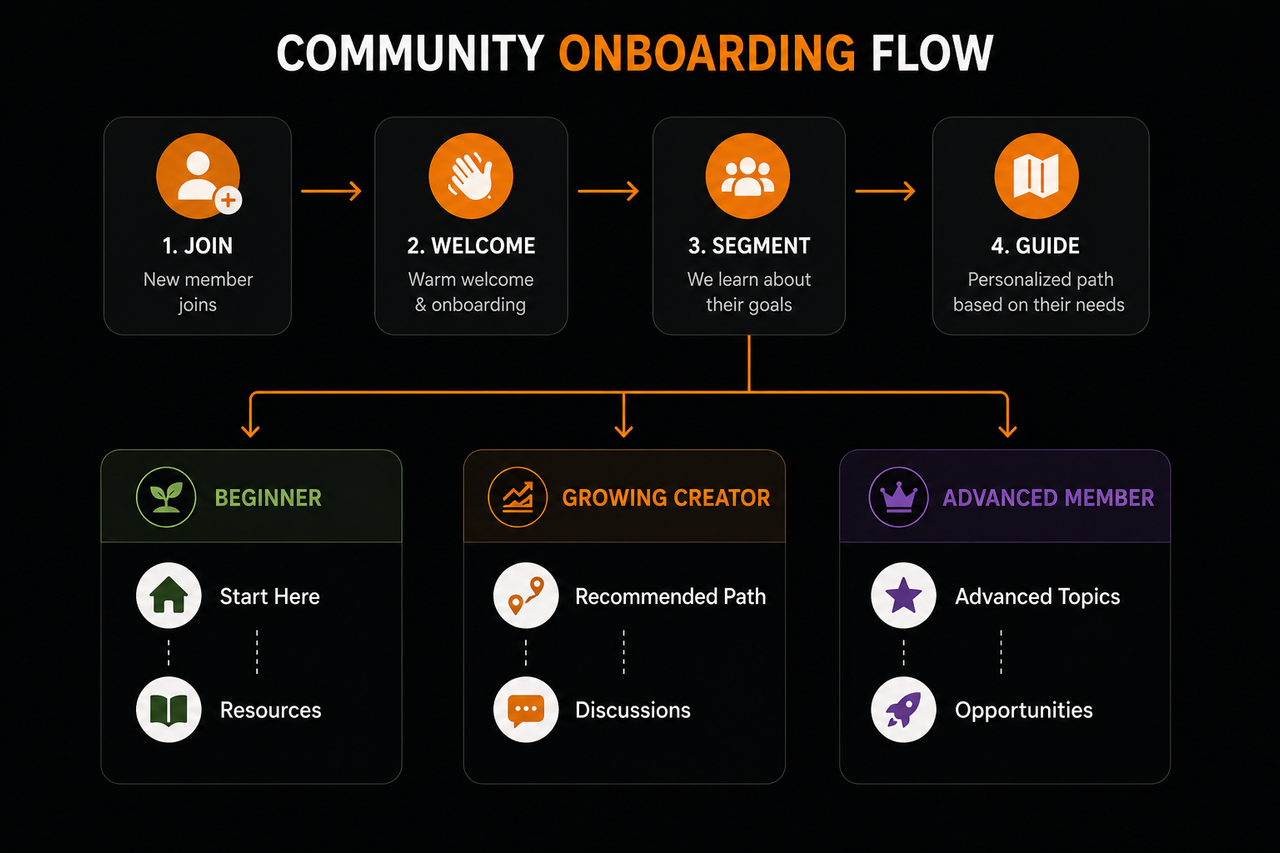
Segment Members Early
Not every member joins at the same stage of their journey.
A beginner creator and a full-time creator have different needs. A new agency owner and an established agency owner have different goals. A first-time founder and an experienced founder are looking for different types of support.
Yet many communities push everyone through the exact same onboarding process.
The result is predictable.
Some members receive information that's too advanced. Others receive information that's too basic.
Neither group gets the most relevant experience.
Segmentation helps solve this problem.
By understanding where members are in their journey, communities can direct people toward the resources, discussions, and opportunities most relevant to them.
The more relevant the onboarding experience becomes, the faster members find value. And members who find value quickly are significantly more likely to remain engaged.
Build Around the First Week, Not the First Minute
Many onboarding discussions focus heavily on what happens immediately after somebody joins.
That's important.
But the first week often matters more than the first welcome message.
A member might join on Monday feeling excited about the community. By Wednesday, work gets busy. By Friday, they've forgotten the community exists.
Not because they disliked it.
Because nothing gave them a reason to come back.
This is why the best communities think beyond day one.
They create multiple touchpoints throughout the first week. Members receive reminders, recommendations, invitations, and opportunities to participate.
Each interaction reinforces the value of the community.
Instead of onboarding being a single event, it becomes an ongoing experience.
That consistency helps members develop habits around participation rather than treating the community as something they briefly checked out after joining.
Create Habits, Not Just Activity
Many communities focus on generating activity.
The strongest communities focus on creating habits.
Activity is temporary. Habits are sustainable.
If members know there is a community call every Friday, they're more likely to return on Friday. If members know accountability check-ins happen every Monday, they're more likely to participate on Monday.
Over time, these recurring activities become part of a member's routine.
That's incredibly valuable because retention often comes from consistency rather than excitement.
Communities don't thrive because members feel motivated every day.
They thrive because members develop habits that keep them engaged over time.
Good onboarding introduces these habits early and helps members understand how participation works.
Scale the Process, Not the Relationship
One misconception many founders have is that scaling requires becoming less personal.
It doesn't.
What changes is the process.
Not the intention.
You may no longer be able to personally welcome every member. You may not have introductory conversations with everyone.
But you can still create systems that help members feel understood.
You can still learn about their goals. You can still guide them toward relevant resources. You can still create opportunities for meaningful interactions.
The relationship remains important.
The process simply becomes more efficient.
That's an important distinction because members don't care whether onboarding was manual or automated. They care whether it helped them succeed.
Automation Should Create More Time for Community
The best onboarding systems all share a common goal.
They reduce administrative work so community owners can spend more time doing things that actually strengthen the community.
The purpose of automation isn't eliminating human interaction.
It's creating more opportunities for it.
Every repetitive task that gets automated creates additional time for:
- Conversations
- Coaching
- Events
- Feedback
- Relationship building
Those are the things members remember.
Those are the things that build trust.
Those are the things that improve retention.
The goal isn't simply welcoming more members.
The goal is helping more members succeed without overwhelming the people responsible for running the community.
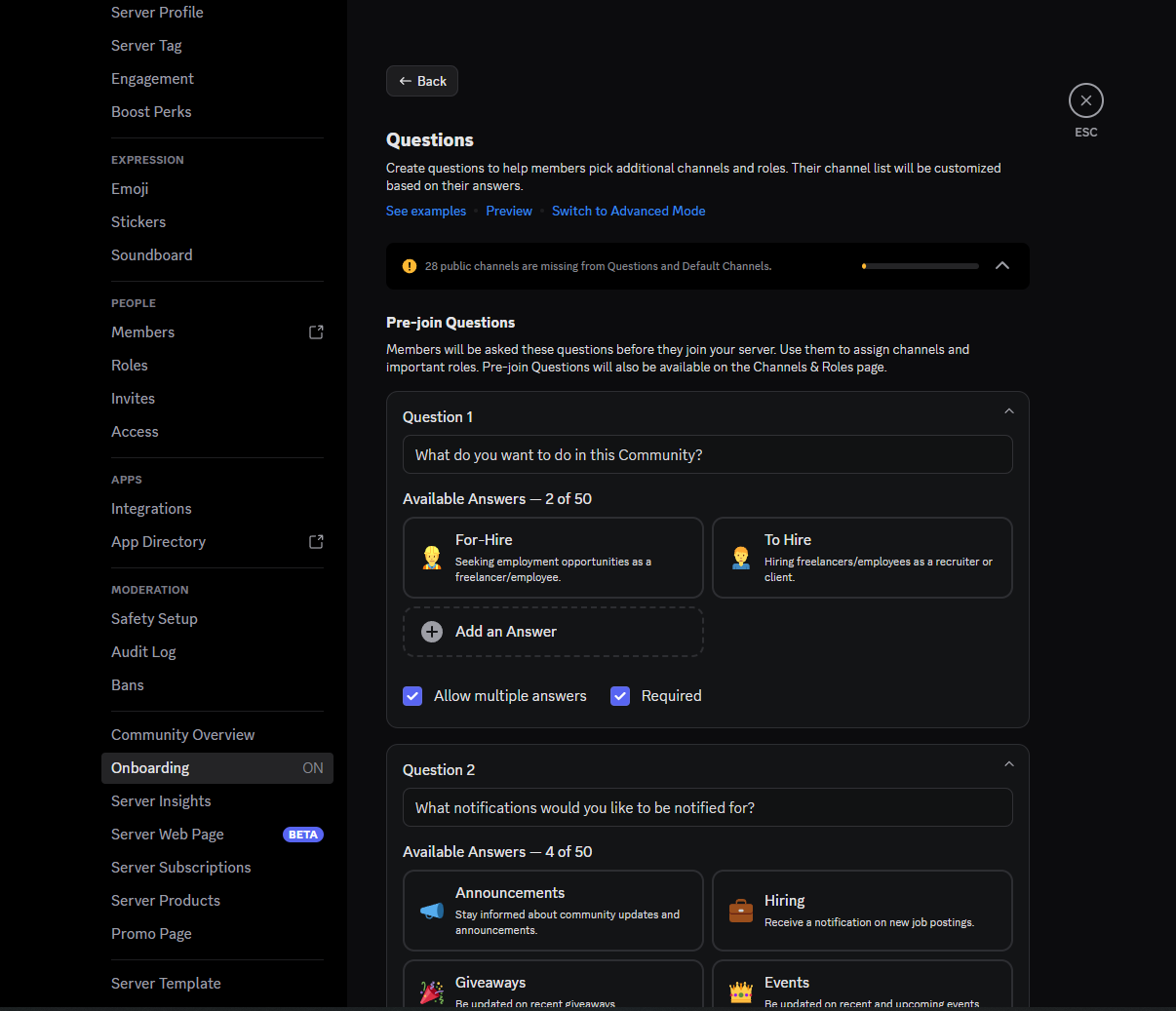
Making It Feel Personal, Not Automated
One of the biggest misconceptions about automation is that it automatically makes an experience feel impersonal.
That's not actually the problem.
People don't dislike automation.
People dislike generic experiences.
Think about the difference between receiving a message that says:
Welcome to the community.
and receiving a message that says:
Hey John, I saw you joined because you're trying to grow your agency. Start with the client acquisition resources and make sure you attend Friday's Q&A. You'll probably get the most value there.
Both messages can be automated.
Only one feels relevant.
That's the difference.
Members don't care whether a message was sent manually or automatically.
They care whether it helps them.
Personalization Starts With Information
The reason many onboarding systems feel generic is because they don't know anything about the member.
Without context, every member receives the same experience.
The same message.
The same resources.
The same recommendations.
The same journey.
The problem is that communities aren't made up of identical people.
Every member joins with different goals.
A creator trying to reach their first 1,000 subscribers doesn't need the same guidance as a creator managing a six-figure business.
A new freelancer doesn't need the same resources as an experienced agency owner.
The more information you gather during onboarding, the more relevant the experience becomes.
This doesn't require lengthy surveys.
In most cases, a few simple questions are enough:
- What brought you here?
- What are you currently working on?
- What's your biggest challenge?
- What would success look like for you?
Those answers can completely change how a member experiences the community.
Relevance Beats Complexity
Many community owners try to improve onboarding by adding more things.
More channels.
More resources.
More guides.
More documentation.
More options.
The problem is that more information doesn't necessarily create a better experience.
In many cases, it creates the opposite.
Imagine joining a community and immediately receiving access to one hundred resources.
It sounds valuable.
In reality, it's overwhelming.
Now imagine joining a community and being shown the three resources most relevant to your current situation.
That's useful.
The difference isn't quantity.
It's relevance.
Members don't need access to everything on day one.
They need access to the right thing on day one.
The Best Communities Feel Guided
One thing you'll notice when studying successful paid communities is that members rarely feel abandoned.
They always know what comes next.
There's always another step.
Another conversation.
Another event.
Another opportunity to participate.
This doesn't happen by accident.
It's usually the result of a well-designed onboarding journey.
The community owner has intentionally thought through questions such as:
- What should members do first?
- What should they do after that?
- How do they find their first win?
- How do they meet other members?
- How do they become regular participants?
The goal isn't simply helping members join.
The goal is helping members integrate into the community.
Those are very different outcomes.
Learning From the Senne Jackson Community
One example that illustrates this well is the onboarding work we helped implement for Senne Jackson's community.
As the community grew, manually handling every new member became increasingly difficult.
The challenge wasn't attracting members.
The challenge was understanding them.
New members were arriving from different places.
Some had discovered the community through content.
Others had been referred by existing members.
Some were beginners.
Others were already experienced.
Treating every member exactly the same created missed opportunities.
The onboarding process was redesigned to gather useful context from new members as they joined.
Information such as acquisition source, goals, and background helped create a more structured experience.
Members weren't simply given access and left to figure everything out themselves.
Instead, the onboarding process created a clearer picture of who they were and what they needed.
That information helped the team guide members more effectively while also improving their understanding of the community as a whole.
The result wasn't just better onboarding.
It was better community management.
Automation Should Support Relationships
The strongest communities understand something important.
Relationships drive retention.
People rarely stay because a Discord server has great channel organization.
They stay because they've built relationships.
They've made progress.
They've participated in discussions.
They've attended events.
They've connected with other members.
Automation should support those outcomes.
For example, automation can:
- Welcome members
- Collect onboarding information
- Assign roles
- Recommend resources
- Surface relevant events
- Trigger reminders
But automation can't build relationships for you.
That's still the responsibility of the community itself.
The goal is using automation to create more opportunities for meaningful interaction.
Not fewer.
Where SalesGenie Fits In
This is one of the reasons tools like SalesGenie exist.
Most community owners don't have a retention problem because they don't care about members.
They have a retention problem because understanding every member becomes harder as the community grows.
SalesGenie helps bridge that gap by creating more structured onboarding experiences, collecting useful member information, and helping community teams understand who has joined and why.
The objective isn't replacing human interaction.
It's making human interaction more effective.
When community owners understand their members better, they can provide more relevant support, recommendations, and guidance.
And that's ultimately what good onboarding is all about.
The Real Goal of Automation
Many people think onboarding automation is about saving time.
That's only part of the story.
The real goal is creating consistency.
Without systems, every member receives a different experience.
Some get welcomed.
Others don't.
Some receive guidance.
Others get lost.
Some find value quickly.
Others never find it at all.
Good onboarding systems ensure every member starts from a strong foundation.
That consistency becomes increasingly important as communities grow.
Because growth magnifies weaknesses.
A confusing onboarding process doesn't become less confusing when you have more members.
It becomes a bigger problem.
The earlier you solve it, the easier growth becomes.
Final Thoughts
A welcome message isn't what makes somebody feel welcome.
A role assignment isn't onboarding.
And automation isn't the enemy of community.
The communities that retain members best understand that onboarding is about helping people find value quickly.
That means reducing confusion. Providing direction. Understanding member goals. Creating opportunities for interaction. Helping people feel like they belong.
The strongest onboarding experiences combine automation and personalization.
Automation handles the repetitive work.
Personalization creates relevance.
Together, they allow communities to scale without sacrificing the member experience.
If you remember one thing from this article, let it be this:
The goal isn't to automate welcomes. The goal is to help every member feel like they matter, even when your community becomes too large to welcome everyone manually.
That's when onboarding stops being an administrative task.
And starts becoming a retention strategy.