

Why Community Is the New Creator Business
For years, the creator economy had a straightforward playbook: build an audience, grow your reach, and find ways to monetize the attention.
That model created countless successful businesses, and audiences still matter. But creators are starting to build something beyond followers, subscribers, and views.
They are building communities.
The difference is what happens after someone discovers you. Instead of relying on a constant cycle of content, reach, and one-off purchases, community gives creators a way to build ongoing relationships with the people who care most about what they do.
Those relationships can create stronger loyalty, recurring revenue, and a business that is not entirely dependent on getting the next post in front of enough people.
The audience is still where people discover you.
But increasingly, community is where the creator business gets built.
From Audience to Community
For most of the creator economy, growth has been measured through audience size. Followers, subscribers, views, impressions, and reach became the numbers creators watched because those numbers represented attention. Build enough attention and opportunities followed: sponsorships, products, affiliate revenue, courses, services, or brand deals.
That model still works.
But creators are increasingly discovering that attention is only the beginning of a creator business. An audience gives you people who know who you are. It does not automatically give those people a meaningful relationship with you, your work, or each other.
That is where community changes the model.
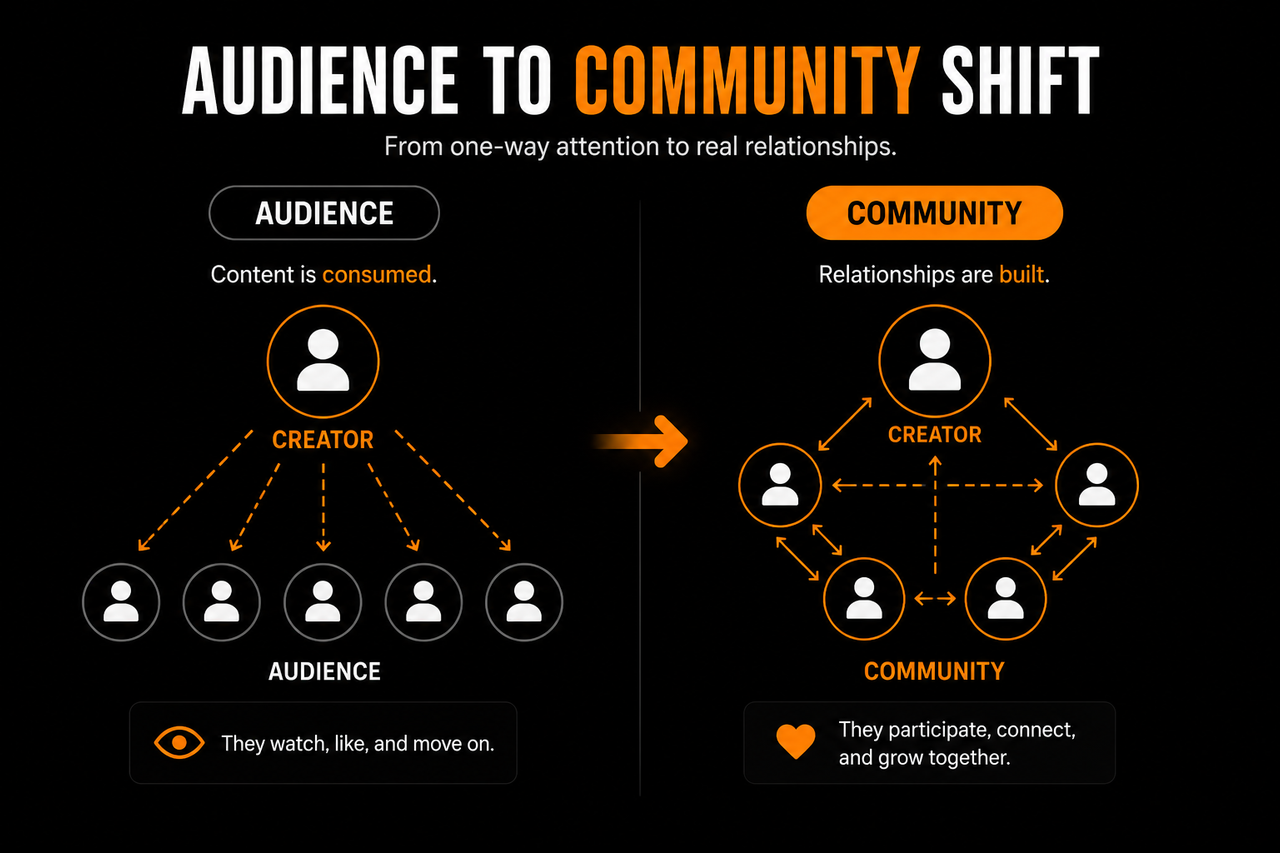
Instead of ending the relationship after someone watches a video, reads a newsletter, or scrolls past a post, a community gives interested followers somewhere to participate. They can ask questions, share experiences, attend events, meet other members, contribute ideas, and become part of what the creator is building.
The shift is not from audience or community. It is from building an audience as the destination to using that audience as the foundation for something deeper.
Attention Gets People In, Community Gives Them Somewhere to Stay
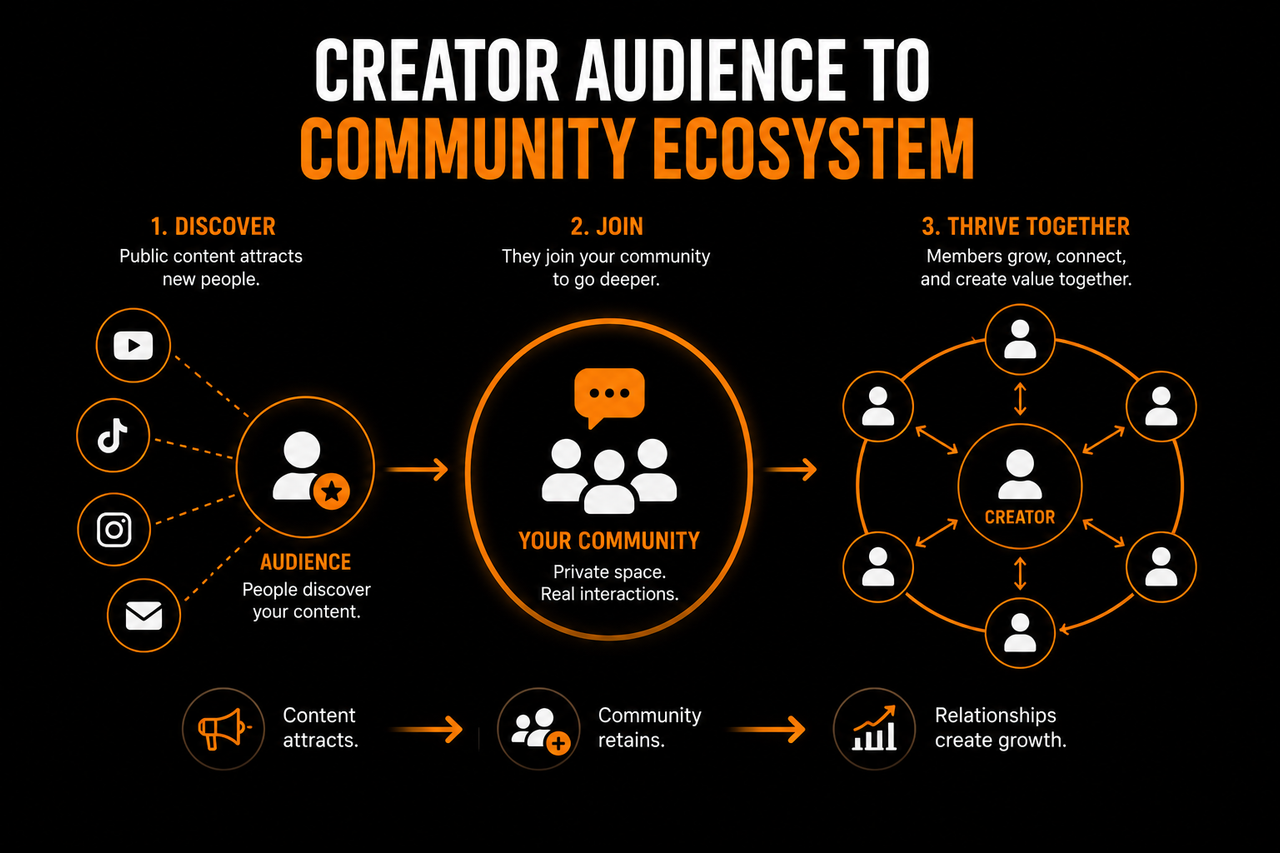
Public content is incredibly effective at discovery.
A YouTube video can reach someone who has never heard of you. A TikTok can appear in front of hundreds of thousands of people. A newsletter can be forwarded. A podcast episode can introduce your ideas to an entirely new audience.
That reach is difficult to replicate inside a private community. But public platforms are designed around consumption.
Someone watches your video, perhaps likes it, and moves on. They may follow you and return for the next one, but most of the relationship still depends on you publishing something that reaches them again.
Community creates a different environment. Someone who enjoyed a creator's content can enter a space where the topic continues after the content ends.
A creator teaching freelancing might publish a video about finding clients. Inside their community, members can discuss how they applied it, share what worked, ask questions when something goes wrong, and compare their experiences with others doing the same thing.
The video created the initial value. The community extends it. That gives creators a useful distinction when thinking about growth:
Content attracts attention. Community develops relationships.
You still need people discovering your work. Community simply gives the people who care most somewhere to go next.
Members Participate Instead of Only Consuming
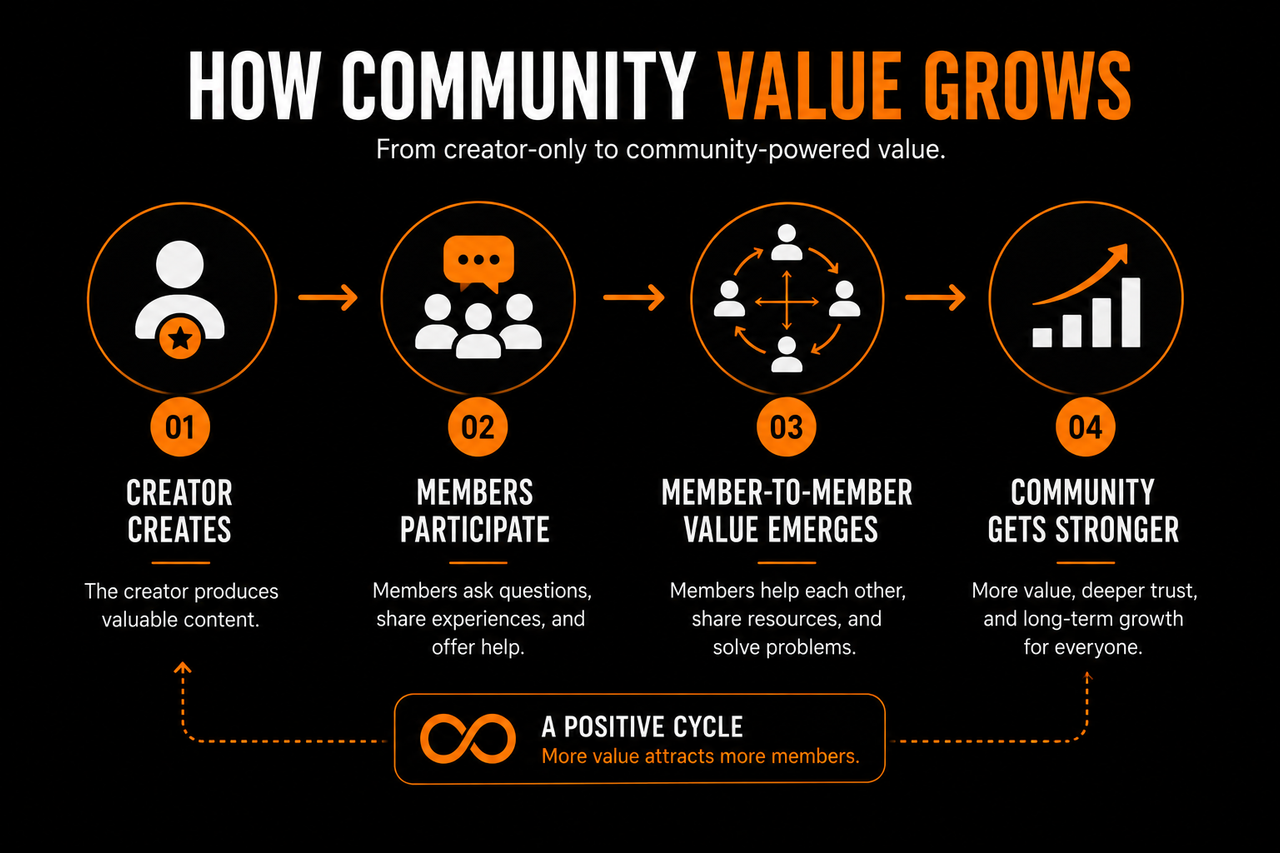
The biggest change happens when the audience begins contributing. Traditional creator content usually flows in one direction. The creator publishes and the audience consumes. Even when people comment or reply, most of the value still originates with the creator. A community introduces another layer: member-to-member value.
Imagine a community built around e-commerce.
One member asks for feedback on a product page. Another member has recently solved the same problem and offers advice. Someone else shares a tool they used. A fourth person explains a mistake they made when trying a similar approach.
The creator did not need to produce another tutorial for that value to exist. They created the environment where useful people could find and help each other. That makes community fundamentally different from simply having a more engaged audience.The relationships are no longer only:
Creator → Audience
They begin becoming:
Creator ↔ Members ↔ Members
This matters because creators have limited time. There are only so many videos they can publish, questions they can answer, and individual conversations they can have. If every useful experience depends on direct creator involvement, growth eventually increases the workload placed on the creator.
A healthy community allows value to come from the group as well. Members can exchange knowledge, opportunities, feedback, accountability, and connections without waiting for the creator to personally provide each one.The creator remains important, but they no longer need to be the only reason people return.
The Creator's Role Starts to Change
Building community does not mean creators stop creating. It changes what they are building. When you have an audience, your primary job is usually producing something people want to consume. When you have a community, part of your job becomes creating an environment people want to participate in.
That means thinking beyond:
What should I publish next?
and beginning to ask:
What should happen between the people who follow my work?
- Maybe members need a place to ask questions.
- Maybe they benefit from meeting people at a similar stage.
- Maybe they need regular accountability.
- Maybe the creator can organize live sessions where members work through problems together.
- Maybe the most useful thing is simply creating a focused space where conversations around a shared goal can happen without getting lost in a public feed.
The creator becomes more than a source of content. They become the person shaping the environment around that content. For many creators, this is where their audience begins turning into something more durable. The value is no longer limited to what was uploaded this week. It also exists in the people, conversations, knowledge, and relationships gathered around the creator's work.
Not Every Follower Needs to Become a Member
A community does not need to contain the creator's entire audience. In fact, it probably should not.
Someone might enjoy watching a creator's videos without wanting anything more. Another person might read every newsletter but have no interest in talking with other readers. There is nothing wrong with that.
An audience serves a different purpose. It keeps the creator accessible to a large number of people and allows new people to continually discover their work. Community is for the smaller portion that wants deeper involvement.
- A viewer might eventually want to ask questions instead of only watching.
- A newsletter subscriber might want to meet other people working toward the same goal.
- A long-time follower might want more direct access, structure, feedback, or accountability.
Community creates a natural next step for those people without requiring the creator to change the experience for everyone else. This is also why community does not automatically mean paid community.
A free community can give followers a place to become more involved before any purchase is involved. A paid community can offer a deeper experience where members receive additional access, support, resources, or structure.
Some creator businesses can use both. The important change is that there is now somewhere for the relationship to develop beyond the public content itself.
From Following a Creator to Belonging Around an Idea
The strongest communities eventually become about more than the person who started them. The creator may be what brings people together initially, but members often stay because they begin recognizing themselves as part of the group.
- A fitness creator's followers may become a group of people working toward similar health goals.
- A business creator's audience may become entrepreneurs sharing progress and helping each other solve problems.
- An artist's followers may become creators sharing work, feedback, and inspiration.
The shared interest already existed in the audience. Community makes that shared interest visible. People who previously knew only the creator begin knowing each other. That is a meaningful transition for a creator business because the creator is no longer building only around their personal ability to capture attention. They are building a place where relationships can form around the ideas, goals, or interests that attracted the audience in the first place.
Public content can continue feeding that ecosystem by bringing new people in.
But once people enter the community, the creator has something an audience alone struggles to create: a space where the relationship can deepen even between uploads. And once that starts happening, community becomes more than an engagement strategy.
It starts changing what the creator is actually building as a business.
Why Community Is the Stronger Creator Business
Building an audience can create enormous opportunities for a creator, but the business underneath that audience can still be surprisingly fragile.
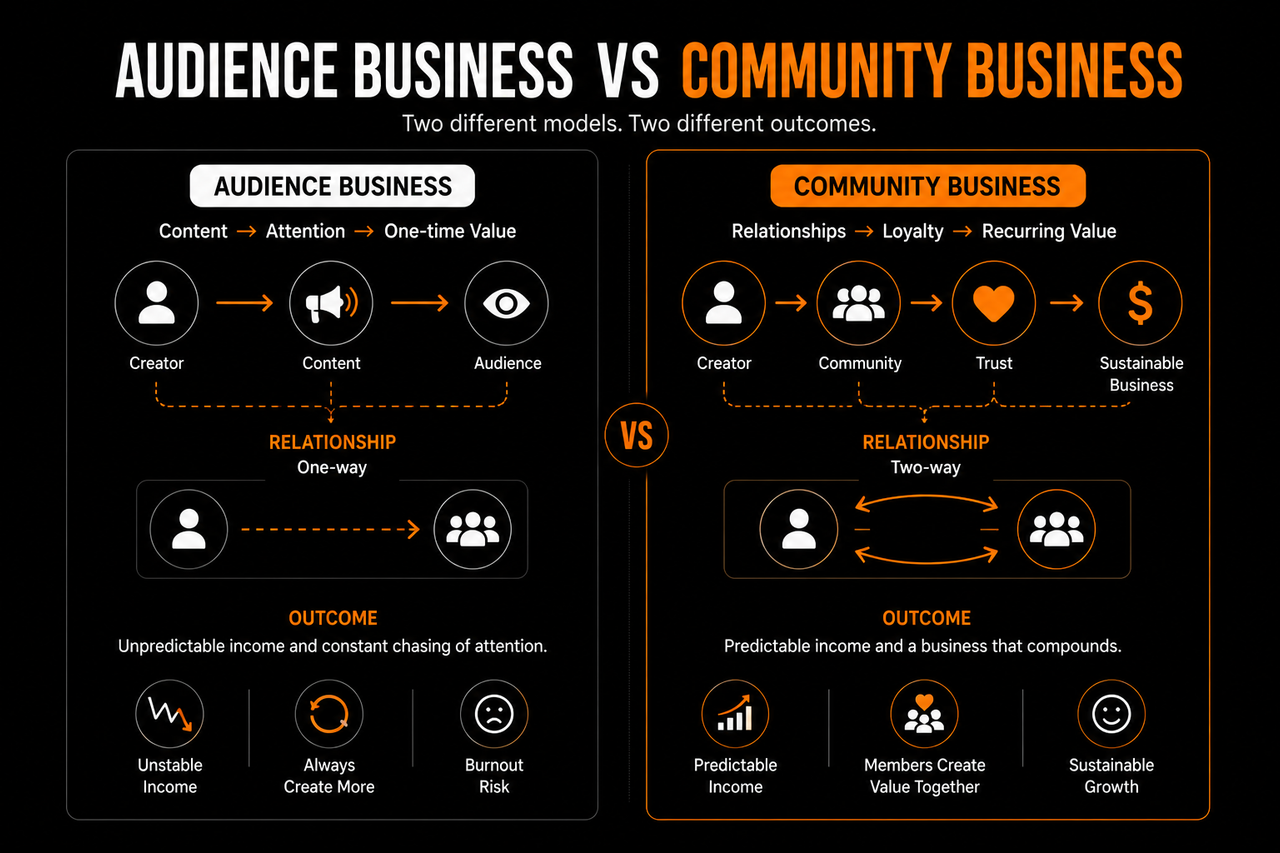
Reach can change from one month to the next. A creator can publish consistently and still have no guarantee that their followers will see what they make. Sponsorships depend on brands continuing to spend. Product launches can generate strong revenue, but they also create pressure to keep finding the next thing to sell.
Community gives creators another way to build. Instead of relying entirely on how many people they can reach, creators can build around a smaller group of people who are more deeply involved in what they do. That changes where the value of the business comes from.
The creator is no longer only monetizing attention. They are creating an environment where members can receive ongoing value through access, conversations, relationships, support, and shared experiences.
For many creators, that creates a stronger foundation than constantly needing another spike in attention.
Reach Is Powerful, but It Is Not Fully Yours
Social platforms have made creator businesses possible at a scale that would have been difficult to imagine before them. A single person can publish something today and reach thousands of people without owning a media company, television network, or publishing business. But that distribution comes with a tradeoff.
The creator does not control the platform.
Algorithms decide which content gets surfaced. Formats change. New features are prioritized while older ones lose reach. Audience behavior shifts from one platform to another. A creator may have built the audience, but the connection to that audience still depends heavily on someone else's system. That does not mean creators should leave public platforms. They remain one of the best ways to get discovered. The stronger approach is to avoid making them the entire business.
A community gives interested followers a place to move beyond the feed. Once they join, the creator is no longer depending on an algorithm to recreate the relationship every time they want to reach those people.The community becomes a more direct connection between the creator and the people who care most about what they are building.
Community Creates More Ways to Deliver Value
Content businesses can easily become trapped in a cycle of production.
- Publish a video.
- Write another newsletter.
- Record another podcast.
- Create another course.
Then repeat.
The creator needs to keep producing because most of the value is packaged into individual pieces of content. A community expands what "value" can mean. A member might join because they want the creator's expertise, but that does not have to be the only thing keeping them there. They may value:
- Feedback on something they are working on.
- Conversations with people facing similar problems.
- Accountability from seeing others make progress.
- Access to live discussions or events.
- Opportunities shared by other members.
- A place to ask questions when they get stuck.
Some of those experiences involve the creator directly. Others exist because the creator brought the right group of people into the same environment. That gives the business more ways to be useful without requiring the creator to personally produce every useful moment. A weekly video is consumed once. A useful community can create new interactions every day.
The Product Can Improve as the Community Grows
Growth can create an unusual problem for creator businesses. If the product is primarily direct access to the creator, more customers can make the experience harder to deliver. Ten coaching clients may be manageable. One hundred probably require a different structure. A thousand cannot all have unlimited access to one person.
Community allows part of the value to scale differently.
More members can mean more experiences, perspectives, knowledge, and connections inside the group. Consider a community for freelance designers. With twenty members, there may be a handful of people available to give feedback or share advice. With two hundred relevant and engaged members, someone asking a question may find people with experience across different industries, pricing models, clients, tools, and career stages.
Growth has added something to the experience.
That does not happen automatically. A poorly managed community can become noisier as it grows rather than more valuable. The creator still needs structure, moderation, onboarding, and a clear reason for members to be there.
But when the right people are brought together and encouraged to contribute, growth can increase the amount of useful knowledge and opportunity available inside the community.
The members become part of the value being created.
Creators Can Learn From Members Instead of Guessing
There is another business advantage to having people gathered in one place: creators get a much clearer view of what their audience actually needs.
Public metrics can tell you what performed well. A video received more views. A post got more comments. A particular topic generated more clicks. Those signals are useful, but they do not always explain why something mattered or what people need next. Community conversations reveal that naturally.
- Members ask questions.
- They explain what they are struggling with.
- They discuss what they have tried.
- They tell you what they found useful.
- The same problem may appear repeatedly across different conversations.
For a creator, that information can shape the rest of the business.
A question that keeps appearing could become a new piece of content. A common problem might justify a workshop. Members repeatedly asking for more structure could lead to a program. A resource being shared constantly might reveal something that should become easier to access. Instead of building every offer based on assumptions about what the audience wants, the creator can observe what members are already asking for. The community becomes a feedback loop.
The creator provides value to members, members reveal what they need, and those insights help the creator improve what they build next.
A Community Business Is Harder to Copy
Content itself is increasingly easy to reproduce. Someone can watch a creator's video and make their own version of the topic. Courses covering similar subjects can appear everywhere. Templates can be recreated. Information that once felt exclusive can become widely available very quickly.
Relationships are harder to copy.
Another creator might teach the same skill, but they cannot instantly recreate years of conversations, trust, member relationships, shared experiences, and culture inside an established community.
That makes the community itself part of what differentiates the business. People are not only choosing between information. They may be choosing where they want to learn, who they want to learn alongside, whose feedback they trust, and which group they want to be associated with.
This is particularly important as information becomes easier to access. When ten creators can explain the same topic, simply possessing the information becomes less valuable. The experience around that information becomes more important.
Community can provide that experience.
The Business Becomes About More Than the Creator
A creator-led business will naturally depend on the creator. Their reputation attracts attention. Their ideas shape the brand. Their personality may be a major reason people discovered it in the first place. But there is a difference between the creator being important and the creator needing to personally power every part of the business.
Community creates room for something larger to develop around them. Members begin forming relationships. Experienced members help newer ones. People share opportunities. Regular events become part of the routine. The culture of the group becomes recognizable. Over time, members may return because of the creator and because of everything surrounding them.
That is a stronger position than having every bit of value disappear the moment the creator stops publishing for a week.
The creator still leads. But they are leading an ecosystem rather than simply feeding an audience. That is why community can become such a strong foundation for a creator business. It creates a direct relationship with the people who care most, expands the ways value can be delivered, gives creators better insight into what members need, and allows the people inside the community to contribute to the experience themselves.
And when people consistently find value in an environment they want to remain part of, the business begins gaining something even more important than attention:
loyalty.
That loyalty is what makes recurring revenue possible without every month feeling like another attempt to sell the audience something new.
Loyalty and Recurring Revenue
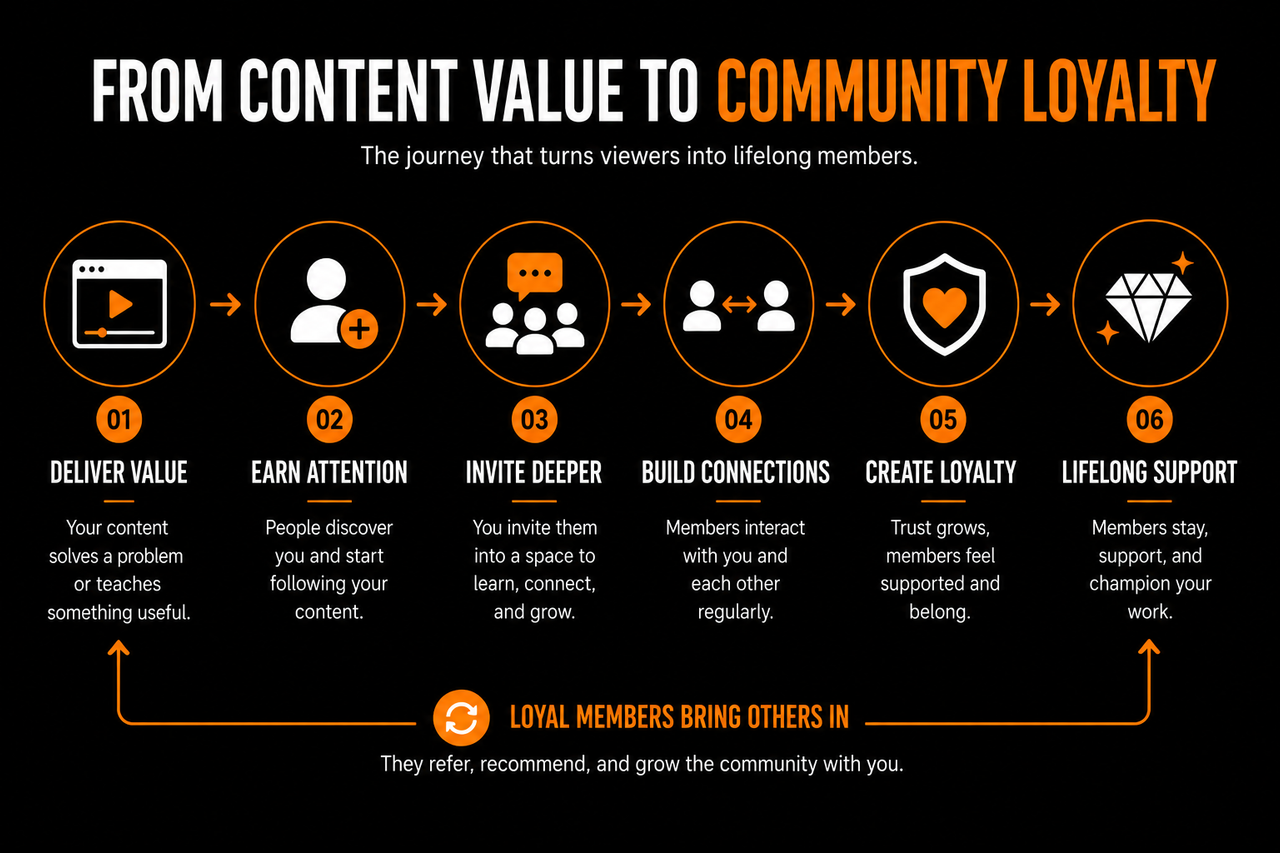
A creator can get someone's attention in seconds. Keeping that person connected for months or years is much harder. That is why loyalty matters so much to a creator business. Growth brings new people into the ecosystem, but loyalty determines whether those relationships continue after the initial excitement disappears.
Community creates an environment where that loyalty can develop.
People are no longer returning only because the creator published something new. They may return because they know other members, have ongoing conversations, participate in regular events, share their progress, or simply feel that the community has become part of their routine. That changes the relationship from occasional consumption into continued participation.
And when a community consistently gives members reasons to stay, recurring revenue becomes a natural business model around that relationship.
Loyalty Comes From More Than Good Content
Great content can make someone follow a creator for years. But there is still distance between enjoying someone's work and feeling connected to what they have built.
Community closes some of that distance.
A member might join because of the creator, but over time their reasons for staying can expand.They recognize the people they regularly talk to.They know where to ask for help. Other members know what they are working on. They attend the same weekly sessions. They have conversations that continue from one week to the next. They begin accumulating history inside the community.
That history matters.
Someone deciding whether to leave a community is not simply deciding whether they still want access to a collection of content. They may also be leaving relationships, routines, conversations, and an environment they have become familiar with.This is where belonging becomes part of the value. The strongest communities are not valuable only because of what members can access. They are valuable because of what members become part of.
Membership Changes the Revenue Model
Many creator businesses earn revenue in bursts.
- A course launches and generates a large month.
- A sponsorship arrives.
- A new product drops.
- A coaching cohort opens.
Then the creator needs to generate the next opportunity. There is nothing wrong with one-time offers, and they can remain an important part of a creator business. But relying entirely on them can make revenue unpredictable.
Membership introduces a different model.
Instead of asking someone to repeatedly make new purchasing decisions, the creator provides an ongoing experience in exchange for recurring payment. The relationship changes from:
Here is something new to buy.
to:
Here is something worth continuing to be part of.
That distinction is important. Recurring revenue only works when recurring value exists. A creator cannot simply take content that would normally be sold once, put a monthly price on it, and assume people will remain subscribed indefinitely. Members continually evaluate whether the experience is still useful.
That value might come from new resources or training, but it can also come from things that naturally continue inside a community: conversations, support, accountability, events, access, relationships, and opportunities. The membership renews because the experience continues.
Retention Becomes as Important as Acquisition
An audience-focused creator business naturally spends a lot of energy on acquisition.
- How do we get more views?
- How do we gain more followers?
- How do we grow the email list?
- How do we reach new people?
Those questions still matter when building a community, but another question becomes equally important:
Why should existing members stay?
Imagine a paid community gains 100 new members every month but loses nearly as many during the same period. Acquisition might look strong, yet the community barely grows. The creator has to keep replacing people who leave just to remain in the same position.
Now imagine another community attracts fewer new members but keeps them significantly longer.
Growth may appear slower at first, but each new member adds to a base that remains relatively stable. That changes how the business operates. Instead of relying entirely on an endless stream of new customers, more revenue comes from continuing to serve people who already understand the community and have chosen to be part of it. Retention therefore becomes more than a subscription metric.
It becomes evidence that members continue finding enough value to stay.
The Community Itself Can Increase Retention
In many creator products, the relationship exists primarily between the customer and the product. Someone buys a course, watches it, gets what they need, and leaves. That can be a successful outcome. Community works differently because the experience can develop over time. A member who joins today has no history inside the group. Six months later, they may know dozens of people. They may have attended events, received useful advice, helped newer members, and become known for something themselves.
Their experience is now richer than it was on day one.
This creates an interesting dynamic. A course can become less valuable after someone consumes it because there is less left to discover. A healthy community can become more valuable to a member as their relationships inside it deepen. The information may have attracted them initially. The relationships can become part of what keeps them there. This does not mean community owners can ignore the actual membership experience and expect friendships to handle retention for them.
Members still need a clear reason to be there. But relationships create another layer of value that is difficult to deliver through a standalone product.
Recurring Revenue Creates Room to Think Longer Term
Predictability can also change how creators make decisions. When most revenue depends on individual launches, the business naturally revolves around the next launch.
- What should we sell next?
- When should we promote it?
- How do we create another spike in sales?
Recurring membership revenue does not eliminate those questions, but it can reduce how dependent the business is on them.A growing base of members creates revenue that does not reset to zero at the beginning of every month. That gives the creator more room to focus on improving the experience people already purchased.
- Better onboarding.
- Better events.
- Better conversations.
- Better resources.
- Better support.
- Better connections between members.
The incentives begin aligning around long-term value. The creator benefits when members stay. Members stay when the community remains useful.That is a healthier relationship than constantly needing to extract another transaction from the same audience.
Free Members Can Build Loyalty Too
Not every community relationship needs to begin with payment. For many creators, a free community can act as the bridge between the public audience and the paid experience. Someone discovers the creator through content, joins the free community, and begins experiencing what being closer to the ecosystem actually feels like.
- They might ask a question and receive a useful answer.
- They might meet someone working toward the same goal.
- They might attend a free event.
- They might see paid members discussing results they achieved through deeper participation.
Over time, the member develops trust through experience rather than promises.
If they eventually consider upgrading, the creator does not need to convince a complete stranger that the community is valuable. The member has already experienced part of that value. And if they are interested but cannot purchase right now, the relationship does not need to stop.
- Continue helping them.
- Give them useful resources.
- Keep the free experience valuable.
- Let them remain part of the community until the paid option makes sense for their situation.
That simple approach can create far more goodwill than treating every free member as an unfinished sale.
The Strongest Revenue Follows the Relationship
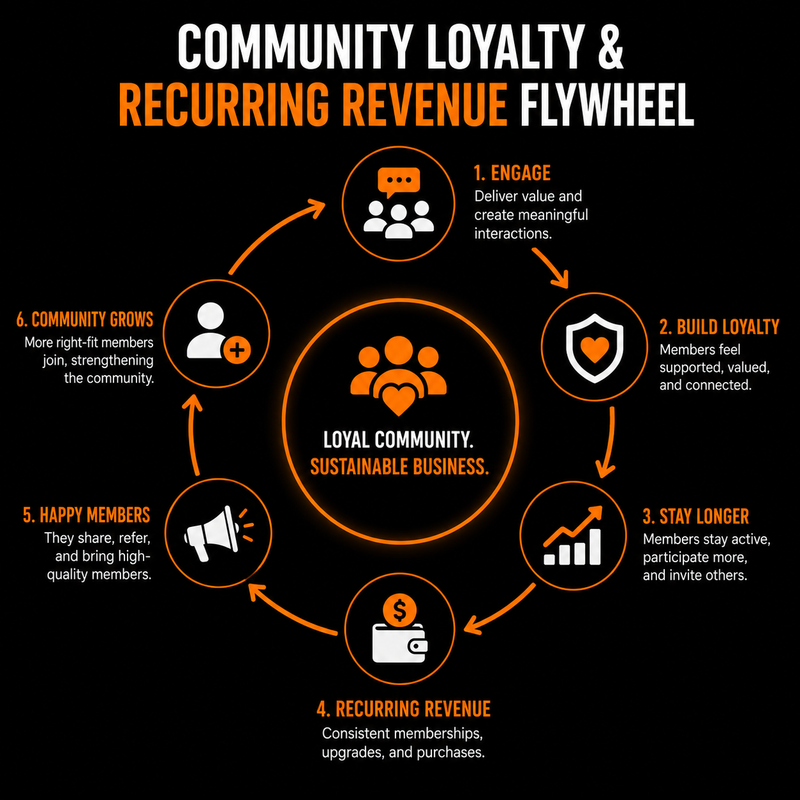
Recurring revenue is attractive because it makes a creator business more predictable. But recurring revenue should be the result, not the starting point. The real asset is the relationship members have with the community.
When people trust the creator, know other members, receive ongoing value, and feel connected to the group, continuing their membership makes sense. When those things disappear, a recurring payment alone will not keep them around forever.
That is why the community model is powerful.
It encourages creators to build something people want to remain part of rather than constantly finding something else to sell them. Attention brings people into the creator's world. Community gives the strongest relationships somewhere to develop. Loyalty gives those relationships time to compound. And recurring revenue gives the creator a business model that can grow alongside them.
The question now is how far that shift goes.
Because as more creators begin treating community as part of the business itself, the traditional line between creator, educator, brand, and community operator is becoming increasingly difficult to separate.
Where This Is Heading
The creator economy is not moving away from content.
Creators will still need videos, newsletters, podcasts, social posts, and other forms of content to reach new people. Public platforms remain incredibly effective at helping someone go from unknown to discovered.
What is changing is what creators build around that attention.
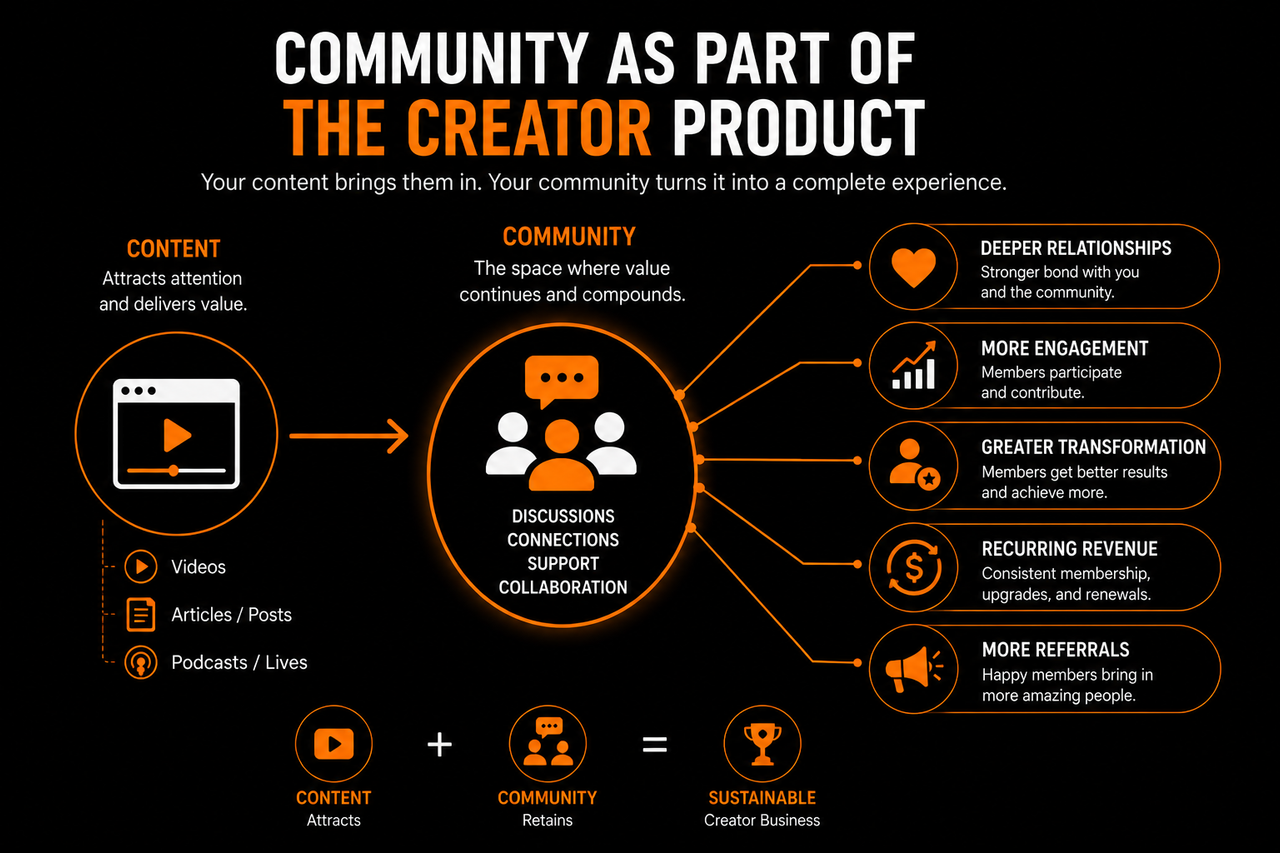
Instead of treating followers as the finished product of audience growth, more creators can use that audience as the starting point for a larger ecosystem. Content attracts people, community brings the most interested people closer, and the relationships formed there create opportunities for memberships, products, services, events, and other parts of the business.
The creator is no longer only building an audience.They are building somewhere for that audience to belong.
Creators Are Becoming Community Operators
Running a community requires a different mindset from publishing content.Content asks:
What should I create for people?
Community adds another question:
What can I help people do together?
That might mean helping members meet the right people, creating regular events, encouraging useful discussions, making introductions, welcoming newcomers, or noticing when someone starts drifting away.
The creator becomes responsible for the environment as much as the content inside it.
This does not mean they need to personally manage every conversation forever. As communities grow, moderators, community managers, automation, and better systems can take over parts of the operation.
But the creator still sets the direction.
They decide who the community is for, what members should get from it, how people are expected to interact, and what makes the experience worth returning to. That ability to create a valuable environment around an audience is becoming a business skill of its own.
Community Can Become Part of the Product
For some creators, community will support an existing product. A course might include a community where students can ask questions. A coaching program might use one for accountability between calls. A software business might create one where customers exchange ideas and learn from each other.
For others, the community itself becomes the product.
Members are paying for continued access to an environment: the people, conversations, events, expertise, opportunities, resources, and support available inside it. That changes what creators need to think about when designing an offer. The question is no longer only:
What do members get when they pay?
It is also:
What experience do members continue having after they pay?
A list of features can help someone understand what is included, but a lasting community needs ongoing reasons to participate. That is why onboarding, engagement, member relationships, and retention become so important. Selling the membership gets someone through the door. Building a community worth staying in creates the business.
Smaller Audiences Can Build Meaningful Businesses
One of the most interesting consequences of this shift is that creators do not necessarily need enormous audiences to build meaningful businesses. An advertising model rewards scale because more views generally create more inventory to monetize.
Community can reward depth.
A creator with a focused audience of people who strongly value their expertise may have a better foundation for a membership than someone with millions of casual viewers. The important question becomes less about how many people are watching and more about how much value the creator can create for the people who care most.
That opens creator businesses to niches that may never generate massive mainstream audiences.
A specialist teaching a particular professional skill does not need millions of followers if a smaller group of people sees significant value in learning from them and each other. A creator serving a specific industry can build around hundreds or thousands of relevant people rather than chasing millions of impressions.
Reach still matters. But it is no longer the only measure of opportunity.
The Next Creator Businesses Will Build Both
Audience and community should not be treated as competing models. The strongest creator businesses can use each for what it does best.
- The audience creates reach.
- The community creates depth.
- Public content allows ideas to travel beyond the existing network and continuously introduces new people to the creator.
- Community gives the people who want more somewhere to continue the relationship.
Together, they create a cycle. Content brings new people in. Some become regular followers. A portion joins the community. Members build relationships and experience deeper value. Some become customers. The experiences and results created inside the community can then produce stories, insights, and ideas that improve the creator's public content. The community strengthens the content. The content grows the community.Neither needs to replace the other.
The Business Is Moving From Attention to Relationships
The creator economy was built on the ability for individuals to capture attention without traditional gatekeepers. That changed who could build a media business. Community is changing what creators can build with that attention once they have it. A follower count tells you how many people decided to keep seeing someone's work. A community asks what happens when some of those people decide to become part of it.
That is where the creator business starts becoming more than a content engine.
Members form relationships. Value begins flowing between people instead of only from the creator. Loyalty develops through participation and belonging. Recurring revenue becomes possible because there is an ongoing experience worth returning to.And the creator begins building something that can become stronger as those relationships deepen. The future of the creator business is not about abandoning audiences, algorithms, or public platforms.
It is about recognizing that attention is most valuable when it leads somewhere.
For more creators, that destination will be community.Because an audience can know your name. A customer can buy your product. But a community can become something people genuinely want to remain part of.